


Featured Image: SpaceX
Liftoff Time | February 8th, 2024 – 06:33:32 UTC | 01:33:32 EST |
|---|---|
Mission Name | PACE (Plankton, Aerosol, Cloud, ocean Ecosystem) |
Launch Provider | SpaceX |
Customer | NASA |
Rocket | Falcon 9 Block 5, booster B1081-4; 51.11-day turnaround |
Launch Location | Space Launch Complex 40 (SLC-40), Cape Canaveral SFS, Florida, USA |
Payload mass | ~ 1,694 kg (3,734 lb) |
Where is the spacecraft going? | A circular Sun-synchronous orbit at 676.5 km (~420 mi) altitude and 98 degrees inclination |
Will they be attempting to recover the first stage? | Yes |
Where will the first stage land? | Landing Zone 1 |
Will they be attempting to recover the fairings? | Yes, and they will be recovered from the water ~475 km (~295 mi) downrange by Bob |
Are these fairings new? | Yes |
This will be the: | – 297th Falcon 9 launch – 12th Falcon 9 mission of 2024 – 12th launch for SpaceX in 2024 – 312th SpaceX mission – 26th orbital launch attempt of 2024 |
Where to watch | Official livestream |
What Does All This Mean?
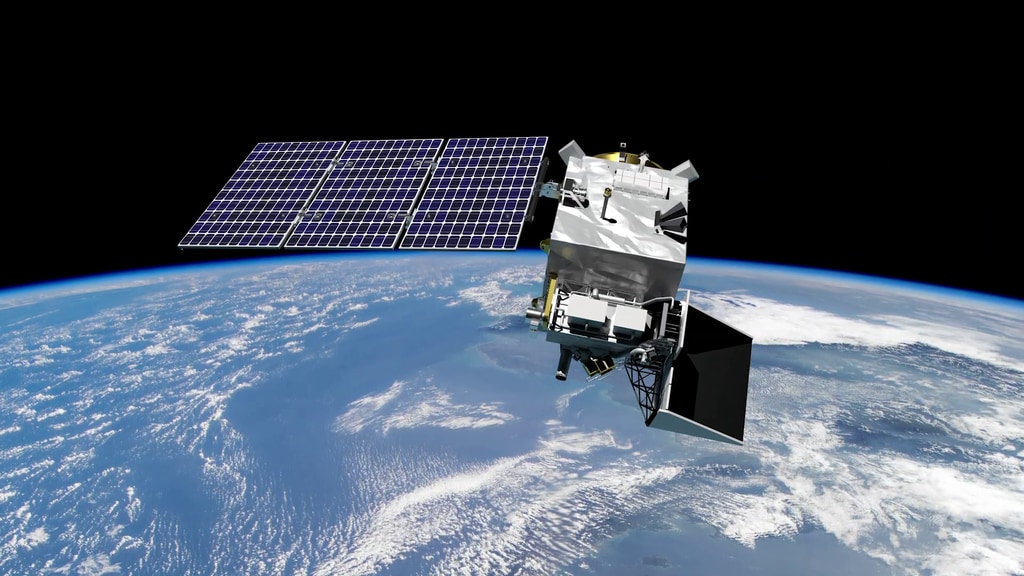
NASA is set to launch PACE (Plankton, Aerosol, Cloud, ocean Ecosystem), an Earth observation satellite, atop a Falcon 9 rocket. The Falcon 9 will lift off from Space Launch Complex 40 (SLC-40) at Cape Canaveral Space Force Station, in Florida and take the satellite to Sun-synchronous orbit.
How Did It Go?
This mission was fully successful, with the rocket lifting off on time. PACE will now spend the next 3-10 years operating in Sun-synchronous orbit.
PACE
PACE (Plankton, Aerosol, Cloud, ocean Ecosystem) is a NASA Earth observation satellite mission that hopes to improve ocean health. The satellite will operate in Sun-synchronous orbit and the expected mission duration is 3-10 years. PACE has two primary scientific goals: “To extend key systematic ocean color, aerosol, and cloud data records for Earth system and climate studies; To address new and emerging science questions using its advanced instruments, surpassing the capabilities of previous and current missions.”
Why Is PACE important?
Ocean Ecology
PACE will help improve our knowledge of ocean ecology. Our oceans are an incredibly diverse physical environment which are full of life, but there are many species that are invisible to us. Microscopic algae, known as phytoplankton, are at the bottom of the marine food chain, being a source of food for tiny animals, who are then a source for larger and larger animals. Because of this, the energy from the phytoplankton is transferred up the marine food chain, ultimately to humans.
However, there is not just one type of phytoplankton. In spring, the North Atlantic ocean is full of forests, which create carbon rich phytoplankton, but there are also areas of the ocean which produce toxic phytoplankton. With current satellites we are able to see how much phytoplankton there is on the ocean surface but are not able to see its diversity. PACE will allow us see this diversity and the role is plays in the oceans ecosystem, as well as help fisheries by alerting them to harmful algal blooms.
Clouds and Aerosols
Aerosols are small particles in the atmosphere which, along with clouds, affect how sunlight is reflected and absorbed by the Earth and atmosphere. While we know that aerosols and clouds interact, we don’t understand all the complex ways in which this happens, as it can vary based on the type of aerosol, the location, and many other factors. Satellites like PACE will help to better our understanding of how much energy the Earth is absorbing from the sun and how this is impacted by clouds and aerosols.
Applied Sciences
The data that PACE collects on the atmosphere and oceans will have a myriad of benefits, particularly in the areas of water resources, impact of disasters, ecological forecasting, human health, and air quality. Both public and private organizations will be able to use the data collected from PACE to help to improve the quality of life for those around the planet.
Science Questions
We still have much to learn about our oceans and atmosphere. Here are some of the questions that NASA is hoping PACE will answer:
- “How is Earth changing and what are the consequences for our living resources and food webs, such as phytoplankton and plankton?”
- “What is the concentration and composition of organisms in our ocean ecosystems? How productive are our ocean ecosystems?”
- “What are the long-term changes in aerosol and cloud properties that can be continued to be revealed with PACE? How are these properties correlated with variations in climate?”
- “How are biological, geological, and chemical components of our oceans changing and why? How might such changes influence the Earth system?”
You can read more about the science behind PACE here.
Science Instruments
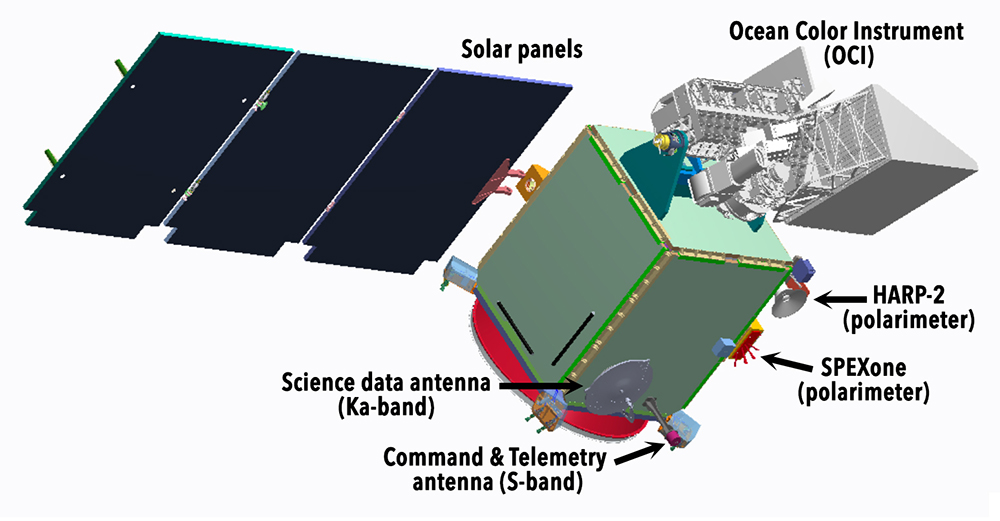
The instruments for this mission include the Ocean Color Instrument (OCI), is a highly advanced optical spectrometer. The OCI will measure light properties across the electromagnetic spectrum, offering finer wavelength resolution than previous NASA satellite sensors. This capability enables continuous measurement of ocean color from ultraviolet to shortwave infrared wavelengths, aiding in extending key ocean color data records for climate studies.
The Spectro-Polarimeter for Planetary Exploration (SPEXone), a multi-angle polarimeter covering wavelengths from 385 to 770 nm. It will measure the intensity, Degree of Linear Polarization (DoLP), and Angle of Linear Polarization (AoLP) of sunlight reflected from Earth’s atmosphere, land surface, and oceans. SPEXone’s focus on achieving high accuracy in DoLP measurements facilitates precise characterization of aerosols in the atmosphere, playing a vital role in climate-related studies.
The Hyper-Angular Rainbow Polarimeter #2 (HARP2) is a wide-angle imaging polarimeter designed to measure aerosol particles, clouds, and properties of land and water surfaces. With multiple along-track viewing angles, four spectral bands in the visible and near-infrared ranges, and three angles of linear polarization, HARP2 provides detailed insights into the microphysical properties of atmospheric particles, including size distribution, amount, refractive indices, and particle shape. Developed by the University of Maryland, Baltimore County’s Earth and Space Institute, HARP2 builds upon its predecessor, HARP, a NASA CubeSat launched to the ISS in 2019.
What Is Falcon 9 Block 5?
The Falcon 9 Block 5 is SpaceX’s partially reusable two-stage medium-lift launch vehicle. The vehicle consists of a reusable first stage, an expendable second stage, and, when in payload configuration, a pair of reusable fairing halves.
First Stage
The Falcon 9 first stage contains nine Merlin 1D+ sea-level engines. Each engine uses an open gas generator cycle and runs on RP-1 and liquid oxygen (LOx). Each engine produces 845 kN of thrust at sea level, with a specific impulse (ISP) of 285 seconds, and 934 kN in a vacuum with an ISP of 313 seconds. Due to the powerful nature of the engine, and the large amount of them, the Falcon 9 first stage is able to lose an engine right off the pad, or up to two later in flight, and be able to successfully place the payload into orbit.
The Merlin engines are ignited by triethylaluminum and triethylborane (TEA-TEB), which instantaneously burst into flames when mixed in the presence of oxygen. During static fire and launch the TEA-TEB is provided by the ground service equipment. However, as the Falcon 9 first stage is able to propulsively land, three of the Merlin engines (E1, E5, and E9) contain TEA-TEB canisters to relight for the boost back, reentry, and landing burns.
Second Stage
The Falcon 9 second stage is the only expendable part of the Falcon 9. It contains a singular MVacD engine that produces 992 kN of thrust and an ISP of 348 seconds. The second stage is capable of doing several burns, allowing the Falcon 9 to put payloads in several different orbits.
For missions with many burns and/or long coasts between burns, the second stage is able to be equipped with a mission extension package. When the second stage has this package it has a grey strip, which helps keep the RP-1 warm, an increased number of composite-overwrapped pressure vessels (COPVs) for pressurization control, and additional TEA-TEB.
Falcon 9 Booster
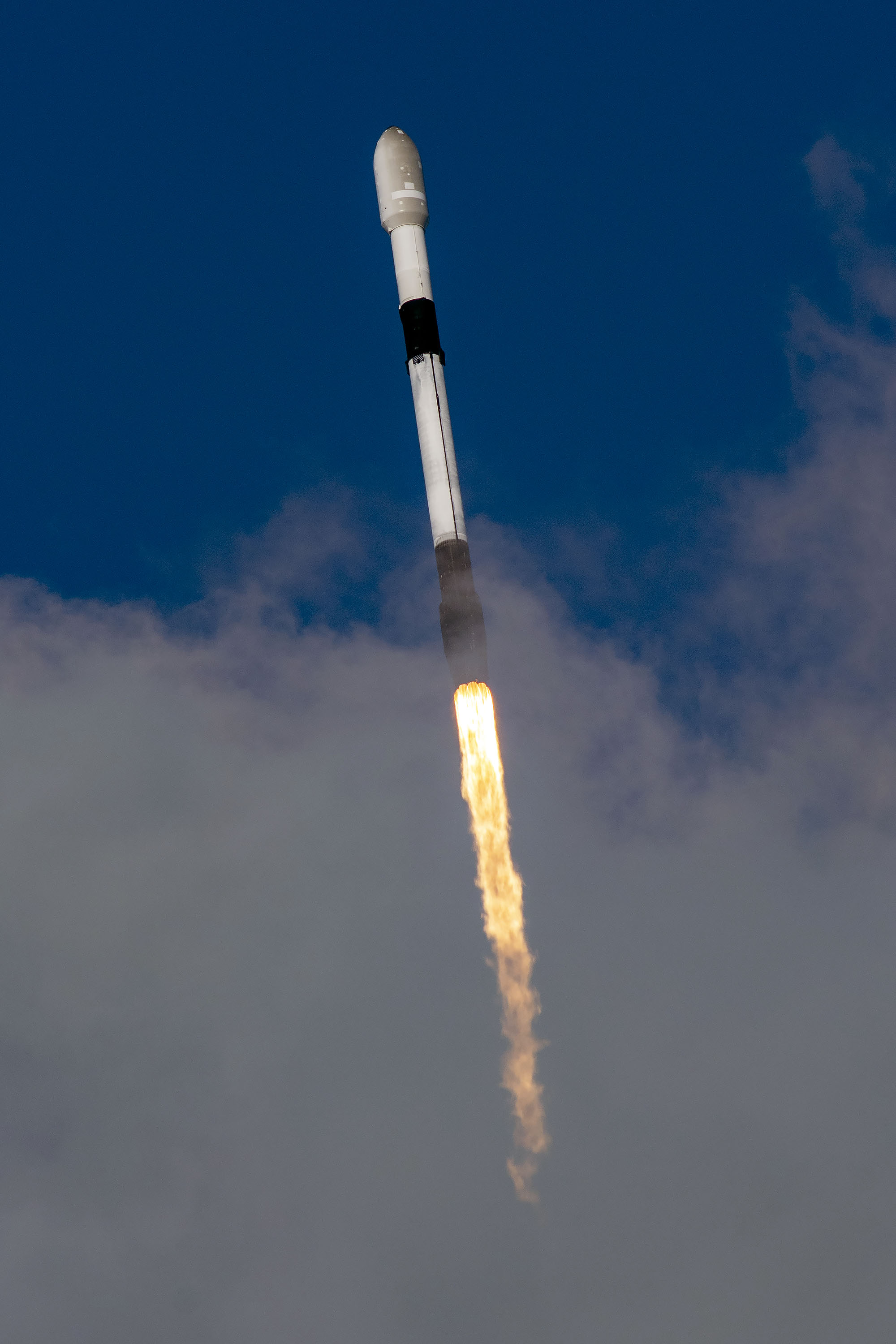
The booster supporting the PACE mission is B1081-4; as the name implies, the booster had supported three previous missions. Following the landing, its designation changed to B1081-4.
| B1081’s previous missions | Launch Date (UTC) | Turnaround Time (Days) |
| Crew-7 | August 26, 2023 07:27 | N/A |
| Dragon CRS-2 SpX-29 | November 10, 2023 01:28 | 75.75 |
| Starlink Group 6-34 | December 19, 2023 04:01 | 39.11 |
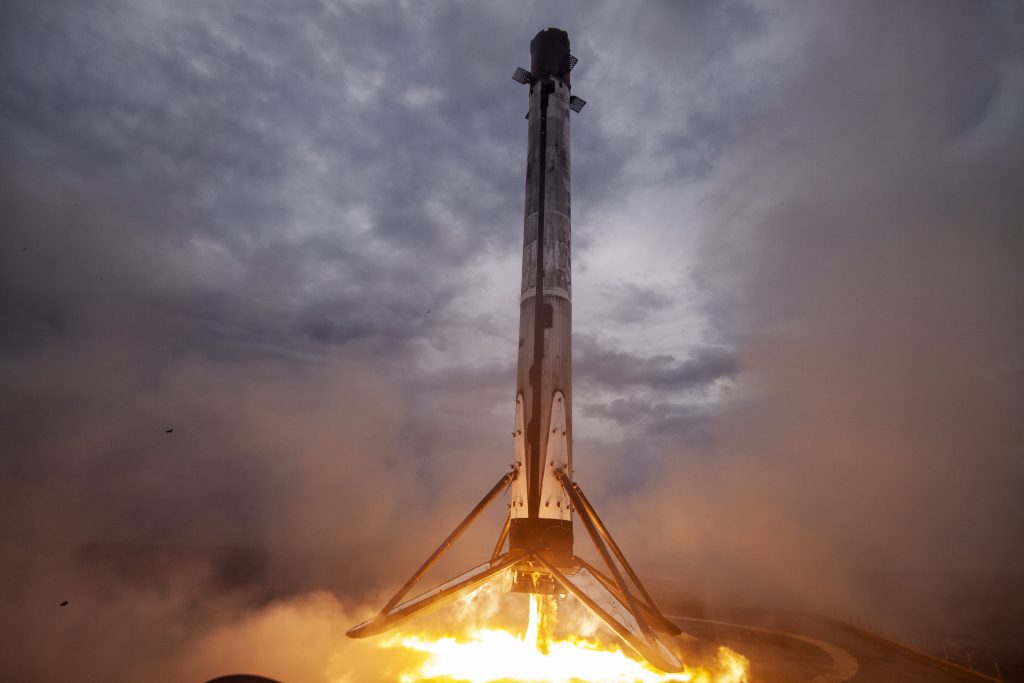
Following launch, the Falcon 9 booster will conduct three burns. These burns aim to softly touch down the booster on Landing Zone 1.
Falcon 9 Fairings
The Falcon 9’s fairing consists of two dissimilar reusable halves. The first half (the half that faces away from the transport erector) is called the active half, and houses the pneumatics for the separation system. The other fairing half is called the passive half. As the name implies, this half plays a purely passive role in the fairing separation process, as it relies on the pneumatics from the active half.
Both fairing halves are equipped with cold gas thrusters and a parafoil which are used to softly touch down the fairing half in the ocean. SpaceX used to attempt to catch the fairing halves, however, at the end of 2020 this program was canceled due to safety risks and a low success rate.
In 2021, SpaceX started flying a new version of the Falcon 9 fairing. The new “upgraded” version has vents only at the top of each fairing half, by the gap between the halves, whereas the old version had vents placed spread equidistantly around the base of the fairing. Moving the vents decreases the chance of water getting into the fairing, making the chance of a successful scoop significantly higher.


PACE’s Countdown
All times are approximate
| HR/MIN/SEC | EVENT |
|---|---|
| 00:38:00 | SpaceX Launch Director verifies go for propellant load |
| 00:35:00 | RP-1 (rocket grade kerosene) loading begins |
| 00:35:00 | 1st stage LOX (liquid oxygen) loading begins |
| 00:16:00 | 2nd stage LOX loading begins |
| 00:07:00 | Falcon 9 begins pre-launch engine chill |
| 00:05:00 | Dragon transitions to internal power |
| 00:01:00 | Command flight computer to begin final prelaunch checks |
| 00:01:00 | Propellant tanks pressurize for flight |
| 00:00:45 | SpaceX Launch Director verifies go for launch |
| 00:00:03 | Engine controller commands engine ignition sequence to start |
| 00:00:00 | Falcon 9 liftoff |
PACE’s Launch, Landing, And Deployment
All times are approximate
| HR/MIN/SEC | EVENT |
|---|---|
| 00:01:07 | Max Q (moment of peak mechanical stress on the rocket) |
| 00:02:19 | 1st stage main engine cutoff (MECO) |
| 00:02:23 | 1st and 2nd stages separate |
| 00:02:30 | 2nd stage engine starts |
| 00:02:36 | Boostback Burn Starts |
| 00:03:15 | Boostback Burn Ends |
| 00:03:54 | Fairing deployment |
| 00:05:51 | 1st stage entry burn start |
| 00:06:13 | 1st stage entry burn ends |
| 00:06:58 | 1st stage landing burn start |
| 00:07:32 | 1st stage landing |
| 00:10:20 | 2nd stage engine cutoff (SECO-1) |
| 00:12:22 | PACE spacecraft deploys |

