


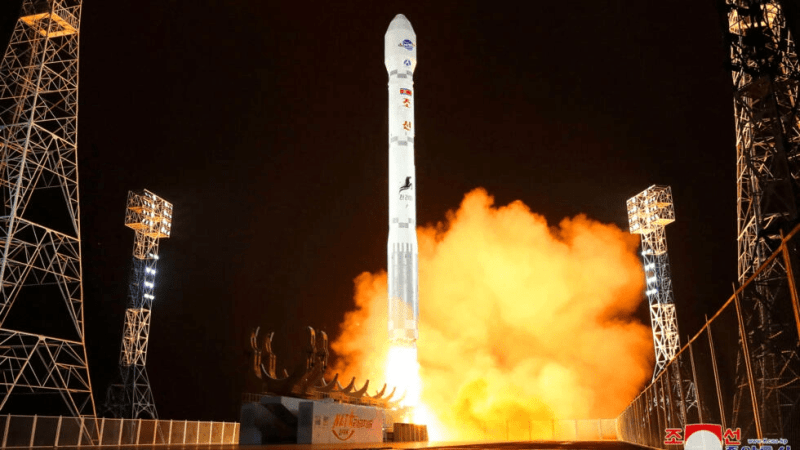

Featured image credit: KCNA via Reuters
Lift Off Time | November 21, 2023 – 13:42:48 UTC | 22:42:48 PYT |
|---|---|
Mission Name | Malligyong-1c (meaning “telescope 1”) |
Launch Provider | National Aerospace Development Administration (NADA), Democratic People’s Republic of Korea (DPRK, commonly known as North Korea) |
Customer | NADA, DPRK |
Rocket | Chŏllima-1 |
Launch Location | Sŏhae Satellite Launching Station, Ch’ŏlsan County, North P’yŏngan Province, DPRK |
Payload mass | 300 kg (~650 lb) |
Where did the satellite go? | It was deployed into a Sun-Synchronous orbit (SSO), with reported orbital paramaters of 512 x 493 km, at an inclination of 97.4°. |
Did they attempt to recover the first stage? | No, this is not a capability of the Chŏllima-1. |
Where did the first stage land? | It crashed back to Earth, splashing down into the Yellow Sea |
Did they attempt to recover the fairings? | No, this is not a capability of the Chŏllima-1. |
Were these fairings new? | Yes |
This was the: | – 1st successful flight of the Chŏllima rocket (acording to DPRK) – 3rd successful orbital launch by North Korea (according to DPRK) – 3rd flight of a Chŏllima rocket – 6th launch from the Sŏhae Satellite Launching Station – 189th orbital launch attempt in 2023 |
Where to watch | We haven’t been able to find an official livestream. However, several mainstream media organisations have covered the launch, in particular NHK World’s coverage of the North Korean launch. |
What Does All This Mean?
North Korea launched its Chŏllima rocket, carrying a Malligyong spy satellite, into a low Earth orbit (LEO) on November 21, 2023.
North Korea has claimed that the launch was a success, but South Korea said it was too soon to tell if the satellite is functioning, after two previous launches failed earlier in 2023. According to the BBC (https://www.bbc.co.uk/news/world-asia-67517260), “South Korea confirmed that the launch was successful but said it was too early to determine if the satellite was functioning as claimed by the North.”
What Is Malligyong-1c?
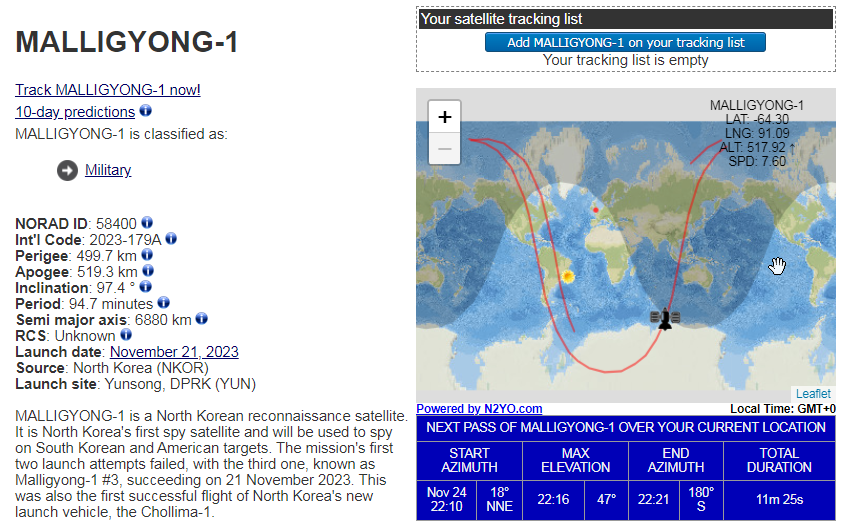
All we can say is that it is a reconnaissance satellite, in other words a spy satellite. We are able to show you how to look for the satellite, or whether it is likely to be seen from the ground at your location.
According to the state-run Korean Central News Agency (KCNA), Mr. Kim and his wife Ri Sol Ju and daughter Kim Ju Ae, all appeared together at a reception of space scientists and technicians which took place on Thursday, November 23rd. This has been reported to be in celebration of the successful launch.

North Korea’s Korean Central News Agency (KCNA) has reported that the Malligyong-1c satellite was deployed successfully. Under normal situations with a launch from any country, international bodies such as The United Nations Office for Outer Space Affairs (UNOOSA) will publish observed orbital details from their catalog.
UNOOSA’s website states: “Since 1962, the United Nations has maintained a Register of Objects Launched into Outer Space. Originally established as a mechanism to aid the United Nations Committee on the Peaceful Uses of Outer Space in its discussions on the political, legal and technical issues concerning outer space, the evolution of international space law resulted in space object registration becoming a means of identifying which States’ bear international responsibility and liability for space objects.”
Website N2YO.com uses the orbital data from the US’ Air Force Space Command (AFSPC) to illustrate where the satellite is flying at the current time. This is one indication that the launch itself was successful.
What Is Chŏllima-1?
Chŏllima is a new three-stage rocket, that has never flown before 2023. We can provide some information on the first stage, but have no information on the remaining stages.
First Stage
The booster stage, or first stage, of Chŏllima 1 is thought to be derived from, or even just the same as, the first stage on the Hwasong-17 (HS-17) Inter-Continental Ballistic Missile (ICBM). The HS-17 was the most powerful North Korean booster seen at the time of its first flight, reported to be capable of lofting a 400 kg payload to a reference orbit of 500 km.
Such payload performance is a significant upgrade from the 200 kg limit that could be achieved using the older Unha orbital booster.

The engines on the HS-17 are thought to be twin-chamber engines that are derived from the Russian RD-250.

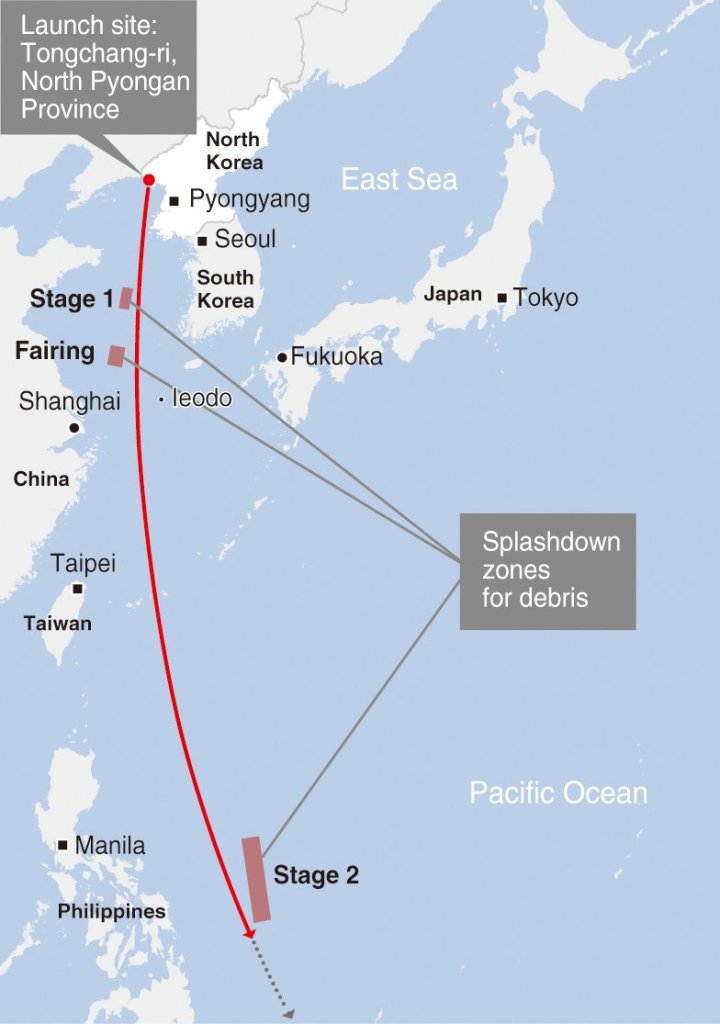
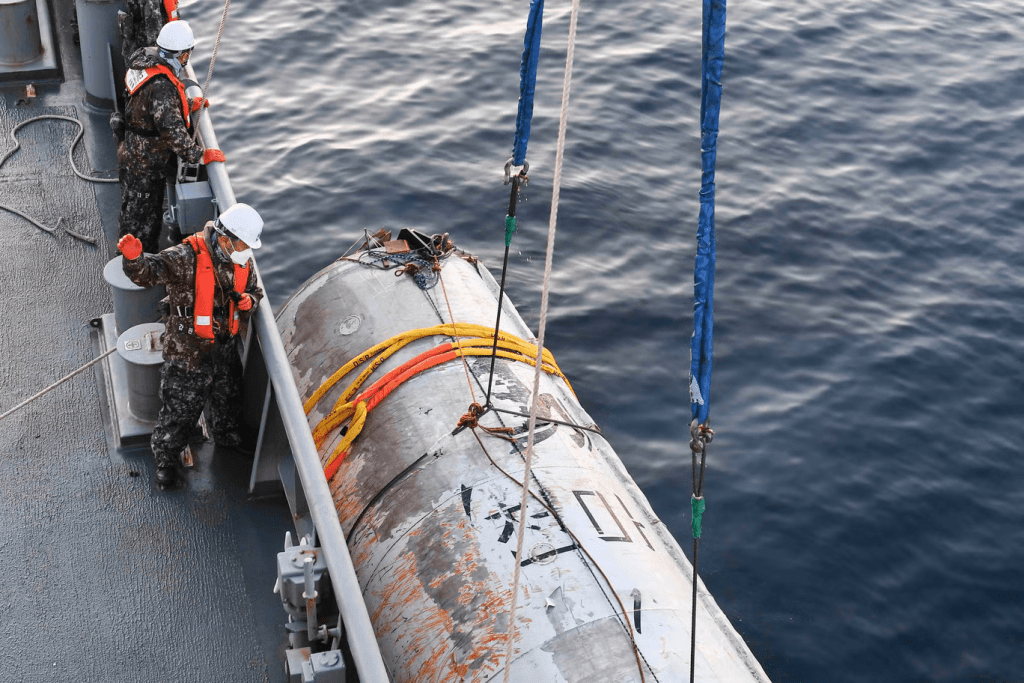
We are able to report that, from the two previous launches, both of which failed to deploy their payloads, the first flight failed under power from the second stage, and the second flight failed under power from the third stage. On the first flight, pieces of the booster stage were recovered from the Yellow Sea.
In the latter case, it may be that the Flight Termination System (FTS) was used to end the flight under known conditions by the launch provider, NADA.


Rest easy Andy. You are missed dearly.