


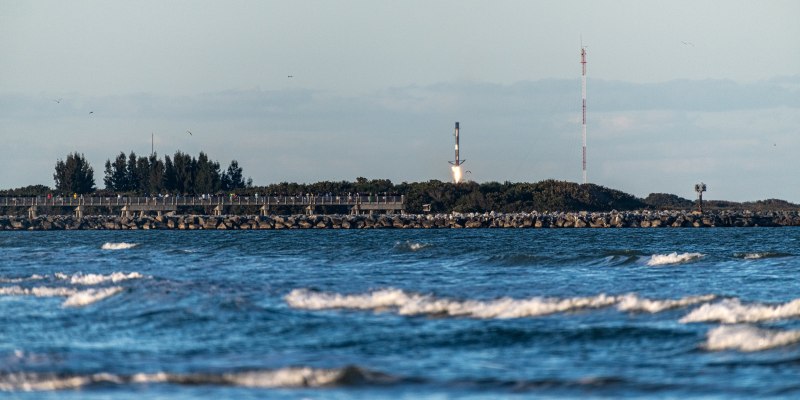

Featured image of USSF-124’s booster landing, by John Pisani / Cosmic Perspective
Liftoff Time | February 14, 2024 – 22:30 UTC | 17:30 EST |
|---|---|
Mission Name | USSF-124 |
Launch Provider | SpaceX |
Customer | United States Space Force (USSF) – US Missile Defense Agency (MDA) – Space Development Agency (SDA) |
Rocket | Falcon 9 Block 5; booster B1078-7, 73.77-day turnaround time |
Launch Location | Space Launch Complex 40 (SLC-40), Cape Canaveral Space Force Station, Florida, USA |
Payload mass | Unknown |
Where were the satellites going? | To a circular low-Earth orbit (LEO) at 1,000 km (~620 mi) altitude, and 40 degrees inclination |
Did they attempt to recover the first stage? | Yes |
Where did the first stage land? | The booster softly touched down on Landing Zone 2 (LZ-2), ~9.0 km (~5.6 mi) away from the launch pad |
Did they attempt to recover the fairings? | Yes, and they were recovered from the water about 480 km downrange by vessel Doug |
Were these fairings new? | TBD, but SpaceX usually flies reused fairing halves |
This was the: | – 298th Falcon 9 launch – 229th Falcon 9 flight with a flight-proven booster – 243rd reflight of a booster – 12th reflight of a booster in 2024 – 272nd booster landing – 198th consecutive landing (a record) – 13th launch for SpaceX in 2024 – 168th SpaceX launch from SLC-40 – 28th orbital launch attempt of 2024 |
Where to re-watch? | SpaceX’s official replay on X |
What’s All This Mean?
The United States Space Force (USSF) bought a ride on SpaceX’s launch vehicle, the Falcon 9, in order to carry out USSF-124. Hence, the rocket will lift off from the pad at Space Launch Complex 40, located within Cape Canaveral Space Force Station, in Florida. In this case, six satellites are the passengers, all bound for low-Earth orbits. On the other hand, the booster will return to the Cape, and descend to Landing Zone 2 (LZ-2).

How Did It Go?
Once the countdown reached T0, the Falcon 9 carrying the USSF-124 mission began its journey. It went through all phases of flight nominally, and then the first stage returned to land onto SpaceX’s Landing Zone 2. Thus, the company obtained the secondary mission success, with the second stage continuing its flight to space. Given the classified nature of the payloads, we infer primary mission success from SpaceX publishing photos of the launch.
What Is USSF-124?
Originally, the manifest for the USSF-124 mission only featured satellites from the Missile Defense Agency (MDA). However, another unit belonging to the USSF, the Space Development Agency (SDA), needed to remove some payloads from a dedicated flight in the past. These are presently launching atop the Falcon 9, showing that both the MDA and the SDA are closely collaborating toward very similar goals. Nevertheless, the target orbits will likely be different depending on the payload.
Hypersonic And Ballistic Tracking Space Sensor (HBTSS) On USSF-124
The MDA lofts two prototypes — one by Northrop Grumman, and one by L3Harris — to kick off its overhead persistent infrared (OPIR) satellite constellation. More specifically, the latter aims at detecting and tracking highly advanced missile threats with lower heat signatures. Inside this category fall both ballistic weapons and hypersonic glide vehicles. These sensors are intended to provide continuous monitoring, so they can enable threat interception before reaching US territory. In fact, interceptors should be able to reach their targets before ground-based systems see them.
According to Northrop Grumman, the HBTSS satellites will perform the following missions:
- “Detect and track all-range missiles,”
- “Detect and track hypersonic glide vehicles,”
- “Detect and track satellite launches, maneuvering, and re-entry,” and
- “Monitor static tests.”
Northrop Grumman published a video on YouTube explaining the mission of the HTBSS constellation. L3Harris also has a video related to this mission.


Tranche 0 Tracking Layer On USSF-124
Previously, SpaceX had launched twice for the SDA (see table below), delivering satellites to two of its constellation’s layers: the transport, and tracking layers. However, production delays forced a change in schedules, meaning four L3Harris satellites had to be moved to the present flight. In order to know more about the SDA payloads, read our dedicated articles on them by following the links on the table below.

| Mission Name | Date (UTC) | Launch Pad |
|---|---|---|
| Transport & Tracking Layers 0-1 | April 2, 2023 – 14:29 | SLC-4E |
| Transport & Tracking Layers 0-2 | September 2, 2023 — 14:25 | SLC-4E |
What Is Falcon 9 Block 5?
The Falcon 9 Block 5 is SpaceX’s partially reusable two-stage medium-lift launch vehicle. The vehicle consists of a reusable first stage, an expendable second stage, and, when in payload configuration, a pair of reusable fairing halves.
It is worth noting that the rocket showcases the mission extension package, and you can read more on this item below.
First Stage
The Falcon 9 first stage contains nine Merlin 1D+ sea-level engines. Each engine uses an open gas generator cycle and runs on RP-1 and liquid oxygen (LOx). Each engine produces 845 kN of thrust at sea level, with a specific impulse (ISP) of 285 seconds, and 934 kN in a vacuum with an ISP of 313 seconds. Due to the powerful nature of the engine, and the large amount of them, the Falcon 9 first stage is able to lose an engine right off the pad, or up to two later in the flight, and be able to successfully place the payload into orbit.
The Merlin engines are ignited by triethylaluminum and triethylborane (TEA-TEB), which instantly burst into flames when mixed in the presence of oxygen. During static fire and launch the TEA-TEB is provided by the ground service equipment. However, as the Falcon 9 first stage is able to propulsively land, three of the Merlin engines (E1, E5, and E9) contain TEA-TEB canisters to relight for the boost back, reentry, and landing burns.
Second Stage
The Falcon 9 second stage is the only expendable part of the Falcon 9. It contains a singular MVacD engine that produces 992 kN of thrust and an ISP of 348 seconds. The second stage is capable of doing several burns, allowing the Falcon 9 to put payloads in several different orbits.
SpaceX is currently flying two different versions of the MVacD engine’s nozzle. The standard nozzle design is used on high-performance missions. The other nozzle is a significantly shorter version of the standard, decreasing both performance and material usage; with this nozzle, the MVacD engine produces 10% less thrust in space. This nozzle is only used on lower-performance missions, as it decreases the amount of material needed by 75%. This means that SpaceX can launch over three times as many missions with the same amount of Niobium as with the longer design.
For missions with many burns and/or long coasts between burns, the second stage is able to be equipped with a mission extension package. When the second stage has this package it has a gray strip, which helps keep the RP-1 warm, an increased number of composite-overwrapped pressure vessels (COPVs) for pressurization control, and additional TEA-TEB.

Falcon 9 Booster
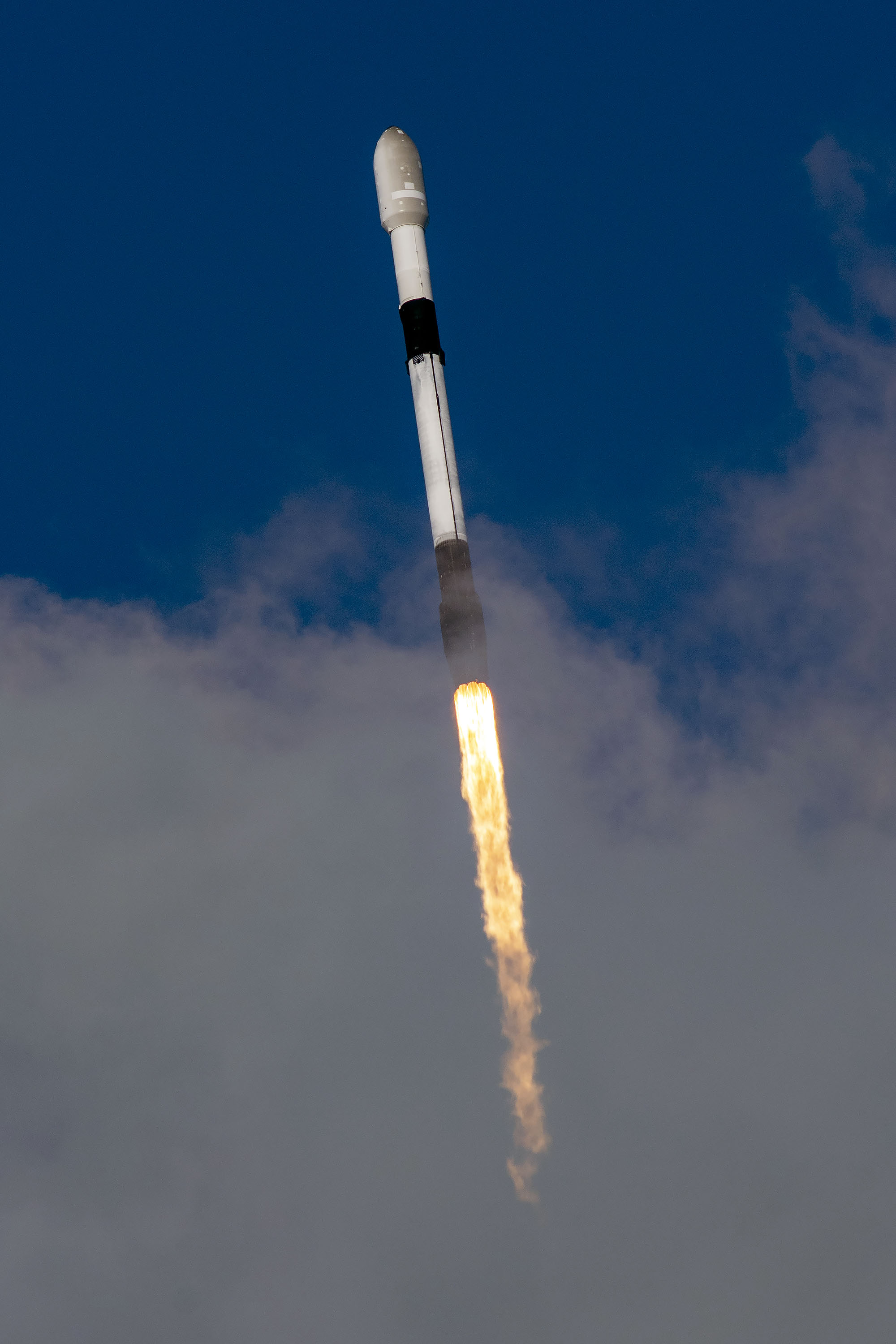
The booster supporting the USSF-124 mission was B1078-7; as the name implies, the booster had supported six previous missions. Following its landing, its designation changed to B1078-8.
| B1078’s previous missions | Launch Date (UTC) | Turn Around Time (Days) |
|---|---|---|
| Crew-6 | March 02, 2023 05:34 | N/A |
| O3b mPower 3 & 4 | April 28, 2023 22:12 | 57.69 |
| Starlink Group 6-4 | June 4, 2023 12:20 | 36.59 |
| Starlink Group 6-8 | August 7, 2023 02:41 | 63.60 |
| Starlink Group 6-16 | September 16, 2023 03:38 | 40.04 |
| Starlink Group 6-31 | December 03, 2023 04:00 | 78.02 |
Following stage separation, the Falcon 9 conducted three burns. These burns allowed for a successful touchdown of the booster on SpaceX’s Landing Zone 2 (LZ-2).
Falcon 9 Fairings
The Falcon 9’s fairing consists of two dissimilar reusable halves. The first half (the half that faces away from the transport erector) is called the active half, and houses the pneumatics for the separation system. The other fairing half is called the passive half. As the name implies, this half plays a purely passive role in the fairing separation process, as it relies on the pneumatics from the active half.
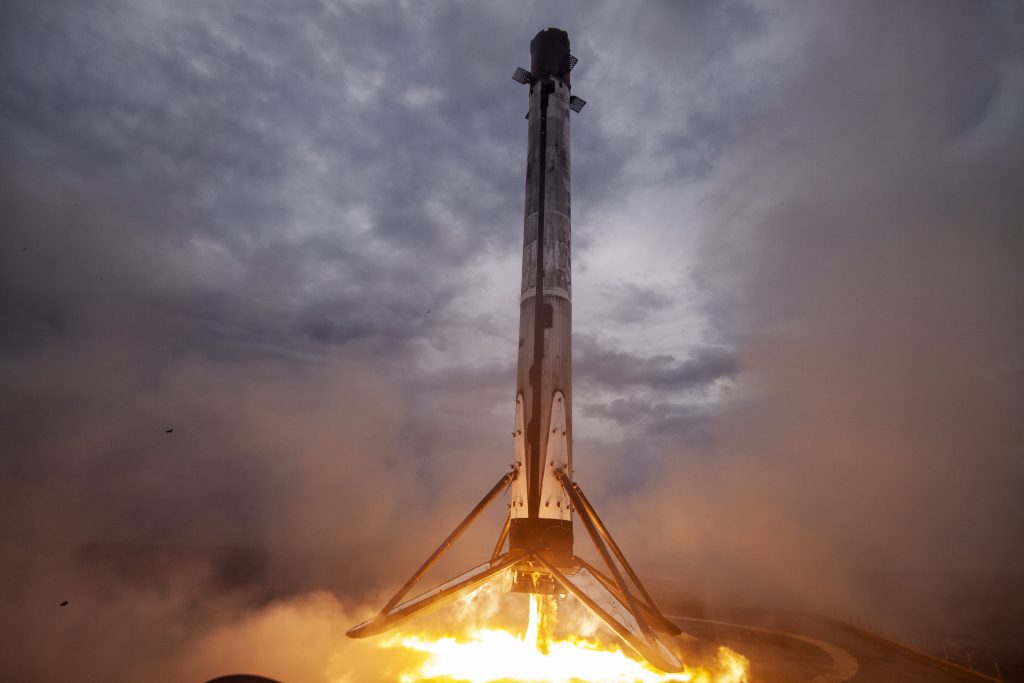
Both fairing halves are equipped with cold gas thrusters and a parafoil which are used to softly touch down the fairing half in the ocean. SpaceX used to attempt to catch the fairing halves, however, at the end of 2020 this program was canceled due to safety risks and a low success rate. On USSF-124, SpaceX recovered the fairing halves from the water with its recovery vessel Doug.
In 2021, SpaceX started flying a new version of the Falcon 9 fairing. The new “upgraded” version has vents only at the top of each fairing half, by the gap between the halves, whereas the old version had vents placed spread equidistantly around the base of the fairing. Moving the vents decreases the chance of water getting into the fairing, making the probability of a successful scoop significantly higher.
USSF-124’s Countdown
All Times Approximate
| Hr/Min/Sec | Event |
|---|---|
| 00:38:00 | SpaceX Launch Director verifies go for propellant load |
| 00:35:00 | RP-1 (rocket grade kerosene) loading begins |
| 00:35:00 | 1st stage LOX (liquid oxygen) loading begins |
| 00:16:00 | 2nd stage LOX loading begins |
| 00:07:00 | Falcon 9 begins engine chill prior to launch |
| 00:01:00 | Command flight computer to begin final prelaunch checks |
| 00:01:00 | Propellant tank pressurization to flight pressure begins |
| 00:00:45 | SpaceX Launch Director verifies go for launch |
| 00:00:03 | Engine controller commands engine ignition sequence to start |
| 00:00:00 | Falcon 9 liftoff |
USSF-124’s Launch, Landing, And Deployment
All Times Approximate
| Hr/Min/Sec | Event |
|---|---|
| 00:01:12 | Max Q (moment of peak mechanical stress on the rocket) |
| 00:02:16 | 1st stage main engine cutoff (MECO) |
| 00:02:19 | 1st and 2nd stages separate |
| 00:02:27 | 2nd stage engine starts (SES-1) |
| 00:02:32 | Boostback burn begins |
| 00:03:08 | Fairing deployment |
| 00:03:26 | Boostback burn ends |
| 00:06:16 | 1st stage entry burn begins |
| 00:06:34 | 1st stage entry burn ends |
| 00:07:32 | 1st stage landing burn begins |
| 00:08:01 | 1st stage landing |

