


Featured Image: JAXA/Mitsubishi Heavy Industries
Liftoff Time | January 12, 2024 – 04:44:26 UTC | 13:44:26 JST |
|---|---|
Mission Name | IGS Optical 8 |
Launch Provider | Mitsubishi Heavy Industries (MHI) |
Customer | Cabinet Satellite Information Center, Japan |
Rocket | H-IIA 202 |
Launch Location | Launch Area Y1, Tanegashima Space Center (TNSC), Japan |
Payload mass | Unknown, but no more than ~5,200 kg (~11,500 pounds) (according to the rocket’s capabilities) |
Where did the satellites go? | A circular Sun-synchronous orbit (SSO) at approximately 500 km (~310 mi) in altitude, and 97,5 degrees of inclination (according to the orbits of previous IGS Optical satellites) |
Did they attempt to recover the first stage? | No. The H-IIA does not have this capability |
Where did the first stage land? | It crashed into the ocean |
Did they attempt to recover the fairings? | No. The H-IIA does not have this capability |
Were these fairings new? | Yes |
This was the: | – 11th orbital launch attempt in 2024 – 48th flight of the H-IIA rocket overall – 1st flight of the H-IIA in 2024 |
Where to watch | Unofficial summary video |
What’s All This Mean?
The Cabinet Satellite Information Center (CSICE) launches the IGS Optical 8 satellite (or the Intelligence Gathering Satellite designated Optical 8), on an H-IIA 202 rocket provided by Mitsubishi Heavy Industries (MHI). The H-IIA 202 rocket carrying the reconnaissance satellite lifts off from the Tanegashima Space Center in Kagoshima, southern Japan. It aims at placing the satellite into a SSO minutes after launch. CSICE and MHI do not publish all the launch details, such as the altitude of spacecraft release, for security reasons.

How Did It Go?
The Japanese rocket lifted off as planned, performing nominally during the flight. The H-IIA F48 achieved every expected milestone, including side-booster separation, a dogleg turn, fairing separation, and stage separation. Finally, the launch provider confirmed the satellite deployed successfully.
What Is IGS Optical 8?
The IGS Optical 8, or in Japanese 情報収集衛星光学8号機 (Jōhō shūshū eisei kōgaku 8-gō-ki), is specifically designed to capture images of the Earth’s surface from hundreds of kilometers. Moreover, this is without any doubt a spy satellite. Japan started this program as a direct result of North Korea conducting a test of a Taepodong-1 missile over Japan’s territory back in 1988.
The IGS satellites are operated by the Cabinet Satellite Information Center of Japan. The satellite serves both Japan’s national defense and civil natural disaster monitoring. Some of them operate as optical sensing devices and others use radar (IGS Radar #) to study the target area on the ground. Reports suggest that these satellites are capable of achieving a ground resolution better than 40 cm (~1.3 ft).
Latest IGS Launches
Prior to IGS Optical 8’s launch, there have been many other flights carrying this kind of satellite. Here is a list of the last five of them:
| Date | H-IIA Variant | Mission Name | Flight ID |
| March 17, 2017 – 01:20 UTC | 202 | IGS Radar 5 | F33 |
| February 27, 2018 – 04:34 UTC | 202 | IGS Optical 6 | F38 |
| June 12, 2018 – 04:20 UTC | 202 | IGS Radar 6 | F39 |
| February 9, 2020 – 01:34 UTC | 202 | IGS Optical 7 | F41 |
| January 26, 2023 – 01:49 UTC | 202 | IGS Radar 7 | F46 |
What Is The H-IIA 202 Rocket?
H-IIA is a two-stage liquid-fuel medium-lift launch vehicle operated by Mitsubishi Heavy Industries for JAXA. It is about 53 m (174 ft) in height and 4.0 m (13 ft) in diameter, while being capable of placing a 4,000 kg payload into geostationary transfer orbit (GTO). Its maiden flight took place on August 29, 2001. Since then, it has launched 47 times, with just one failure that occurred on November 29, 2003. The H-IIA rocket has several variants, though only the H-IIA 202 remains active.
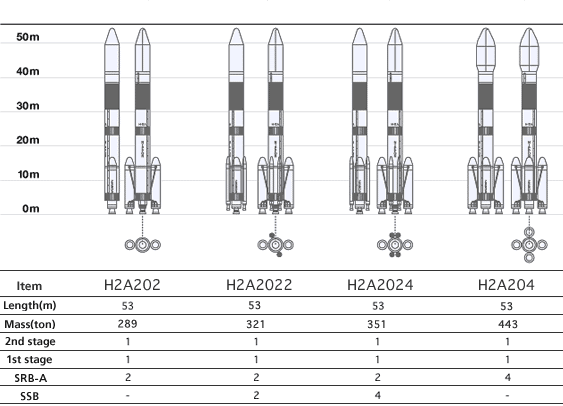
H-IIA rockets have a three to four number configuration code following the prefix “H2A”. The first number represents the number of stages. Then, the second number denotes the number of liquid rocket boosters (LRBs). However, the configurations using LRBs never saw the light of day. Finally, the third number shows the number of solid rocket boosters (SRBs). Consequently for this launch, the H-IIA 202’s designation means two stages, no LRBs, and two SRBs.
| First Stage | Solid Rocket Booster | Second Stage | |
| Engine | LE-7A | SRB-A | LE-5B |
| Propellant | LH2/LOx | HTPB Composite | LH2/LOx |
| Propellant Mass, kg | 100,000 | 65,000 each | 16,600 |
| Thrust, kN (lbf), vacuum | 1,098 (246,840) | 2,520 (566,519) each | 137 (30,799) |
| Specific Impulse (ISP), s, vacuum | 440 | 283 | 448 |
| Burning Time, s | 390 | 100 | – |

First Stage
All stages of the H-IIA rocket are in fact expendable. Its first stage is powered by an LE-7A engine, which is capable of producing 1,098 kN of thrust, with an ISP of 440 s. The propulsion system runs on both liquid hydrogen (LH2), and liquid oxygen (LOx). This stage consists not only of the engine section, but also of fuel tanks, a center section connecting them, and an interstage.
SRB-A
A pair of SRB-As on the H-IIA 202 rocket fire for approximately 100 s from liftoff. Each one of them is capable of producing 2,520 kN of thrust, with an ISP of 283 s, consequently augmenting total thrust of the rocket.
Second Stage
The second stage is powered by an LE-5B engine that also runs on LH2 and LOx and can be ignited up to three times. This stage is capable of producing 137 kN of thrust, while featuring an ISP of 448 s. Furthermore, the equipment panel of this stage hosts the avionics system. The hydrazine-jet reaction control system is mounted under the avionics equipment panel and is used for attitude control.
In addition, a long-coast variation of this stage is available for geostationary orbit missions. It features several modifications that allow enhancing the mission time and suppressing the propellant loss during long coast periods.
Payload Fairings
Three types of payload fairings (4S, 5S, and 4/4D-LC) are available for H-IIA rockets. The first two of them can be used for a dedicated launch, whereas the 4/4D-LC model can be used for a dual launch.
Latest H-IIA Launches
| Date | H-IIA Variant | Mission Name | Flight ID |
| November 29, 2020 – 07:25 UTC | 202 | JDRS-1 | F43 |
| October 26, 2021 – 02:19 UTC | 202 | QZS-1R | F44 |
| December 21, 2021 – 15:32 UTC | 204 | Inmarsat I-6 F1 | F45 |
| January 26, 2023 – 01:49 UTC | 202 | IGS Radar 7 | F46 |
| September 6, 2023 – 23:42 UTC | 202 | XRISM/SLIM | F47 |

