


Featured Image Credit: Austin DeSisto/Everyday Astronaut
Liftoff Time | January 08, 2024 07:18:38 UTC | 02:18:38 EST |
|---|---|
Mission Name | CERT-1 (Peregrine lunar lander) |
Launch Provider | United Launch Alliance |
Customer | Astrobotic |
Rocket | Vulcan |
Launch Location | Space Launch Complex 41 (SLC-41), Cape Canaveral Space Force Station, Florida, USA |
Payload mass (wet) | 1,283 kg (2,828 lbs) |
Where did the spacecraft go? | Lunar trajectory (did not land) |
Did they attempt to recover the first stage? | No |
Where did the first stage land? | It crashed into the Atlantic Ocean |
Did they attempt to recover the fairings? | No |
Were these fairings new? | Yes |
This was the: | – 1st launch of Vulcan – 3rd lunar mission of the Artemis program – 2nd robotic lunar mission of the Artemis program – 5th orbital launch attempt of 2024 |
Where to watch | Official livestream Tim Dodd, the Everyday Astronaut, will be streaming; come ask questions and join the conversation live! |
How Did It Go?
The United Launch Alliance methane-fueled Vulcan Centaur rocket soared above the Florida skies for the first time on the CERT-1 mission. Additionally, the BE-4 engines, manufactured by Blue Origin, used on Vulcan launched for the first time and performed nominally. ULA experienced 100% launch success, delivering the Peregrine lunar lander, built by Astrobotic, to its desired orbit within the margins expected.
Peregrine Problems
Unfortunately, Peregrine will not land on the Moon. The speculation on the main cause is a loss of propellant after “a valve between the helium pressurant and oxidizer failed to reseal after actuation during its initialization” (Astrobotic). The company believes that the oxygen tank was ruptured as a result. A full analysis and the root cause will be determined after the mission is complete.
Throughout the mission, Astrobotic continually kept the media and public highly informed through updates on social media which included images from the lander. During the initialization, Peregrine was unable to orient it’s solar panel towards the Sun to charge the batteries. The team, however, was able to correct for this and recharge the batteries.

While it is unfortunate that Peregrine will not be landing on the moon, it is important to zoom out and understand the scope of this mission as a whole. Astrobotic CEO John Thornton sat down with me about 12 hours before launch to discuss Peregrine and the future or lunar exploration. “Just getting on the pad today is a huge success,” John told Everyday Astronaut. The lessons learned from building Peregrine have already seen applications on the company’s next lander, Griffin, which will carry NASA’s Viper rover to the lunar south pole and be launched on a Falcon Heavy.
“The biggest milestone after launch will be orienting to the sun so we can keep the spacecraft powered,” he continued. Despite some difficulties, Peregrine was able to do just that. Overall, the Astrobotic and ULA partnership was strong throughout the process as Peregrine passed all pre-launch tests “with flying colors”. And for the record, Astrobotic was confident the Vulcan would launch in January (Everyday Astronaut 2024 poll).
What Is Peregrine And What Is Its Mission?
To understand the Peregrine lunar lander, we must first acquire a short background of the company that it belongs to. Astrobotic, a Pittsburgh, Pennsylvania, based spaceflight company, makes “advanced navigation, operation, power, testing, and computing systems for spacecraft” according to its website. In addition to Peregrine, the company also has the larger, Griffin lander in production as well as a small, but advanced Cuberover.
Founded in 2007, all of Astrobotic’s operations come from its 47,000 square foot (14,000 square meter) private facility which also houses its mission control center. The company’s mission statement reads, “Astrobotic is making space accessible to the world. We are committed to empowering a thriving human presence beyond Earth”.
For its first major mission, Astrobotic purchased the first ride on the United Launch Alliance (ULA) Vulcan rocket, which propelled the spacecraft into a ballistic Earth orbit.
Peregrine Lander
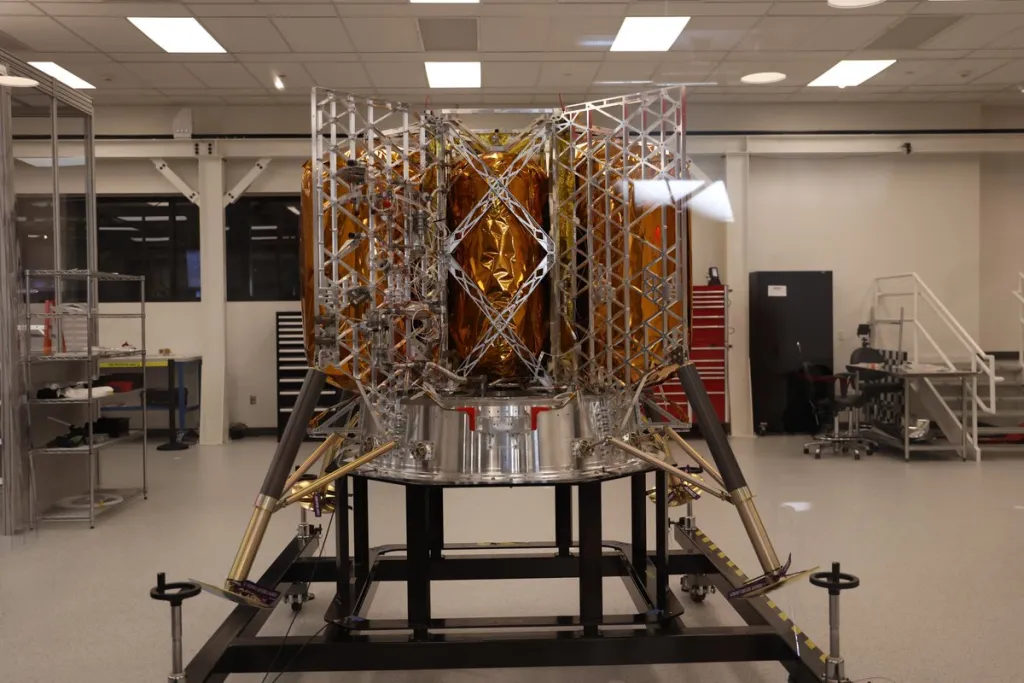
In April 2022, before payloads were integrated, Astrobotic revealed Peregrine to the public for the first time. The lander, poised in the cleanroom, measured 1.9 meters tall and 2.5 meters wide. It has the capability to carry up to 90 kg of payload. For power and cooling, the lander has a top-mounted solar panel and side-mounted radiators.
During the unveiling, Astrobotic CEO John Thornton spoke about the importance or Peregrine and its role in bringing humanity back to the Moon. “This is our nation’s first lander headed back to the surface of the Moon, nearly 50 years since Apollo.” The mission itself is an internationally collaborative effort, hosting payloads from seven countries including the United States, Germany, United Kingdom, Japan, Mexico, Hungary, and the Seychelles.
Structure And Specifics
The lander’s bus is a complicated, yet rigid, aluminum alloy structure comprised of the adapter cone, isogrid shear panels, and two honeycomb enclosures. Fuel tanks, which take up a large amount of space, are covered in a gold foil-like material and supported by the isogrid shear panels. There is also a platform for mounting payloads.
For propulsion, Peregrine has five engines that can each produce 667 Newtons of thrust, totaling 3,335 Newtons of thrust. In addition to these five main engines, there are 12 Attitude and Control System (ACS) engines that are grouped in clusters of three. They are oriented in various positions around the spacecraft to ensure control is possible in all degrees of freedom. Each engine can produce 45 Newtons of thrust.

The engines use a pressure-fed hypergolic bipropellant system, which removes the need for a complicated ignition system. This is common in small spacecraft engines as the hypergolic fuels ignite upon contact with each other. The fuel being used is a hydrazine derivative known as Mono-Methyl-Hydrazine (MMH) and the oxidizer is a solution of nitric oxide in dinitrogen tetroxide/nitrogen dioxide, 25% Mixed Oxides of Nitrogen (MON-25).
What Payloads Are On Board?
Originally planned for 24 payloads, due to technical complications, the number of payloads now totals 21. Six payloads are from NASA, one from Mexico, one from the United Kingdom, one from Hungary, two from Germany, one from Japan, one from Seychelles, and eight from other entities in the United States. The purpose and origin of the payloads are noted in the table below:
| Payload | Purpose | Country/Agency |
|---|---|---|
| Near-Infrared Volatile Spectrometer System (NIRVSS) | NIRVSS will measure surface and subsurface hydration, carbon dioxide and methane – all resources that could potentially be mined from the Moon — while also mapping surface temperature and changes at the landing site. It is being developed at NASA’s Ames Research Center in Silicon Valley, California. | NASA’s Ames Research Center |
| Linear Energy Transfer Spectrometer (LETS) | The LETS radiation sensor will collect information about the lunar radiation environment and relies on flight-proven hardware that flew on the Orion spacecraft’s inaugural uncrewed flight in 2014. | NASA’s Johnson Space Center |
| Neutron Spectrometer System (NSS) | NSS will search for indicators of water-ice near the lunar surface by measuring how much hydrogen-bearing materials are at the landing site and determining the bulk composition of the regolith there. | NASA’s Ames Research Center |
| Laser Retroreflector Array (LRA) | LRA is a collection of approximately half-inch (1.25 cm) retroreflectors – a unique kind of mirror that is used for measuring distance – mounted to the lander. This mirror reflects laser light from other orbiting and landing spacecrafts to precisely determine the lander’s position. | NASA’s Goddard Space Flight Center |
| Peregrine Ion-Trap Mass Spectrometer (PITMS) | PITMS will characterize the lunar exosphere after descent and landing and throughout the lunar day to understand the release and movement of volatiles. PITMS is a partnership between NASA Goddard Space Flight Center, The Open University (OU), NASA, and the European Space Agency (ESA). | NASA’s Goddard Space Flight Center and ESA |
| Navigation Doppler Lidar (NDL) | NDL will determine the Peregrine spacecraft’s exact velocity and position to land on the Moon using LiDAR (light detection and ranging). NDL was developed by NASA over 10 years ago for precise, safe landings on the Moon and in other challenging environments. | NASA’s Langley Research Center |
| LINX-UNAM (together with Agencia Espacial Mexicana (AEM)) | LINX-UNAM, together with Agencia Espacial Mexicana (AEM), will fly the first Latin American scientific instrument to the surface of the Moon. Consisting of 5 small rovers each weighing <60 g and measuring 12 cm across, the miniature rovers will demonstrate autonomous and coordinated exploration of the lunar surface | Mexico |
| BitMEX | A unique physical coin destined for the Moon, loaded with one Bitcoin. | Seychelles |
| Astrobotic – Terrain Relative Navigation | Astrobotic will demonstrate its standalone Terrain Relative Navigation (TRN) sensor as a payload on its first mission to the Moon. TRN will enable spacecraft to perform landings on planetary surfaces with an unparalleled accuracy of less than 100 meters. The TRN sensor is being developed under a $10 million NASA Tipping Point contract with NASA Johnson Space Center, Jet Propulsion Laboratory, and Moog. | USA |
| BTC INC. | This plate includes a copy of the Genesis Block, the first block of bitcoin (BTC) to be mined. This cornerstone of the Bitcoin network provides the foundation for an ecosystem that would challenge our perception of how money is valued and managed in the digital age. | USA |
| Astroscale | Astroscale will send the Pocari Sweat Lunar Dream time capsule to the Moon, which contains 185,872 messages from children from around the world. | Japan |
| Iris Lunar Rover | Carnegie Mellon University (CMU) students, staff, and professors collaborate with Astrobotic to develop space robotics technology. CMU is currently developing the Iris rover for Astrobotic’s inaugural lunar mission. CMU is also a subcontractor on Astrobotic’s MoonRanger lunar rover mission. | USA |
| MoonArk | The MoonArk, an epochal collaborative space project at Carnegie Mellon University, embodies the arts, humanities, sciences, and technologies in a set of intricately designed objects intended to spark wonderment and discovery for future generations. | USA |
| Elysium Space | Elysium is providing lunar memorial services to deliver a symbolic portion of remains to the surface of the Moon. | USA |
| Celestis | Celestis is the first company to have successfully conducted Memorial Spaceflight Missions, the only company to have been selected by NASA to honor one of its scientists, and for more than two decades an iconic pioneer and global leader of the commercial space age. | USA |
| M-42 | This radiation detector is a complement to another scientific experiment riding aboard NASA’s Artemis I mission. These sensors will precisely measure the level of radiation a human body will encounter on a trip to the Moon and back. The data from both Artemis I and Peregrine Missions will improve our understanding of lunar spaceflight environmental conditions with respect to astronaut health, as space radiation will be one of the key risks in the future of Human Space Exploration. | Germany |
| DHL MoonBox | Astrobotic accepted small personal mementos for inclusion on Peregrine Mission One. “Moon Capsules” containing payloads from around the world will be stored aboard Peregrine on the Moon for centuries to come. From photographs and novels to student work and a piece of Mount Everest — life’s most meaningful moments will be forever linked with the our nearest celestial neighbor. | Germany |
| Lunar Mission One | Lunar Mission One will send the first digital storage payloads to the Moon. The payload will support Lunar Mission One’s “Footsteps on the Moon” campaign. | USA |
| Puli Space Technologies | Team Puli, from Hungary, will send a unique plaque for the “Memory of Mankind (MoM) on the Moon” project. The plaque contains archival imagery and texts readable with a 10x magnifier. | Hungary |
| Spacebit Plaque | Spacebit is a privately held UK company that is working on space data analytics tools and robotic concepts of space exploration that include AI and advanced microrobotics. The company believes in creating a commercially sustainable data and robotics business in space exploration. Its goal is to create new opportunities for industry and academia by developing infrastructure for commercial resource exploration on the Moon and beyond. | United Kingdom |
| The Arch Mission Foundation | The Arch Mission Foundation designs, builds, delivers, and maintains curated, long-term archives that are housed in specially designed devices called Arch Libraries, or Archs (pronounced “Arks”). Archs are being developed with a variety of form factors to survive for long durations in space, as well as on the surfaces of planets, moons, and asteroids. | USA |
A few payloads stand out for a few reasons. Some are testbeds for future missions to the Moon and others are unique experiments, yet to be conducted in this manner on the lunar surface.
One major component to the Peregrine lander is the hardware it will be proving in-situ for future missions. In this case, the Terrain Relative Navigation (TRN) hardware that has been developed between NASA and Astrobotic over the past few years will also be used on NASA’s VIPER lunar lander. VIPER will be the agency’s first mission to the lunar south pole. Additionally, the hardware will see use on Astrobotic’s future Griffin lander.
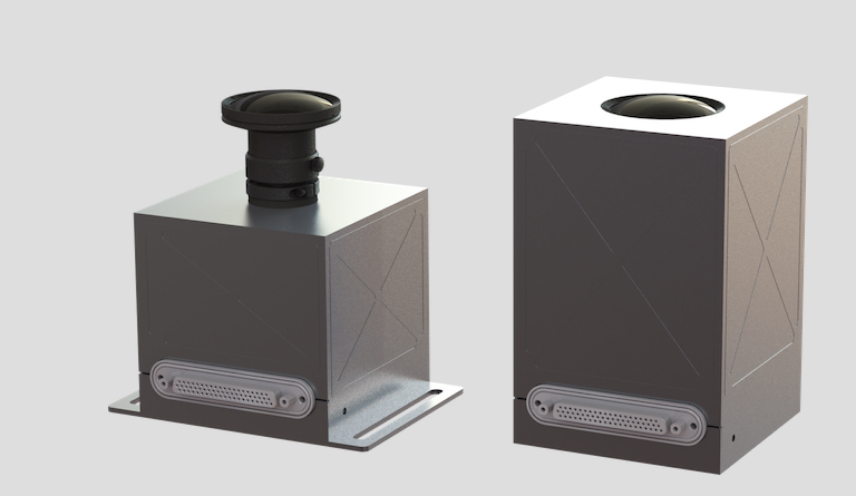
The system is an ultra-light and small system, saving mass and space on smaller and even larger spacecraft. Known as UltraNav, the sensor can be packaged as a standalone sensor or be incorporated into a larger navigation system. Due to its advanced capability, it can be used on anything from small CubeSats to human landers.
Iris Lunar Rover
Weighing in at only two kilograms, the Carnegie Mello University built Iris Lunar Rover is set to become the “smallest and lightest rover ever to go to space”. Additionally, it will also be the first American rover to go to the Moon since Apollo. The scientific goals of Iris are large, despite its tiny size.
A front-mounted camera, in combination with others positioned around the rover, will gather geological survey images during the rover’s exploration of the lunar surface. To save weight and provide efficiency, the wheels on Iris are made of thin carbon fiber folded over multiple times to make flaps for traction in the loose lunar soil. The rover also aims to gather Ultra Wide Band Radio Frequency ranging data to test new relative ranging techniques.
M-42
From liftoff to the surface of the Moon, the German built M-42 radiation detector will constantly send back radiation readings to Earth. Weighing only 250 grams, the detector is mounted to the payload tray of the lander. No instrument like it has ever been sent to the Moon, resulting in a lack of long-term radiation data from the the Moon. For future long duration lunar stays by humans, radiation levels on the surface must be known in order to properly prepare for the radiation humans will experience when we return to the Moon.

Laser Retroreflector Array (LRA)
The technology of retroreflectors is nothing new to the surface of the moon. During Apollo, large retroreflectors were left on the surface and still serve the purpose of calculating the distance from Earth to the Moon today. This smaller retroreflector will serve a similar purpose of distance estimation but on a smaller scale. The LRA will be used by lunar orbiting spacecraft to determine the location of the lander. There are eight circular reflectors measuring 1.27 centimeters in diameter mounted around the gold-plated dome pointed in different directions. Each reflector has a useable light incidence angle of +/- 20 degrees.
Celestis: Enterprise Flight
There is also another payload on board that is not placed on the Peregrine lander. Celestis, a company specializing and offering memorial spaceflight of loved ones is launching the Enterprise Flight to deep space. On board are creamted remains, human genome individual DNA samples, and names from across the globe. Fittingly, several members and the creator of the original Star Trek series, an Apollo-era astronaut, and others from all walks of life.
What Is The Vulcan Rocket?
The next heavy-lift rocket in the United Launch Alliance fleet is Vulcan. Initially, after the unveiling of the Peregrine lander, its launch was planned for the end of 2022, but was then pushed to the end of 2023. Finally, Vulcan is now slated to launch in the second week of 2024. As ULA retires the Delta IV Heavy rocket, Vulcan will service the gap left by its powerful predecessor. Similarly to ULA’s Atlas V rocket, Vulcan is customizable to fit customer needs.
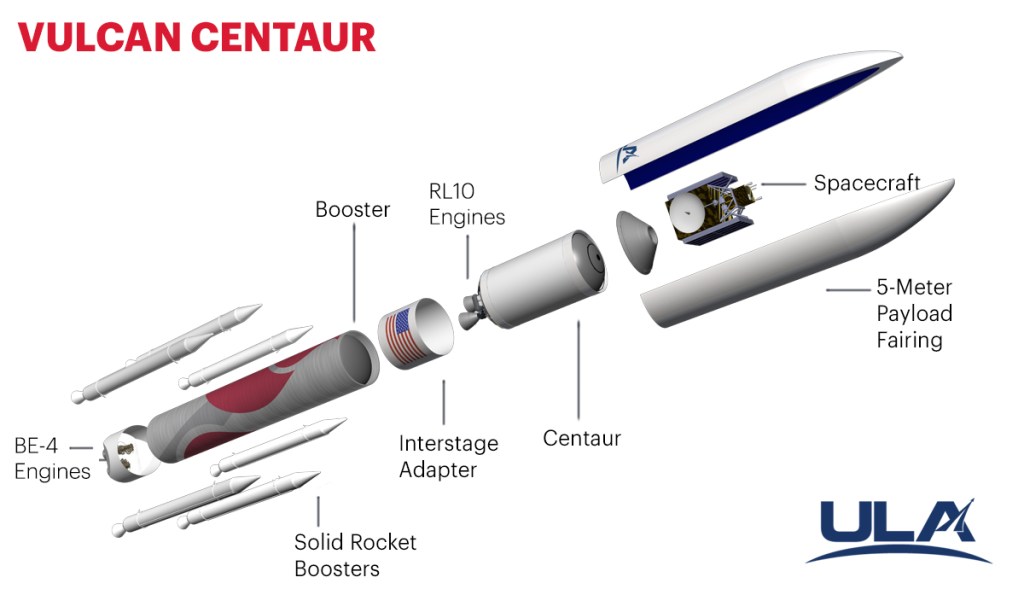
Generally speaking, Vulcan presents different lengths depending on payload fairing configuration. The shortest one reaches about 61.6 meters in length, while the longest, approximately 67.4 meters. The fuselage has a constant diameter of 5.4 meters, except in the nosecone region, as it becomes obvious in the following image.
Configurations
Vulcan’s configuration can be easily identifiable by its key. For example, it’s inaugural launch is on a VC2S. The “V” stands for Vulcan, the “C” stands for Centaur, the “2” stands for the number of solid rocket boosters (up to six), and the “S” is the payload fairing length, which comes in standard and long. Additionally, there can be a Multi-Manifest Long fairing that utilizes a load-bearing separating canister that can enclose a small satellite while supporting a larger one on top.
Solid Rocket Boosters
The Vulcan launch vehicle can support up to six Graphite Epoxy Motor (GEM) 63XL Solid Rocket Boosters from Northrop Grumman. Each booster has a nominal burn time of 90 seconds and can output 459,600 lbs in vacuum. Previous GEM SRBs have flown on Delta II and Delta IV rockets, while the GEM 63 variants took flights on Atlas Vs before flying on Vulcan.
First Stage
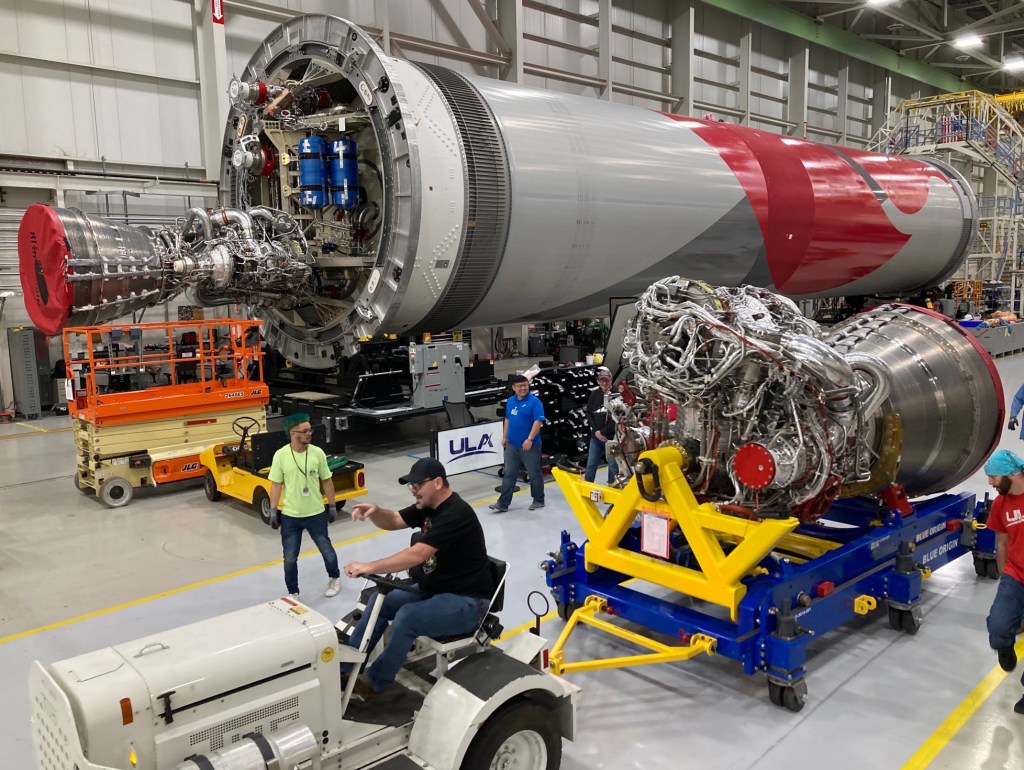
Powered by two BE-4 engines manufactured by Blue Origin, the first stage sports a unique and modern red flame design. Both engines operate independently of each other and use liquified natural gas (LNG) for its fuel and liquid oxygen LO2) for its oxidizer. Nominal thrust at sea level is 550,000 lbs between both engines.
Second Stage (Centaur)
A familiar name to the Atlas family of rockets and therefore a highly proven component to the Vulcan/Centaur system, the Centaur upper stage on Vulcan features two RL10C engines which have flown nearly 400 successful flights. Built by Aerojet Rocketdyne, the RL10C engines are restartable and have a lot of similar characteristics of previous Centaur variants. Combined, the engines can produce 24,000 lbs and use liquid hydrogen for fuel and liquid oxygen for oxidizer.
However, modifications have been made from the previous Centaur III version to the current Centaur V that will fly on Vulcan. Centaur V is 5.4 meters in diameter to fit the large size of Vulcan’s first stage. This is in contrast to the 3.05 meter wide Centaur that is featured on Atlas.


Excellent comprehensive article. Only one slight error. Landing site is not the lunar South Pole. It is the Sinus Viscositatis near the Gruithuisen Domes.