


Featured Image: SpaceX
Liftoff Time | December 29, 2023 – 01:07 UTC December 28, 2023 – 20:07 EST |
|---|---|
Mission Name | USSF-52 / OTV-7, a launch of the Space Force’s X-37B space plane |
Launch Provider | SpaceX |
Customer | United States Space Force |
Rocket | Falcon Heavy; B1064-5 (MY), B1065-5 (PY), B1084-1 (center); 76.45, 76.45, and N/A day turnaround time, respectively |
Launch Location | LC-39A, Kennedy Space Center, Florida, USA |
Payload mass | Under 5,000 kg |
Where will the spacecraft go? | Molniya type orbit (highly elliptical high inclination orbit) based on marine zones; exact orbit classified |
Will they attempt to recover the first stage? | Partially, both side boosters will be recovered but the center core will be expended |
Where will the first stage land? | The side boosters will land on Landing Zone 1 and 2 (LZ-1 & LZ-2); the center core will splash down in the Atlantic Ocean |
Will they be attempting to recover the fairings? | Yes, the fairing halves will be recovered from the water ~1,474 km (~916 mi) downrange by Doug |
Are these fairings new? | The fairing halves are new |
How is the weather? | The weather is currently 80% go for launch |
This will be the: | – Fastest a plane has ever traveled – 1st launch of the X-37B on Falcon Heavy – 7th overall X-37B launch – 4th launch for X-37B Vehicle 2 – 9th Falcon Heavy launch – 5th Falcon Heavy launch in 2023 – 229th and 230th re-flight of a booster – 95th and 96th re-flight of a booster in 2023 – 257th and 258th booster landings – 183rd and 184th consecutive landings (a record) – 97th launch for SpaceX in 2023 – 72nd SpaceX launch from LC-39A – 218th orbital launch attempt of 2023 |
Where to watch | Official livestream Tim Dodd, the Everyday Astronaut, will be streaming. Tune in live for questions and conversation! |
What’s All This Mean?
SpaceX will launch the X-37B space plane to a Molyina type orbit for the United States Space Force (USSF). This flight will mark the seventh overall launch and fourth for this vehicle (Vehicle 2) and will be launched atop SpaceX’s Falcon Heavy. Following the launch, both side boosters will be recovered downrange and the center core will be expended.
How Did It Go?
This launch was fully successful; the two boosters successfully landed and the payload was placed into the correct initial orbit.
What Is The X-37B?
The X-37B is an uncrewed test vehicle designed and manufactured by Boeing and operated by the USSF. This reusable spaceplane is derived from the earlier Boeing X-40 and has a similar aerodynamic design to the space shuttle’s orbiter. On orbit, the spacecraft demonstrates a large number of new technologies and conducts scientific investigations demonstrating space awareness.
As the mission name implies, the X-37B has launched a total of six times ahead of this mission — five times on the Atlas V 501 and once on the Falcon 9. Following its mission in orbit, which usually lasts on the order of two-to-three years, the plane lands back at Vandenberg Space Force Base or at Edwards Space Force Base. The 8.92-meter-long and 4.55-meter-wide spacecraft stands 2.9 meters tall and has a max take-off mass of 4,990 kg. For work in orbit, the spacecraft has two gallium arsenide solar cells and additional lithium-ion batteries. The vehicle had a designed orbital life of 270 days, which has been shattered as OTV-6 spent 908 days in orbit. An expendable service module is attached to the back of the vehicle to support these long orbital missions.
The purpose of this spacecraft is highly uncertain due to the classified nature of the mission. However, it is known that this mission will carry NASA’s Seeds-2 mission, which will expose plant seeds to harsh radiation environments of a long spaceflight. Additionally, this mission will deploy the FalconSat-8 — a small satellite developed by the United States Air Force Academy that will test various technologies and perform scientific investigations in orbit. Further details on this mission are unknown.

What Is The Falcon Heavy?
First Stage
The Falcon Heavy first stage contains 27 Merlin 1D+ sea-level engines across three cores. Each engine uses an open gas generator cycle and runs on RP-1 and liquid oxygen (LOx). Each engine produces 845 kN of thrust at sea level, with a specific impulse (ISP) of 285 seconds, and 934 kN in a vacuum with an ISP of 313 seconds. Due to the powerful nature of each engine, and the large amount of them, the Falcon Heavy first stage is able to lose several engines right off the pad, or up to two later in the flight, and be able to successfully place the payload into orbit.
The Merlin engines are ignited by triethylaluminum and triethylborane (TEA-TEB), which instantly burst into flames when mixed in the presence of oxygen. During static fire and launch the TEA-TEB is provided by the ground service equipment. However, as the Falcon first stage is able to propulsively land, three of the Merlin engines (E1, E5, and E9) contain TEA-TEB canisters to relight for the boost back, reentry, and landing burns.
Second Stage
The Falcon Heavy second stage is the same as the Falcon 9’s. It contains a singular MVacD engine that produces 992 kN of thrust and an ISP of 348 seconds. The second stage is capable of doing several burns, allowing the Falcon to put payloads in several different orbits.
SpaceX is currently flying two different versions of the MVacD engine’s nozzle. The standard nozzle design is used on high-performance missions. The other nozzle is a significantly shorter version of the standard, decreasing both performance and material usage; with this nozzle, the MVacD engine produces 10% less thrust in space. This nozzle is only used on lower-performance missions, as it decreases the amount of material needed by 75%. This means that SpaceX can launch over three times as many missions with the same amount of Niobium as with the longer design.
For missions with many burns and/or long coasts between burns, the second stage is able to be equipped with a mission extension package. When the second stage has this package it has a gray strip, which helps keep the RP-1 warm, an increased number of composite-overwrapped pressure vessels (COPVs) for pressurization control, and additional TEA-TEB.
Falcon Heavy Boosters
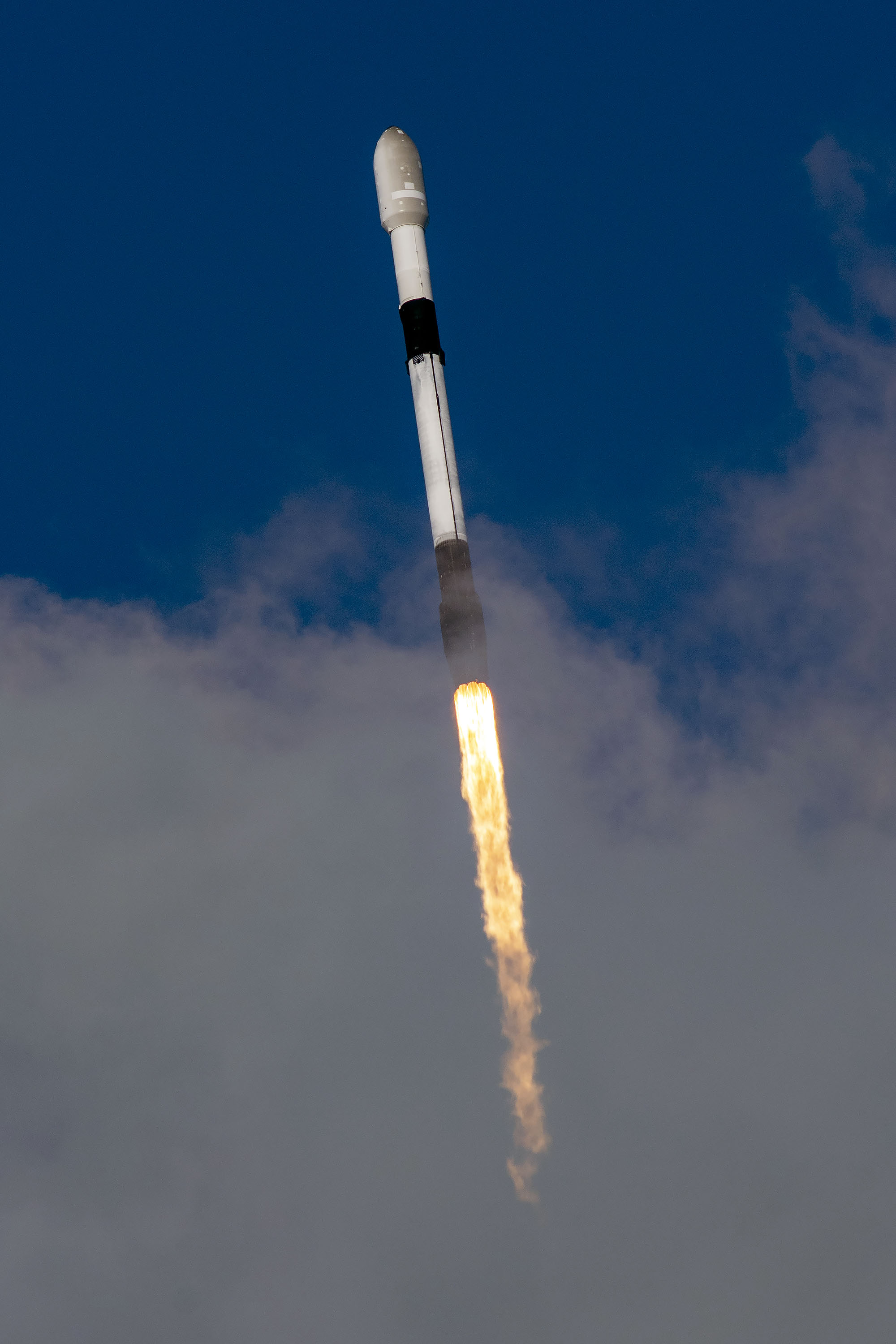
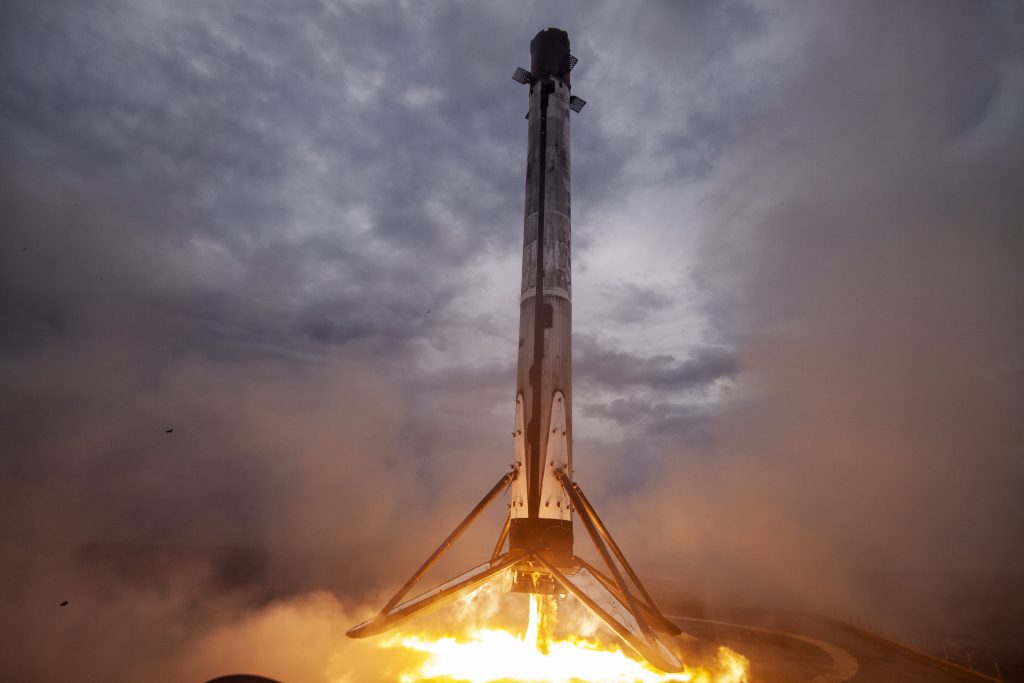
The boosters supporting the USSF-52 mission are B1084-1 as the center core, the minus Y booster is B1064-5, and the positive Y booster is B1065-5. As the name implies, both side boosters have flown four previous missions and the center core is new. The side boosters previously flew as a set on USSF-44, USSF-67, EchoStar 24, and Psyche.
Following stage separation, the Falcon Heavy side boosters will conduct three burns. These burns will allow the cores to touch down on SpaceX’s landing pads LZ-1 and LZ-2. The center core will be expended, splashing down in the Atlantic Ocean.
Falcon Heavy Fairings
The Falcon Heavy’s fairing consists of two dissimilar reusable halves. The first half (the half that faces away from the transport erector) is called the active half, and houses the pneumatics for the separation system. The other fairing half is called the passive half. As the name implies, this half plays a purely passive role in the fairing separation process, as it relies on the pneumatics from the active half.
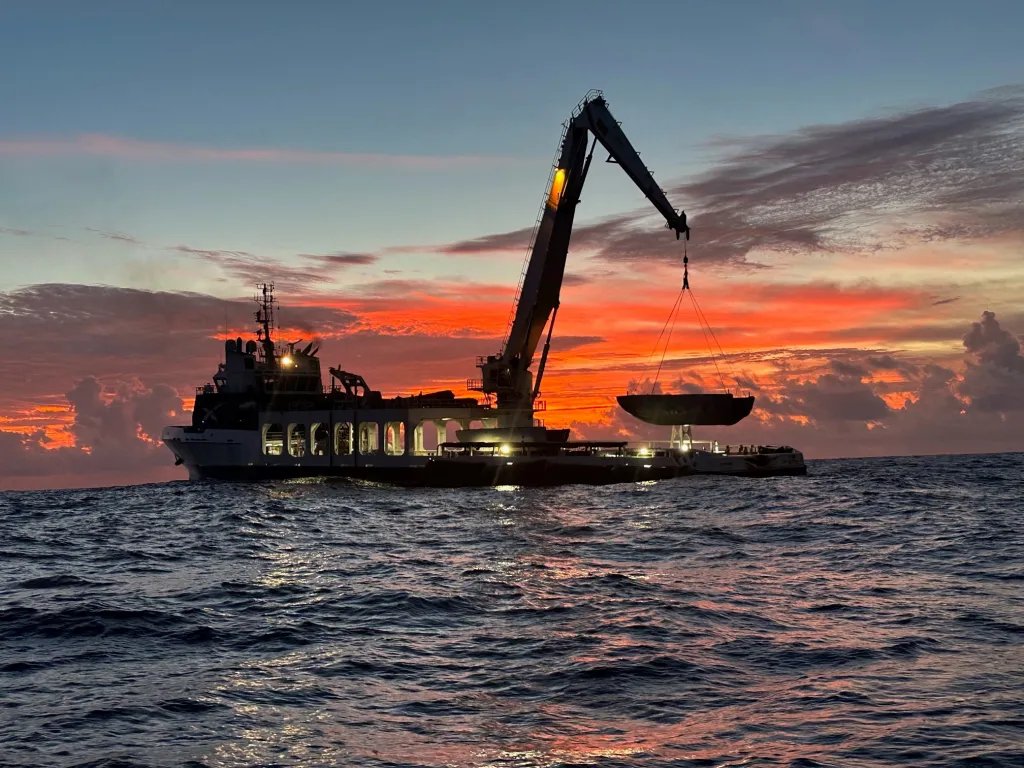
Both fairing halves are equipped with cold gas thrusters and a parafoil which are used to softly touch down the fairing half in the ocean. SpaceX used to attempt to catch the fairing halves, however, at the end of 2020 this program was canceled due to safety risks and a low success rate. On USSF-52, SpaceX will attempt recovery of the fairing halves from the water with its recovery vessel Doug.
In 2021, SpaceX started flying a new version of the Falcon 9/Heavy fairing. The new “upgraded” version has vents only at the top of each fairing half, by the gap between the halves, whereas the old version had vents placed spread equidistantly around the base of the fairing. Moving the vents decreases the chance of water getting into the fairing, making the chance of a successful scoop significantly higher.
USSF-52 Countdown
| HR/MIN/SEC | EVENT |
|---|---|
| – 00:53:00 | SpaceX Launch Director verifies go for propellant load |
| – 00:50:00 | 1st stage RP-1 (rocket grade kerosene) loading begins |
| – 00:45:00 | 1st stage LOX (liquid oxygen) loading begins |
| – 00:35:00 | 2nd stage RP-1 (rocket grade kerosene) loading begins |
| – 00:18:30 | 2nd stage LOX loading begins |
| – 00:07:00 | Falcon Heavy begins engine chill |
| – 00:00:59 | Flight computer commanded to begin final pre-launch checks |
| – 00:00:45 | SpaceX Launch Director verifies go for launch |
| – 00:00:20 | Propellant tanks pressurize for flight |
| – 00:00:06 | Engine controller commands engine ignition sequence to start |
| – 00:00:00 | Falcon Heavy liftoff |
USSF-52 Launch and Landing
| HR/MIN/SEC | EVENT |
|---|---|
| 00:01:11 | Max Q (moment of peak mechanical stress on the rocket) |
| 00:02:24 | Side boosters engine cutoff (BECO) |
| 00:02:28 | Side boosters separate |
| 00:02:43 | Side boosters’ boostback burns begin |
| 00:03:52 | Side boosters’ boostback burns end |
| 00:03:54 | 1st stage main engine cutoff (MECO) |
| 00:03:57 | Center core 1st and 2nd stages separate |
| 00:04:03 | 2nd stage engine starts (SES) |
| 00:04:28 | Fairing deployment |
| 00:06:46 | Side boosters’ entry burns start |
| 00:07:03 | Side boosters’ entry burns end |
| 00:08:06 | Side boosters’ landing burns start |
| 00:08:24 | Side boosters’ landing |


Will the flight be northerly or southerly- critical toknow if you want to drive to where you can see it
How do I join ya