


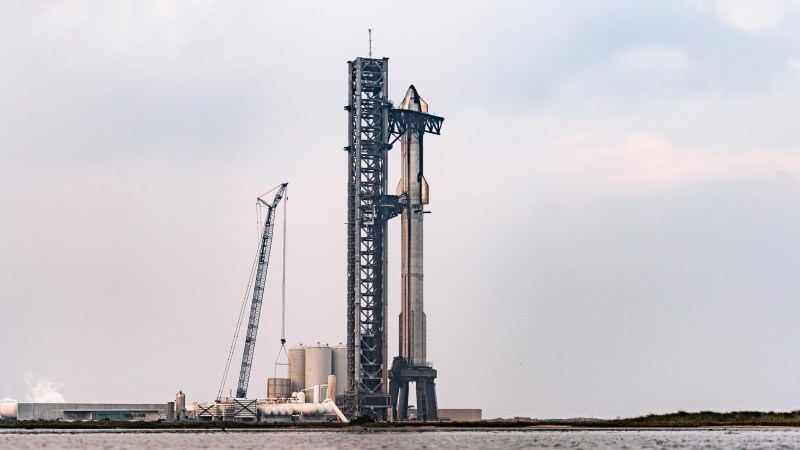

Featured Image: Ryan Chylinski / Cosmic Perspective
*All details are based on public information and previous test flights.*
Liftoff Window | October 13, 2024, 12:00 UTC | 07:00 CDT ~ 13:10 UTC / 08:10 CDT |
|---|---|
Mission Name | Starship Flight Test 5 |
Launch Provider | SpaceX |
Customer | SpaceX |
Rocket | Starship (S30)/Super Heavy (B12) |
Launch Location | Orbital Launch Pad 1, Starbase, Texas, USA |
Payload mass | N/A |
Where will Starship go? | It will attempt to reenter and soft splashdown in the Indian Ocean |
Will they attempt to recover the first stage? | Yes |
Where will the first stage land? | Super Heavy will attempt to be caught by the launch tower |
Will they attempt to recover the fairings? | There are no removeable fairings on Starship |
Will they attempt to recover the second stage? | Not this time, but in the future |
This was the: | – 5th flight of the Starship/SuperHeavy stack – 5th launch attempt of an orbital class rocket from the state of Texas – 54th flight of a liquid fueled rocket from the state of Texas |
Where to watch | Official livestream Everyday Astronaut livestream In person? Here’s a guide on Where to view Starship |
What’s All This Mean?
SpaceX is launching the Starship/Super Heavy from Texas for the fifth time. The turnaround time from last launch will be about 129 days and include a number of upgrades intended to further Starship’s success and gather more data, deeper into the mission. For Flight 4, Starship performed a soft spashdown in the Indian Ocean and the Super Heavy performed a soft spashdown in the Gulf of Mexico before experiancing a RUD. The goal for Flight 5 is to catch the booster with the Chopstick arms and to perform another soft splashdown of Starship in the Indian Ocean.
Starship Flight 5 Upgrades
There are a few upgrades the SpaceX has noted for Flight 5, a majority of which are centered around the launch pad. During flight, the hot staging ring will now be jettisoned to reduce mass during the landing phase of flight. Ship recieved a large heat sheild overhaul with a new tiles and the addition of an ablative layer underneath the tiles. More cameras were added and two more vents. For the booster, more FTS charges were added.
The Pad (Stage Zero)
In the days prior to launch, the ship will be placed on top of the booster via the chopstick arms, also known as “Mechazilla.” Once on top, the arms will release and open wide near the top of the tower in order to swing as far away from the stack as possible. These chopstick arms are designed to catch both the booster and ship on future missions.
In light of Flight 1, SpaceX has installed a number of new measures on and near the Stage Zero in order to protect the pad. One of the major additions includes a water-cooled steel plate mounted directly underneath the Orbital Launch Table. Before ignition, water gets sprayed up from and around the steel plate to provide cooling and sound dampening. Visual imagery from recent flights seemed to indicate that the water-cooled plate is working incredibly well.
SpaceX conducted tons of work on the chopstick arms, including slap tests on a test tank to simulate the load on the booster. This work presumably enhanced the integrity of the chopsticks so that they would have the best chance of holding up when catching the booster.
That being said, there is no flame trench such as seen on other launch pads, so the exhaust from all 33 engines will be able to spread in all directions. The steel plate acts as a flame diverter since it diverts the flame from immediately contacting the concrete.
Launch Viewing
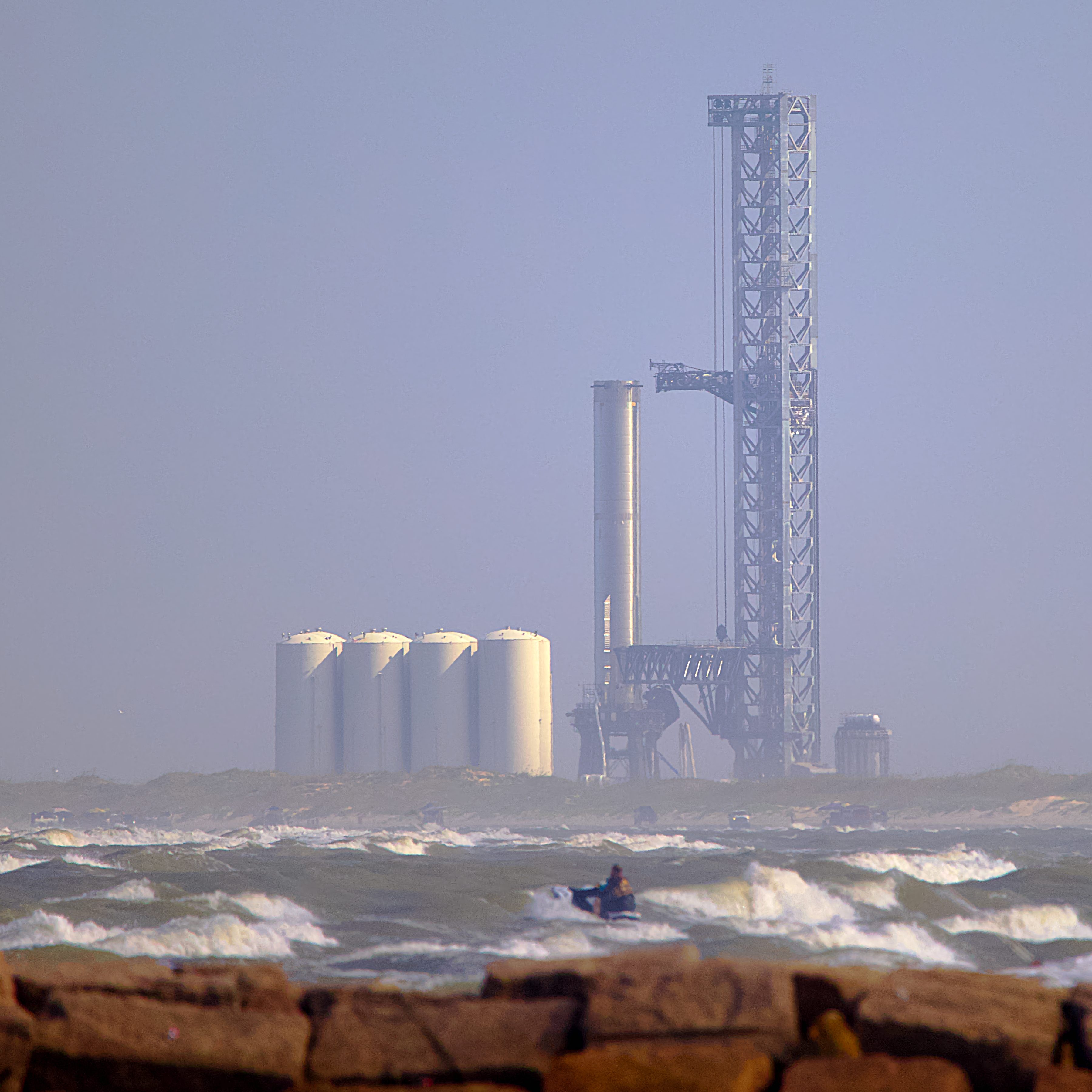
The closest public viewing point is expected to be on South Padre Island about eight kilometers (five miles) away. Despite uncertainties in the exact dimensions of the exclusion zone, it will certainly be large due to the size of Starship/SuperHeavy and the fact that it is an unproven rocket.
If attending in person is not an option, Everyday Astronaut will be live on location from Studio B with views all around the island and pad. Tim will be available to answer questions. A livestream link can be found here once we get closer to launch.
SpaceX is also expected to have an official live stream on X (formerly Twitter).
Starship/Super Heavy
For the past seven years, SpaceX has been developing their facility in Boca Chica, Texas. They have dubbed it “Starbase” and it contains tents, bays of various heights and widths, as well as all the infrastructure to produce the world’s largest and most powerful rocket. Information on the test campaign can be found in the “History” section below.
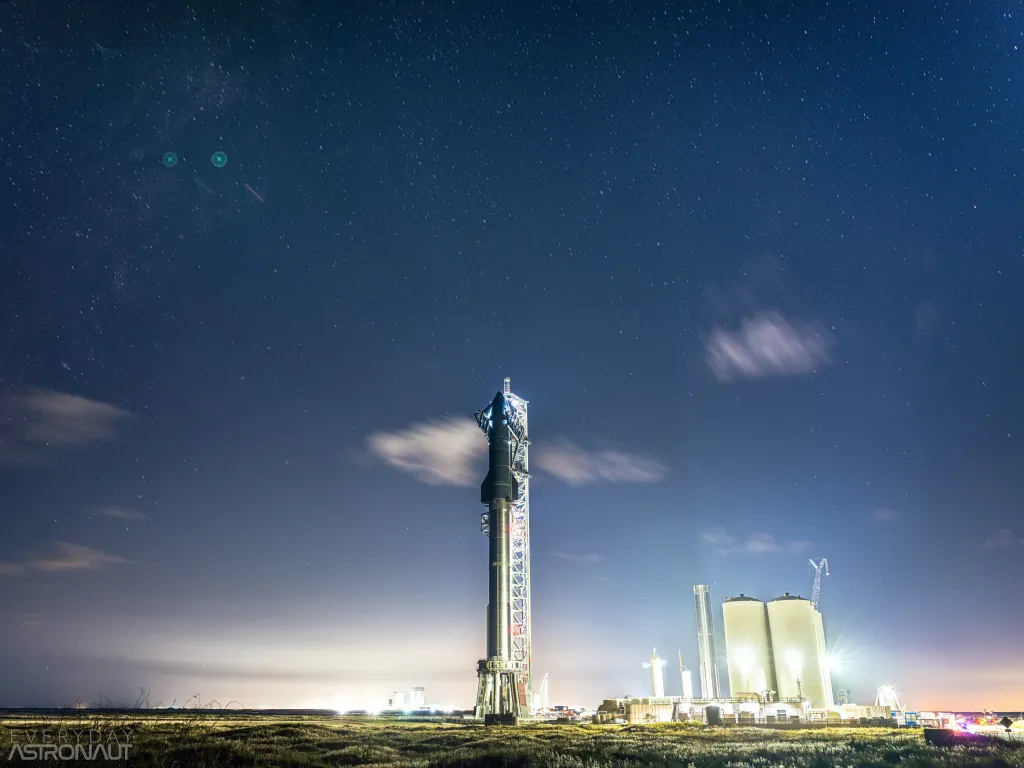
The full stack consists of two vehicles, each with different jobs relating to the launch process. On the bottom is the booster, also known as Super Heavy, which makes up about 58% of the full stack. The orbital ship rests on top of the booster to enable easy separation during staging.
The Booster
The booster, or bottom part of the rocket, is powered by 33 Raptor 2 engines formed in a series of rings, stands 69 m (230 ft) tall. To fuel all 33 engines, the booster uses a liquid oxygen (LOx) tank and a methane (CH4) tank on the bottom and top, respectively. The booster is fueled by the Booster Quick Disconnect (BQD) which is located on the Orbital Launch Table and connects to the booster near the bottom.
Shortly before the booster experiences first motion, the BQD retracts and a protective door rapidly shuts in order to prevent the connections from getting blasted by rocket engine exhaust. Near the bottom of the booster are four elongated triangular chines. Each of these contain Composite Overwrapped Pressure Vessels (COPVs). The COPVs provide helium and other gasses for engine start up and other functions on the booster. The square trapezoidal pyramids mainly contain electronics units.
On the top of the booster are four grid fins which provide control during booster descent through the atmosphere. These work similarly on the Falcon 9, however are much larger on Super Heavy. On top of the grid fins is a hot staging ring, where the ship is mounted.
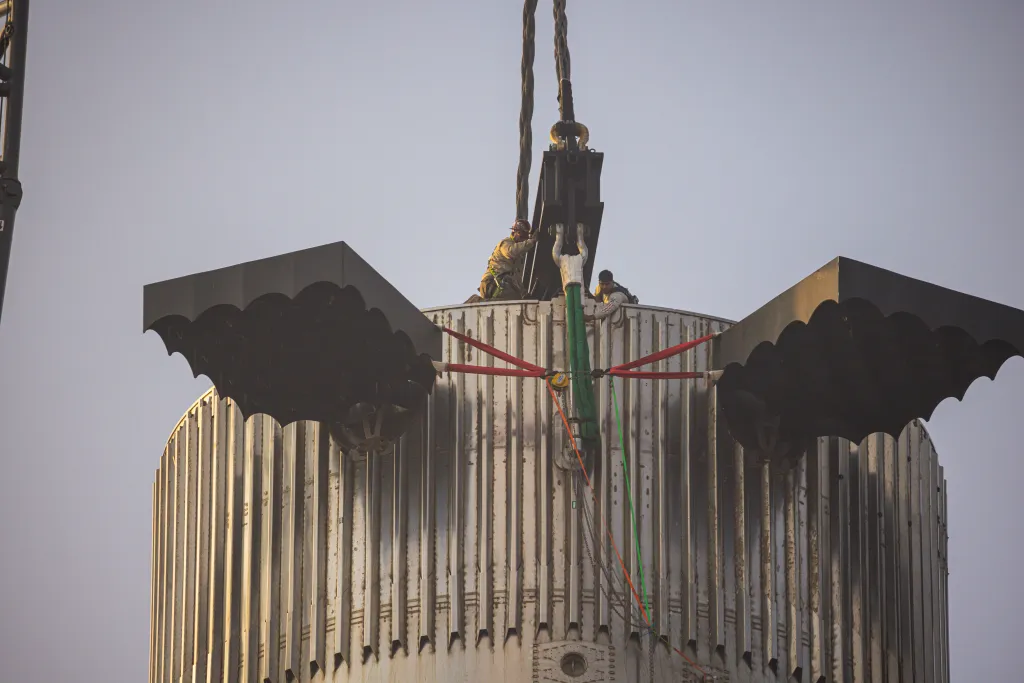
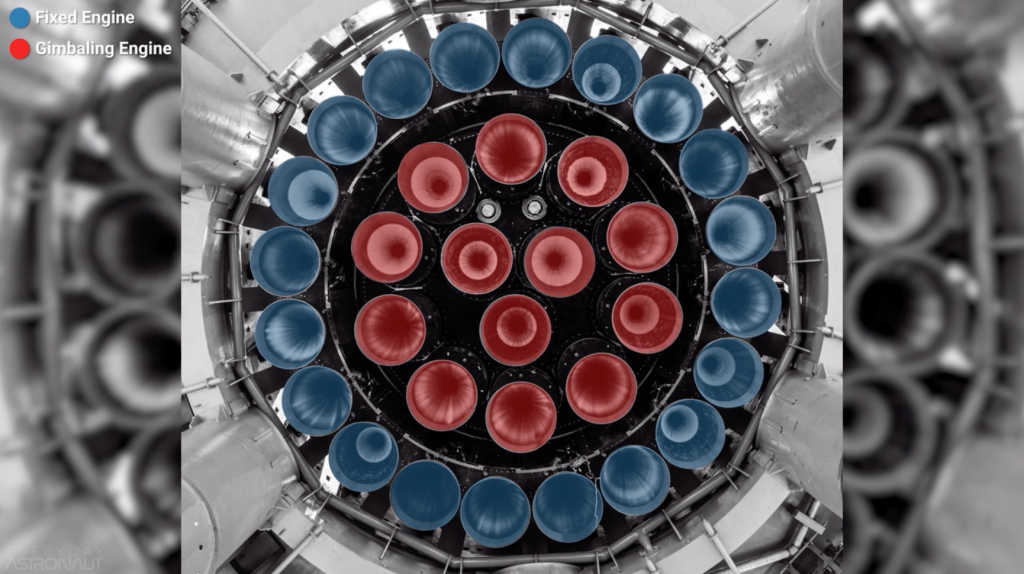
All 33 sea-level Raptor 2 engines are arranged in three clusters or rings. The three inside engines form a triangle and have the ability to gimbal. The next ring contains 10 engines which also have the ability to gimbal. Finally, the outer ring contains the remaining 20 engines that do not have the ability to gimbal.
During hot staging, only the three center engines stay ignited. After staging is completed, the inner ring of engines relight to assist with the boostback burn.
The Ship
Starship, or the top part of the rocket, is powered by three sea-level Raptor 2 engines, and three vacuum optimized Raptor 2 engines, standing an overall 50 m (160 ft) tall. The three vacuum optimized engines have elongated bells to adapt to the lack of air pressure in space. To learn more about Raptor engine development, check out Everyday Astronaut’s video “How SpaceX Is Upgrading Raptor To Be The Ultimate Rocket Engine!“
On the bottom of the ship is a skirt which encloses the engines and provides a structural element for the booster and ship to connect. Unlike the Falcon 9, the interstage section on Starship is on the ship and the top of the booster is the hot staging ring. During stage separation, all six Raptor engines on Starship will ignite, pushing the vehicle away from the booster. This is possible because of the addition of a hot stage ring that allows the exhaust from Starship’s engines to expand outwards.

The bigger of the two sets of flaps, the aft flaps can work in conjunction with the three center mounted sea-level engines which gimbal, to orient the ship during entry, descent, and landing. On the top of the ship, are the slightly smaller forward flaps that also aid in ship orientation during entry, descent, and landing.
About two-thirds of the way up the vehicle is the payload bay. Designed for Starlink satellites, there is a narrow door that deploys one satellite at a time. Sometimes called the “PEZ dispenser,” named after the popular candy, the internal structure of the payload bay is specially designed to deploy Starlink satellites in this manner.
COUNTDOWN
All times approximate
| HR/MIN/SEC | EVENT |
|---|---|
| 01:15:00 | SpaceX Flight Director conducts poll and verifies GO for propellant load |
| 00:49:50 | Ship fuel (liquid methane) load underway |
| 00:48:40 | Ship LOX (liquid oxygen) load underway |
| 00:40:40 | Booster fuel load underway |
| 00:34:03 | Booster LOX load underway |
| 00:19:40 | Raptor begins engine chill on booster and ship |
| 00:03:20 | Ship propellant load complete |
| 00:02:50 | Booster propellant load complete |
| 00:00:30 | SpaceX flight director verifies GO for launch |
| 00:00:10 | Flame deflector activation |
| 00:00:03 | Raptor ignition sequence begins |
| 00:00:00 | Excitement guaranteed |
FLIGHT TEST TIMELINE | BEST CASE SCENARIO
All times are approximate
| HR/MIN/SEC | EVENT |
|---|---|
| 00:00:02 | Liftoff |
| 00:01:02 | Max Q (moment of peak mechanical stress on the rocket) |
| 00:02:33 | Booster MECO (most engines cut off) |
| 00:02:41 | Hot-staging (Starship Raptor ignition and stage separation) |
| 00:02:48 | Booster boostback burn startup |
| 00:03:41 | Booster boostback burn shutdown |
| 00:03:43 | Hot-stage ring jettison |
| 00:06:08 | Booster is transonic |
| 00:06:33 | Booster landing burn startup |
| 00:06:50 | Splashdown is no catch attempt |
| 00:06:56 | Booster landing burn shutdown and catch attempt |
| 00:08:27 | Starship engine cutoff |
| 00:48:03 | Starship entry |
| 01:02:34 | Starship is transonic |
| 01:03:43 | Starship is subsonic |
| 01:05:15 | Landing flip |
| 01:05:20 | Landing burn |
| 01:05:34 | An exciting landing! |
Starship Program History
For nearly all of its lifetime, the Starship program has resided in south Texas, at Starbase. The area where Starbase resides has changed names many times over the past decades. The town where Starbase is located was originally called Kennedy Shores. After a hurricane it was renamed Kopernik Shores, and most recently is known as Boca Chica.
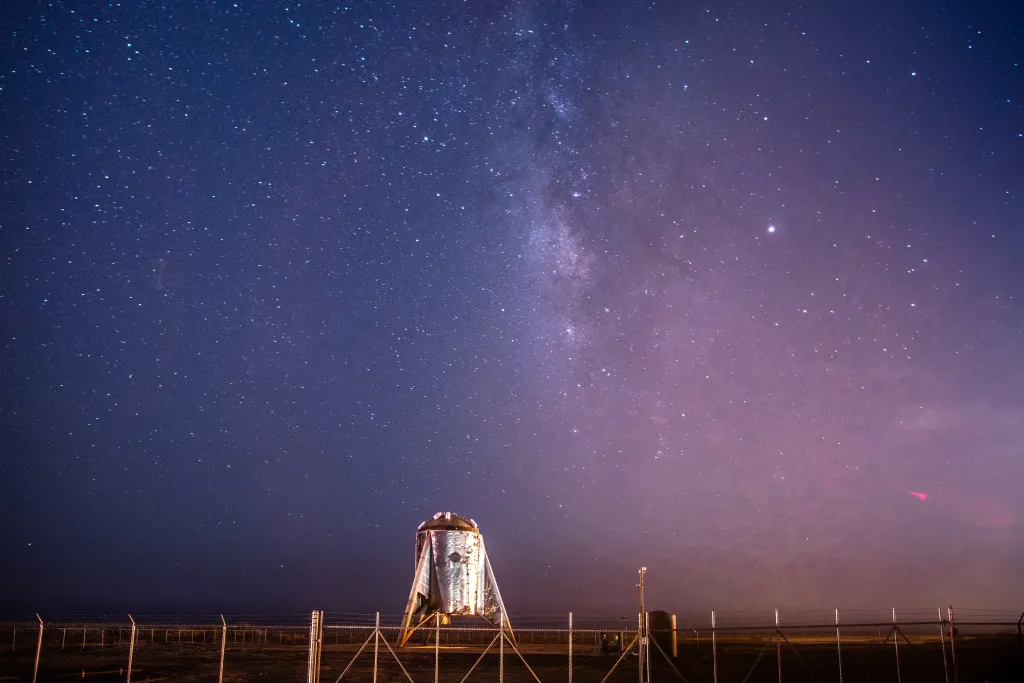
Originally purchased in 2014, the land in the area of Boca Chica gradually fell into SpaceX’s hands. For the next four years, progress was fairly dormant, despite some occasional ground work. In 2018, a water tower-like structure first stood on the paper-flat landscape. This “water tower” would be later known as Starhopper, a Raptor engine test vehicle.
Test Hops
Starhopper flew untethered for the first time on July 25, 2019 under the power of one Raptor engine serial number six to a height of 20 m (65 ft). A little over a month later, Starhopper would fly for the second and final time, reaching a height of 150 m (500 ft). The main purpose of Starhopper was as a Raptor flight test vehicle. Presently, Starhopper remains at the launch site, covered in speakers, cameras, and other communication and monitoring equipment.
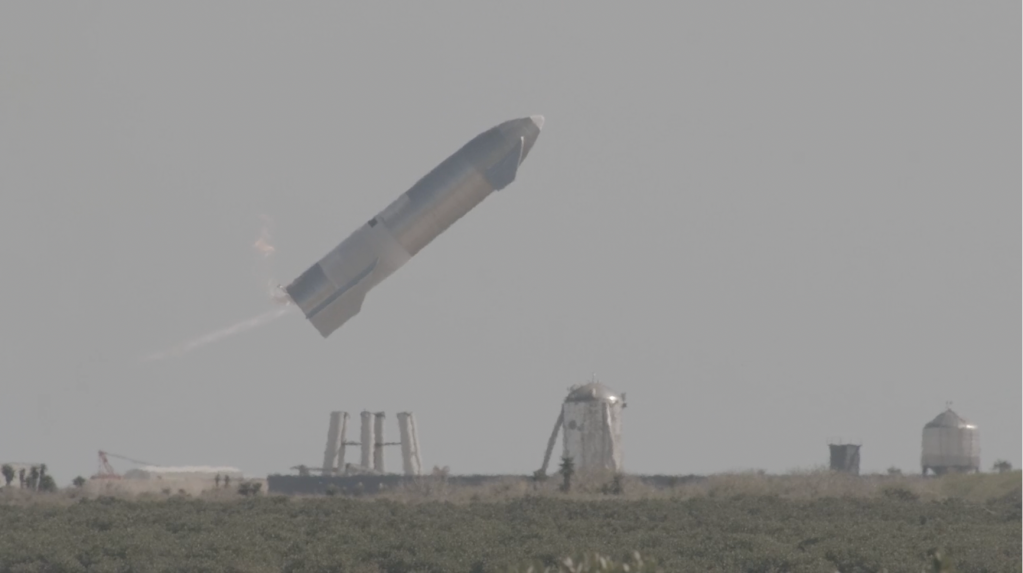
Two more test vehicles would fly to a height of 150 m (500 ft), SN5 and SN6. However, before these two successes came the spectacular malfunction of SN4. While conducting a static fire test, SN4 suffered an explosion, or a rapid unscheduled disassembly, which quickly ended its testing career. SN5 and SN6 would launch a year after Starhopper, about one month apart.
First Flights
At this point, SpaceX transitioned to higher flights which would utilize three Raptor engines and aimed to test the belly flop, flip, and landing maneuver. The first Starship to attempt this maneuver would be SN8, which launched on December 9, 2020 and flew to an altitude of 12.5 km (41,000 ft). Flying for a total duration of six minutes, 42 seconds, the flight concluded in SN8 crashing on the landing pad. A sudden pressure loss in the methane header tank caused the engines to stop producing thrust, resulting in a rapid unscheduled disassembly of the vehicle.
SN9 would be next up in line to attempt a successful landing. SN8 had already proved that Starship could perform a belly-side-down dive, relight its engines, and (partially) flip over. During construction, SN9 fell over in the High Bay which caused concern for its structural integrity. SN9’s flight was the same as SN8, however, it only traveled to 10 km (33,000 ft) in altitude. Upon landing, one of its three Raptor engines failed to relight resulting in an over-rotation of the vehicle. SN9 landed at a slight angle and exploded on the landing pad.
SN10’s flight came with an emotional roller coaster. As its predecessor did, SN10 flew to 10 km (33,000 ft) and performed its descent maneuver as designed. The flip and engine relight went smoothly, but a hard touchdown damaged the skirt and fragile landing legs. After standing poised on the landing pad, about eight minutes later, SN10 also exploded in a massive fireball.
Explosion And Success
SN11 still remains a large mystery. Due to the abnormally dense and low lying fog, the entire flight was entirely obscured, leaving the only evidence of flight to the in-person observer, the sound, and a still image captured by Trevor Mahlman. Upon relight and shortly before landing, SN11 rapidly exploded, scattering debris across the area around Starbase for miles. The only visuals of this explosion were from ground based cameras that saw debris falling from the sky.
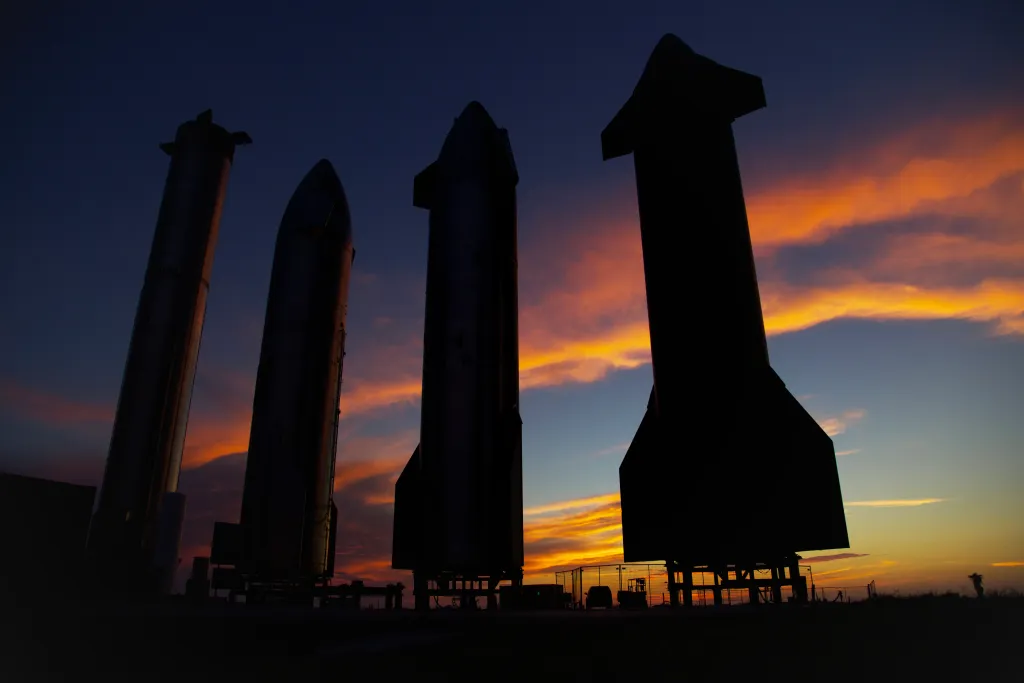
Finally, SN15 was the first Starship prototype to fly to 10 km (33,000 ft), dive down on its belly, flip, and land successfully. The prototypes between SN11 and SN15 allowed for necessary upgrades which enabled a successful landing. While a small fire ignited underneath the vehicle, it was quickly extinguished allowing SN15 to live on. Currently, SN15 sits with other vehicles in the Rocket Garden.
Recent Updates
Although SN15, which flew almost two and a half years ago in May 2021, was the last flight from Starbase, testing and rapidly accelerated construction has progressed and changed the landscape. Some highlights of this construction include the completion of the Orbital Launch Tower and Orbital Tank Farm. Both of these elements, in conjunction with the Orbital Launch Table, are essential parts of Stage Zero. Stage Zero is, simply put, the launch pad and supporting equipment that enables an orbital launch.
As far as rockets go, SpaceX tested BN3 (Booster Number 3) marking the first static fire of a booster prototype on July 19, 2021. BN3 was quickly scrapped a month later, but paved the way for B4 (Booster 4), which never performed a static fire test, but was part of the first full stack of the Starship/SuperHeavy launch system.
Conclusion
All of the previous test articles paved the way for Booster 7 and Ship 24 to conduct the first orbital flight test. Each explosion, successful landing, static fire test, cryogenic proof test, and even simple rollouts to the pad have allowed SpaceX to test critical elements in preparation for orbital flight. All of the previous test flights have gathered more and more data that will, without a doubt, launch Starship/Super Heavy further into the cosmos.

Great article and video. Thanks Tim. Best of luck to the whole team at SpaceX (Godspeed!). Thanks to all those at SpaceX for continuing to push the industry forward.
Are you going to add the checklist you normally have? They still don’t have a launch license from the FAA, right? Thanks!!
although Tim haven’t made a checklist, OliverNerd7 on twitter/X has been regularly updating a checklist and yes, the FAA license is the only thing missing.
Awe, poor space-x !!! NOT !!!!! It’s nice to see someone stand up for meaning rather than let muck,or I mean musk. The guy thinks he is untouchable, just like another looser he is involved with.. they want to start a bunch of lies over absolutely nothing. Glad to see the money BURN !!!!! Ha ha ha ha ha… Sorry “Leon”….. Show’s what musk actually means to Donald…
They have to design the Starship 1st stage, and 2nd stages to be salt water proof, and Land them in the water. Also launch them from the water too. I think it can be done. This catch system is too complex.