


Featured image credit: SpaceX
Liftoff Time |
September 10, 2024 – 07:38 UTC September 10, 2024 – 03:38 EDT |
|---|---|
Mission Name |
Polaris Dawn |
Launch Provider
|
SpaceX |
Customer
|
Jared Isaacman |
Rocket |
Falcon 9 B1083-4; 118.54-day turnaround |
Launch Location |
Launch Complex 39A (LC-39A), Kennedy Space Center, Florida |
Payload mass |
13,000 kg (28,600 lb) |
Where are the satellites going? |
Low-Earth Orbit |
Where will the first stage land? |
B1083 will be recovered on Just Read the Instructions (JRtI)
Tug: Signet Warhorse I; Support: GO Cosmos |
Will they be attempting to recover the fairings? |
There are no fairings on this flight |
This will be the |
– 1st commercial EVA – Highest Earth orbit achieved by a crewed spacecraft since Apollo – 373rd Falcon 9 mission – 301st Falcon 9 flight with a flight-proven booster – 315th reflight of a Falcon booster – 84th reflight of a Falcon booster in 2024 – 346th booster landing – 5th consecutive booster landing – 90th SpaceX launch of 2024 – 89th SpaceX launch from LC-39A |
What’s This All Mean?
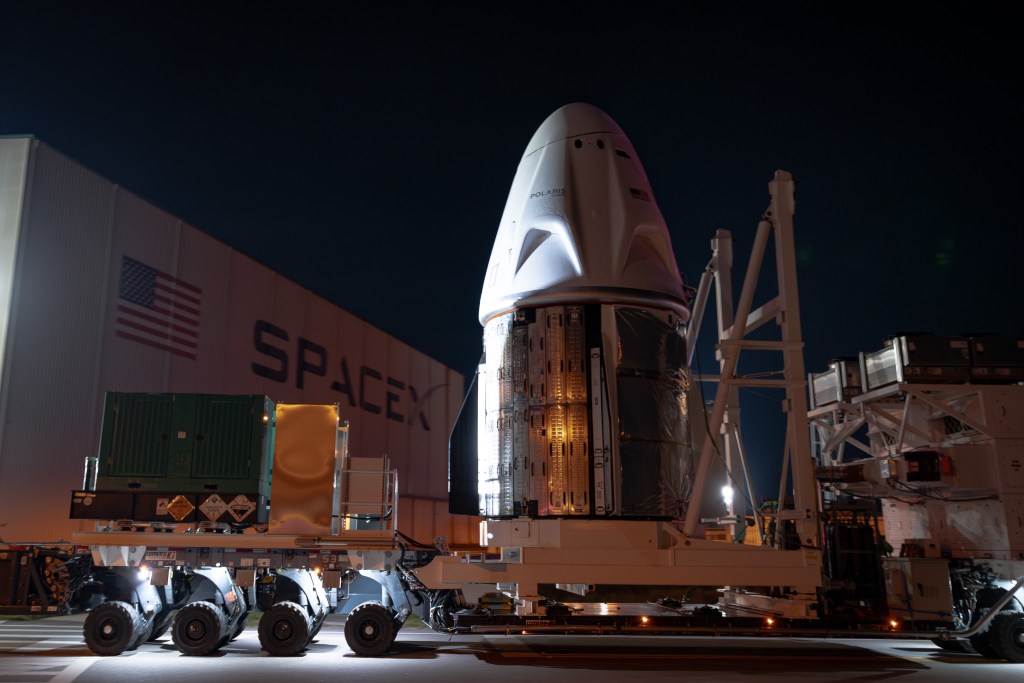
SpaceX will launch a crew of four into low-Earth orbit on the Polaris Dawn mission. The crew will be in Crew Dragon C207 and launch atop Falcon 9 from Launch Complex 39A in Florida. This mission will set a number of records: this will be the first fully commercial EVA; the furthest humans have been from Earth since the Apollo program; and the first mission of the Polaris program. This program is funded by mission commander and Shift4 founder Jared Isaacman.
The Crew
Jared Isaacman – As the mission commander, Jared is not just leading the Polaris Dawn but also funding it through his company, Shift4 Payments. A seasoned pilot with a passion for space, he’s no stranger to the cosmos, having previously commanded the Inspiration4 mission. Jared’s goal with Polaris Dawn is to push the boundaries of what’s possible in space exploration, aiming for records in altitude and human spaceflight endurance.
Scott “Kidd” Poteet – Serving as the mission pilot, Scott brings a wealth of military aviation experience, having flown numerous high-performance aircraft during his time as a U.S. Air Force lieutenant colonel. His role involves not only piloting but also ensuring the spacecraft’s systems operate flawlessly. Scott’s first venture into space with Polaris Dawn marks a significant achievement in his career, transitioning from the skies to the stars.
Sarah Gillis – As a mission specialist, Sarah’s expertise lies in crew operations at SpaceX, where she’s been instrumental in developing astronaut interfaces for the Dragon spacecraft. Her involvement in previous SpaceX missions from the ground gives her a unique perspective, now experiencing space firsthand. Sarah will be particularly focused on the spacewalk, contributing to future astronaut training based on this mission’s insights.
Anna Menon – Also a mission specialist, Anna’s background includes working with NASA astronauts and now stepping into space herself. Her role involves medical oversight and operational support, leveraging her experience in astronaut operations at SpaceX. Anna’s participation in Polaris Dawn not only marks her first spaceflight but also her contribution to understanding human health in space, crucial for future long-duration missions.


Maybe they should consider another inert gas, other than helium. Something with a higher molar mass that won’t leak or diffuse as easily.
@Mystick: Like Nitrogen (N2, mass 28 compared to 4 for He)?