


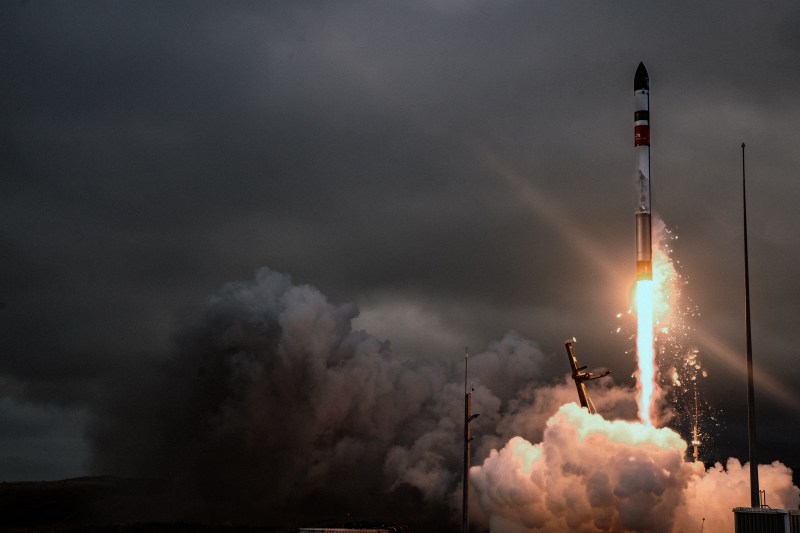

Featured image credit: Rocket Lab
Launch Time | February 18, 2024 – 14:52 UTC February 19, 2024 – 03:52 NZDT |
|---|---|
Mission Name | On Closer Inspection |
Launch Provider | Rocket Lab |
Customer | Astroscale Japan Inc. |
Rocket | Electron |
Launch Location | Launch Complex-1B, Māhia Peninsula, New Zealand |
Payload mass | ~150kg (~330 Ib) |
Where will the satellite go? | ~564.6 km x ~629.4 km Sun-synchronous orbit (SSO) at 98.2° inclination – ADRAS-J will rendezvous with an H-2A upper stage launched in 2009 |
Will they attempt to recover the first stage? | No, Electron will not be recovered this time |
Where will the first stage land? | It will splash down into the Pacific Ocean |
Will they attempt to recover the fairings? | No |
Are these fairings new? | Yes |
This will be the: | – 2nd Rocket Lab launch of 2024 – 2nd Electron launch of 2024 – 11th launch from Launch Complex-1B, Māhia Peninsula, New Zealand – 44th Electron launch – 9th recovery attempt of an Electron – 34rd orbital launch attempt of 2024 |
Where to watch | Official livestream |
What Does All This Mean?
On Closer Inspection is Rocket Lab’s 44th launch overall and its second launch this year, as well as its 11th launch from Launch Complex 1B. Their Electron rocket is launching one satellite for Astroscale Japan Inc. – ADRAS-J. ADRAS-J, or Active Debris Removal by Astro Scale Japan, will rendezvous with the upper stage of an H-2A rocket that launched GOSAT and other satellites into a 668 km x 672 km SSO at 98.03° inclination. After the upper stage had concluded its mission, its final orbit was 613 km x 641 km at 98.05° inclination.


On Closer Inspection
On Closer Inspection is a dedicated launch for Astroscale Japan Inc. to carry one satellite into an approximately 564.6 km x 629.4 km Sun synchronous orbit (SSO) at 98.2° inclination. This mission will deploy a 150 kg satellite called ADRAS-J, or Active Debris Removal by AstroScale Japan. Built by Astroscale Japan Inc., ADRAS-J is a technology demonstrator and is part of JAXA’s Phase 1 of Commercial Removal of Debris (CRD2) project. Once on orbit, it will rendezvous with an H-2A upper stage launched back in 2009. It will safely approach the 11 meter long, four meter in diameter, H-2A upper stage, and take pictures of it, while gathering data on the status of the upper stage to better understand the space debris environment.
During its three to six months long mission, ADRAS-J will demonstrate safely approaching orbital debris, as well as operations and data gathering of space debris. This mission will help future missions to remove space debris for a more sustainable space environment.

Timeline
Pre-Launch
| Hrs:Min:Sec From Lift-Off | Events |
| – 06:00:00 | Road to the launch site is closed |
| – 04:00:00 | Electron is raised vertical, fueling begins |
| – 02:30:00 | Launch pad is cleared |
| – 02:00:00 | LOx load begins |
| – 02:00:00 | Safety zones are activated for designated marine space |
| – 00:30:00 | Safety zones are activated for designated airspace |
| – 00:18:00 | GO/NO GO poll |
| – 00:02:00 | Launch auto sequence begins |
| – 00:00:02 | Rutherford engines ignite |
Launch
| Hrs:Min:Sec From Lift-Off | Events |
| 00:00:00 | Liftoff |
| +00:00:55 | Vehicle supersonic |
| +00:01:01 | Max Q |
| +00:02:24 | Main Engine Cut Off (MECO) on Electron’s first stage |
| +00:02:27 | Stage 1 separates from Stage 2 |
| +00:02:31 | Electron’s Stage 2 Rutherford engine ignites |
| +00:03:04 | Fairing separation |
| +00:06:21 | Battery hot-swap |
| +00:09:04 | Second Engine Cut Off (SECO) on Stage 2 |
| +00:09:08 | Stage 2 separation from Kick Stage |
| +00:50:36 | Kick Stage Curie engine ignition #1 |
| +01:03:30 | Final Curie engine Cut Off |
| ~+01:04:30 | Payload Deployed |
What Is Electron?
Rocket Lab’s Electron is a small-lift launch vehicle designed and developed specifically to place small satellites (CubeSats, nano-, micro-, and mini-satellites) into LEO and Sun-synchronous orbits (SSO). Electron consists of two stages with optional third stages.
Electron is about 18.5 meters (60.7 feet) in height and only 1.2 meters (3.9 feet) in diameter. It is not only small in size, but also light-weight. The vehicle structures are made of advanced carbon fiber composites, which yields an enhanced performance of the rocket. Electron’s payload lift capacity to LEO is 300 kg (~660 lbs).
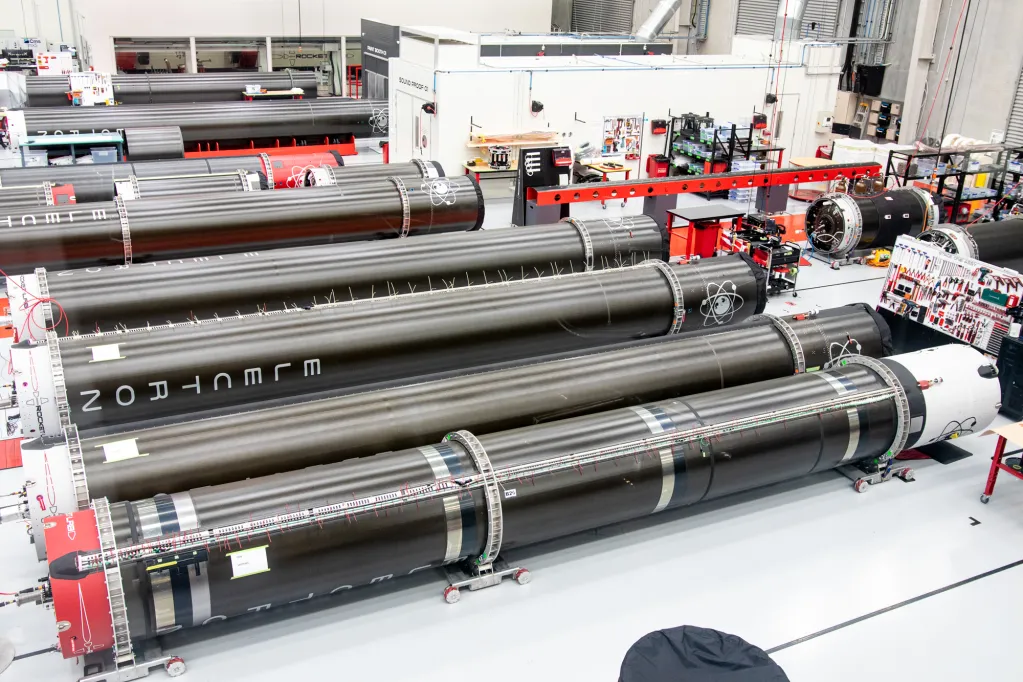
The maiden flight It’s A Test was launched on May 25, 2017, from Rocket Lab’s Launch Complex-1 (LC-1) in New Zealand. On this mission, a failure in the ground communication system occurred, which resulted in the loss of telemetry. Even though the company had to manually terminate the flight, there was no larger issue with the vehicle itself. Since then, Electron has flown a total of 43 times (39 of them were fully successful) and delivered 176 satellites into orbit.
First And Second Stage
| First Stage | Second Stage | |
|---|---|---|
| Engine | Nine (9) Rutherford engines | One (1) vacuum optimized Rutherford engine |
| Thrust Per Engine | 24 kN (5,600 lbf) | 25.8 kN (5,800 lbf) |
| Specific Impulse (ISP) | 311 s | 343 s |
Electron’s first stage is composed of linerless common bulkhead tanks for propellant, and an interstage, and powered by nine sea-level Rutherford engines. The second stage also consists of tanks for propellant (~2,000 kg of propellant) and is powered by a single vacuum optimized Rutherford engine. The main difference between these two variations of the Rutherford engine is that the latter has an expanded nozzle that results in improved performance in near-vacuum conditions.
For the Love At First Insight mission, the company introduced an update to the second stage by stretching it by 0.5 m. Moreover, they flew an Autonomous Flight Termination System (AFTS) for the first time.
Rutherford Engine
Rutherford engines are the main propulsion source for Electron and were designed in-house, specifically for this vehicle. They are running on rocket-grade kerosene (RP-1) and liquid oxygen (LOx). There are at least two things about the Rutherford engine that make it stand out.
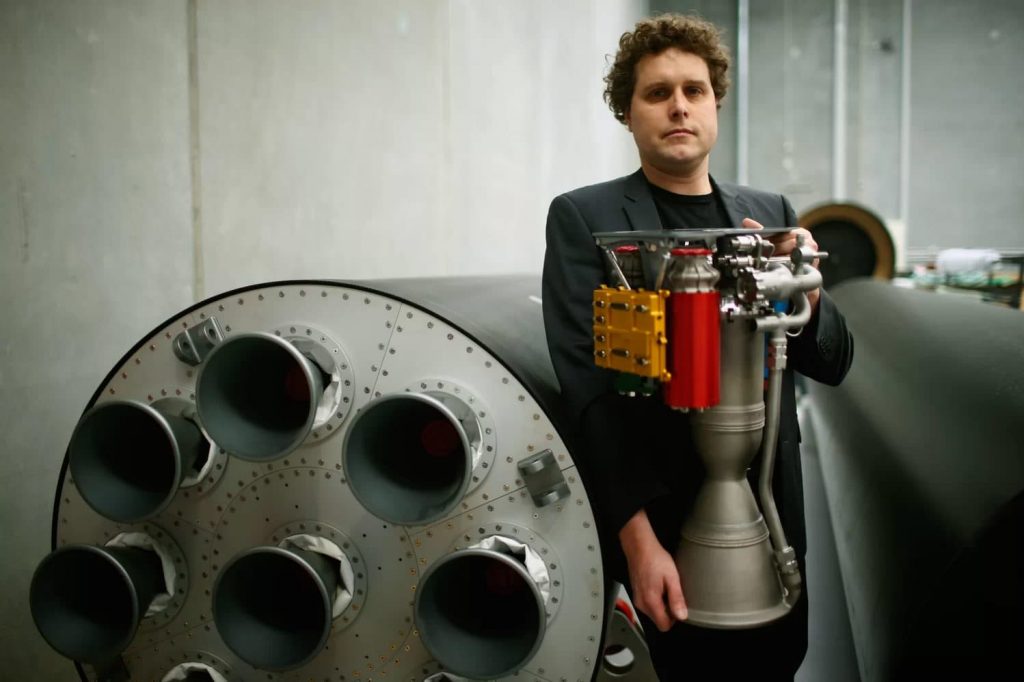
Firstly, all primary components of Rutherford engines are 3D printed. Main propellant valves, injector pumps, and engine chamber are all produced by electron beam melting (EBM), which is one of the variations of 3D printing. This manufacturing method is cost-effective and time-efficient, as it allows to fabricate a full engine in only 24 hours.
Rutherford is the first RP-1/LOx engine that uses electric motors and high-performance lithium polymer batteries to power its propellant pumps. These pumps are crucial components of the engine as they feed the propellants into the combustion chamber, where they ignite and produce thrust. However, the process of transporting liquid fuel and oxidizer into the chamber is not trivial. In a typical gas generator cycle engine, it requires additional fuel and complex turbo-machinery just to drive those pumps. Rocket Lab decided to use battery technology instead, which allowed eliminating a lot of extra hardware without compromising the performance.
Different Third Stages
Kick Stage
Electron has optional third stages, also known as the Kick Stage, Photon, and deep-space version of Photon. The Kick Stage is powered by a single Curie engine that can produce 120 N of thrust. Like Rutherford, it was designed in-house and is fabricated by 3D printing. Apart from the engine, the Kick Stage consists of carbon composite tanks for propellant storage and 6 reaction control thrusters.
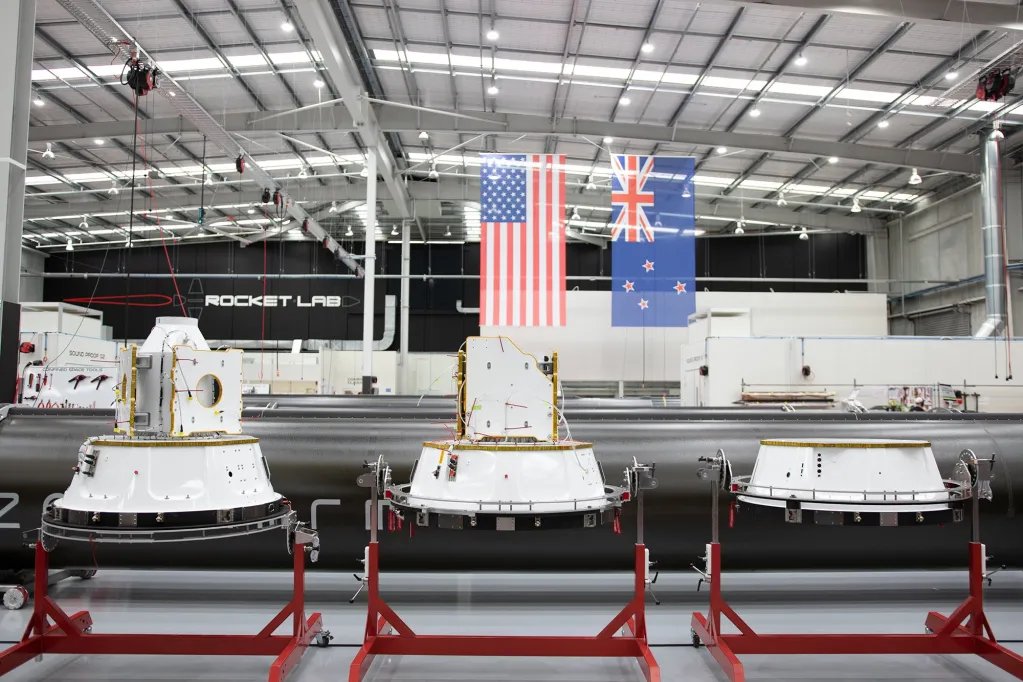
The Kick Stage in its standard configuration serves as in-space propulsion to deploy Rocket Lab’s customers’ payloads to their designated orbits. It has re-light capability, which means that the engine can re-ignite several times to send multiple payloads into different individual orbits. A recent example includes Electron 19th mission, They Go Up So Fast, launched in in 2021. The Curie engine was ignited to circularize the orbit, before deploying a payload to 550 km. Curie then re-lighted to lower the altitude to 450 km, and the remaining payloads were successfully deployed.
Photon And Deep-space Photon
Rocket Lab offers an advanced configuration of the Kick Stage, its Photon satellite bus. Photon can accommodate various payloads and function as a separate operational spacecraft supporting long-term missions. Among the features that it can provide to satellites are power, avionics, propulsion, and communications.
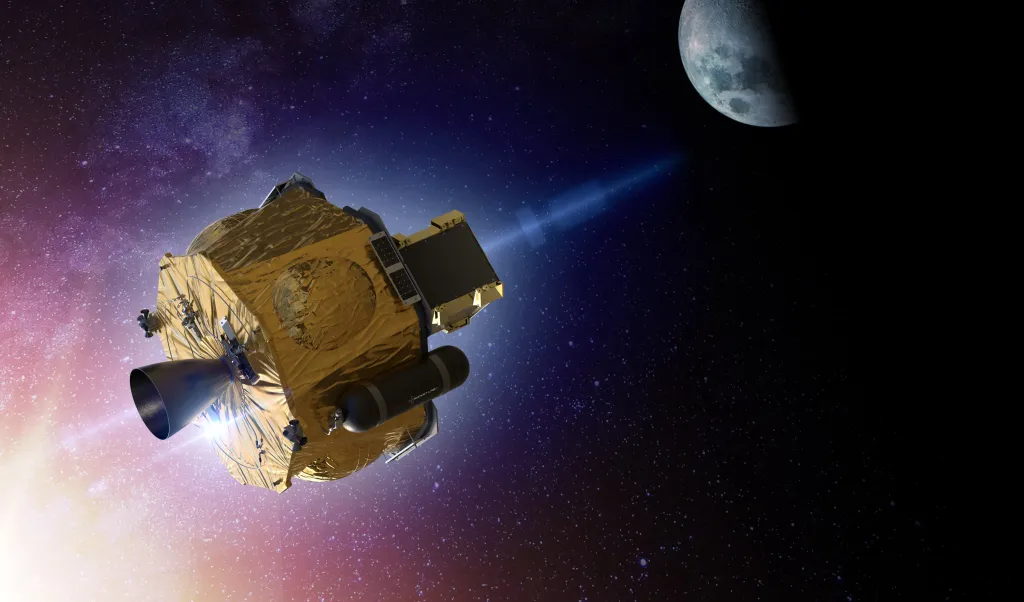
But there is more to it. Photon also comes as a deep-space version that will carry interplanetary missions. It is powered by a HyperCurie engine, an evolution of the Curie engine. The HyperCurie engine is electric pump-fed, so it can use solar cells to charge up the batteries in between burns. It has an extended nozzle to be more efficient than the standard Curie, and runs on some “green hypergolic fuel” that Rocket Lab has not yet disclosed.


