


Featured Image: SpaceX
Liftoff Time | February 20, 2024 – 20:11 UTC | 15:11 EST |
|---|---|
Mission Name | HTS-113BT |
Launch Provider | SpaceX |
Customer | PT Telkom Satelit Indonesia (Telkomsat) |
Rocket | Falcon 9 Block 5, booster B1067-17 |
Launch Location | Space Launch Complex 40 (SLC-40), Cape Canaveral SFS, Florida, USA |
Payload mass | ~ 4,000 kg (8818 lb) |
Where is the spacecraft going? | Geostationary Transfer Orbit |
Will they be attempting to recover the first stage? | Yes |
Where will the first stage land? | Just Read The Instructions |
Will they be attempting to recover the fairings? | Yes |
Are these fairings new? | Yes |
This will be the: | – 302nd Falcon 9 launch – 16th Falcon 9 mission of 2024 – 16th launch for SpaceX in 2024 – 316th SpaceX mission – 35th orbital launch attempt of 2024 |
Where to watch | Official livestream |
What Does All This Mean?
SpaceX is set to launch HTS-113BT, an Indonesian telecommunications satellite, atop a Falcon 9 rocket. The Falcon 9 will lift off from Space Launch Complex 40 (SLC-40) at Cape Canaveral Space Force Station, in Florida.
How Did It Go?
This mission was fully successful; the booster successfully landed and the payload was placed into the correct orbit.
HTS-113BT
HTS-113BT is a telecommunications satellite in C-band/Ku-Band which will provide over 32 Gbps capacity over Indonesia. It is operated by PT Telkom Satelit Indonesia (Telkomsat), a state-owned digital telecommunication company in Indonesia, and has an expected lifetime of 15 years. The satellite is built on Thales Alenia Space’s Spacebus 4000B2 platform and will weigh about 4,000 kg (8818 lb) at launch.
What Is Falcon 9 Block 5?
The Falcon 9 Block 5 is SpaceX’s partially reusable two-stage medium-lift launch vehicle. The vehicle consists of a reusable first stage, an expendable second stage, and, when in payload configuration, a pair of reusable fairing halves.
First Stage
The Falcon 9 first stage contains nine Merlin 1D+ sea-level engines. Each engine uses an open gas generator cycle and runs on RP-1 and liquid oxygen (LOx). Each engine produces 845 kN of thrust at sea level, with a specific impulse (ISP) of 285 seconds, and 934 kN in a vacuum with an ISP of 313 seconds. Due to the powerful nature of the engine, and the large amount of them, the Falcon 9 first stage is able to lose an engine right off the pad, or up to two later in flight, and be able to successfully place the payload into orbit.
The Merlin engines are ignited by triethylaluminum and triethylborane (TEA-TEB), which instantaneously burst into flames when mixed in the presence of oxygen. During static fire and launch the TEA-TEB is provided by the ground service equipment. However, as the Falcon 9 first stage is able to propulsively land, three of the Merlin engines (E1, E5, and E9) contain TEA-TEB canisters to relight for the boost back, reentry, and landing burns.
Second Stage
The Falcon 9 second stage is the only expendable part of the Falcon 9. It contains a singular MVacD engine that produces 992 kN of thrust and an ISP of 348 seconds. The second stage is capable of doing several burns, allowing the Falcon 9 to put payloads in several different orbits.
For missions with many burns and/or long coasts between burns, the second stage is able to be equipped with a mission extension package. When the second stage has this package it has a grey strip, which helps keep the RP-1 warm, an increased number of composite-overwrapped pressure vessels (COPVs) for pressurization control, and additional TEA-TEB.
Falcon 9 Booster
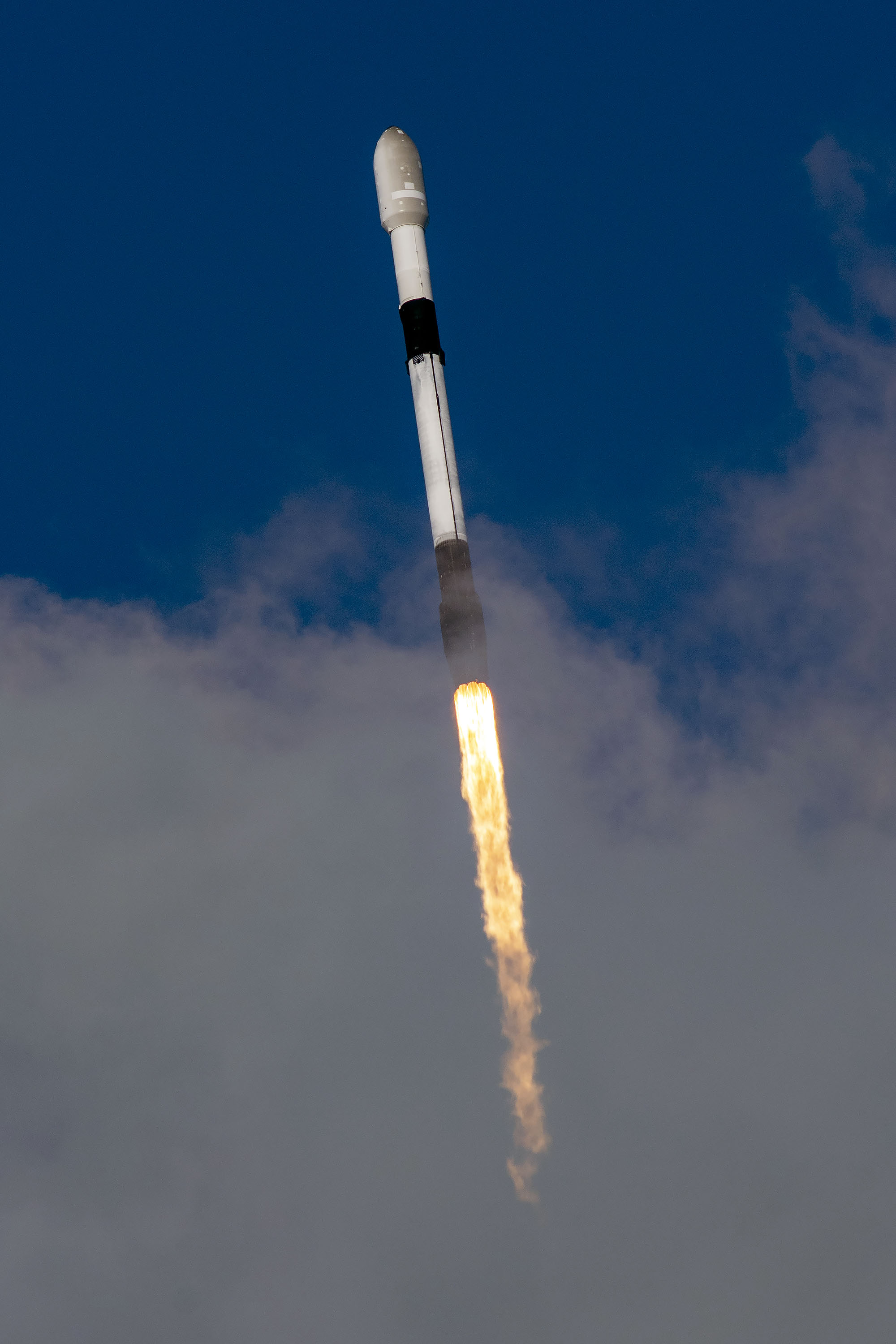
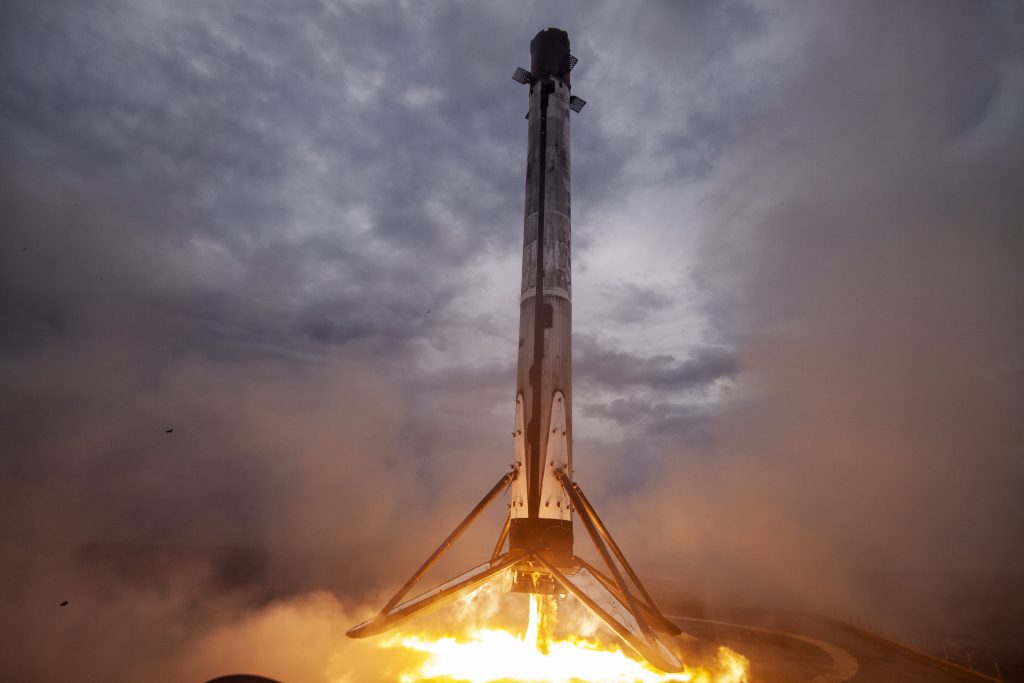
The booster supporting the HTS-113BT mission is B1067-17; as the name implies, the booster has supported 16 previous missions. Following the landing, its designation will change to B1067-18.
| B1067’s previous missions | Launch Date (UTC) | Turnaround Time (Days) |
|---|---|---|
| Dragon CRS-2 SpX-22 | June 03, 2021, 17:29 | N/A |
| Crew-3 | November 11, 2021, 02:03 | 160.36 |
| Türksat 5B | December 19, 2021, 03:58 | 38.08 |
| Crew-4 | April 27, 2022, 07:52 | 129.16 |
| Dragon CRS-2 SpX-25 | July 15, 2022, 00:44 | 78.70 |
| Starlink Group 4-34 | September 19, 2022, 00:18 | 65.98 |
| Hotbird 13G | November 03, 2022, 05:22 | 45.13 |
| O3b mPOWER 1&2 | December 16, 2022, 22:38 | 43.72 |
| Starlink Group 5-2 | January 26, 2023, 9:32 | 40.45 |
| Starlink Group 5-5 | March 24, 2023 15:43 | 57.26 |
| Starlink Group 5-9 | May 14, 2023 05:03 | 50.56 |
| Satria | June 18, 2023 22:21 | 35.72 |
| Starlink Group 6-10 | August 17, 2023 03:36 | 59.22 |
| Starlink Group 6-22 | October 13, 2023 23:01 | 57.81 |
| Starlink Group 6-29 | November 22, 2023 07:47 | 39.37 |
| Starlink Group 6-35 | January 07, 2024 22:35 | 46.67 |
Following launch, the Falcon 9 booster will conduct three burns. These burns aim to softly touch down the booster on Just Read The Instructions.
Falcon 9 Fairings
The Falcon 9’s fairing consists of two dissimilar reusable halves. The first half (the half that faces away from the transport erector) is called the active half, and houses the pneumatics for the separation system. The other fairing half is called the passive half. As the name implies, this half plays a purely passive role in the fairing separation process, as it relies on the pneumatics from the active half.
Both fairing halves are equipped with cold gas thrusters and a parafoil which are used to softly touch down the fairing half in the ocean. SpaceX used to attempt to catch the fairing halves, however, at the end of 2020 this program was canceled due to safety risks and a low success rate.
In 2021, SpaceX started flying a new version of the Falcon 9 fairing. The new “upgraded” version has vents only at the top of each fairing half, by the gap between the halves, whereas the old version had vents placed spread equidistantly around the base of the fairing. Moving the vents decreases the chance of water getting into the fairing, making the chance of a successful scoop significantly higher.


HTS-113BT’s Countdown
All times are approximate
| HR/MIN/SEC | EVENT |
|---|---|
| 00:38:00 | SpaceX Launch Director verifies go for propellant load |
| 00:35:00 | RP-1 (rocket grade kerosene) loading begins |
| 00:35:00 | 1st stage LOX (liquid oxygen) loading begins |
| 00:16:00 | 2nd stage LOX loading begins |
| 00:07:00 | Falcon 9 begins pre-launch engine chill |
| 00:05:00 | Dragon transitions to internal power |
| 00:01:00 | Command flight computer to begin final prelaunch checks |
| 00:01:00 | Propellant tanks pressurize for flight |
| 00:00:45 | SpaceX Launch Director verifies go for launch |
| 00:00:03 | Engine controller commands engine ignition sequence to start |
| 00:00:00 | Falcon 9 liftoff |


One topic of all the cam chats for launches from the Cap is the trajectory/azimuth the rocket is expected to take. That might be really nice info to include in the discussions. Thanks!