


Featured image credit: Firefly
Launch Time | December 22, 2023 – 17:32:30 UTC | 09:32:30 PST |
|---|---|
Mission Name | FLTA004 Fly the Lightning |
Launch Provider | Firefly Aerospace |
Customer | Lockheed Martin |
Rocket | Alpha |
Launch Location | SLC-2, Vandenberg Space Force Base, USA |
Payload mass | Between 250 kg and 380 kg (551-838 lbs) |
Where did the satellite go? | Low Earth orbit at ~159° inclination |
Did they attempt to recover the first stage? | No, this is not a capability of Alpha |
Where did the first stage land? | It will splash down in the Pacific Ocean |
Did they attempt to recover the fairings? | No, this is not a capability of Alpha |
Were these fairings new? | Yes |
This was the: | – 4th launch of Alpha – 4th launch for Firefly – 2nd launch of Firefly in 2023 – 210th orbital launch of 2023 |
Where to re-watch | Official Livestream NSF Livestream (in collaboration with Firefly) |
What Does All This Mean?
Firefly Aerospace will launch their Alpha rocket for the second time in 2023 and for the fourth time in total. This time with a single satellite for Lockheed Martin on the Fly the Lightning mission. This one satellite will be a wideband Electronically Steerable Antenna (ESA) payload demonstrator. It will further showcase both Firefly’s responsive space capabilities after their record breaking Victus Nox mission, and Lockheed Martin’s commitment to perform missions faster once on orbit.

How Did It Go?
Firefly launched their rocket at 17:32:30 UTC (09:32:30 PST), about 14 minutes into their launch window. After about two and a half minutes of nominal first stage burn, MECO occured and the two stages separated. The second stage relit and propelled the payload into a nominal parking orbit. At T+49 minutes the second stage was supposed to relight, but failed to do so. The reason for the second stage failure is unclear, leaving the payload in a lower than planned orbit, where it will likely burn up during reentry way sooner than expected. It is unclear if this off-nominal orbit and the limited on-orbit time will be enough for Lockheed Martin to test out its satellite and the ESA payload.
Fly the Lightning
Fly the Lightning features one single satellite called Tantrum for Lockheed Martin. Their wideband Electronically Steerable Antenna (ESA) featured on Tantrum is a technology demonstrator, which aims to enable Lockheed Martin to perform quicker sensor calibrations compared to traditional sensors. This will result in a much faster on-orbit commissioning and will deliver rapid capabilities to U.S. warfighters.
Lockheed Martin Space’s Ignite organization developed their ESA payload with the aim of scalability and possible mass production, to support Lockheed Martin’s customers’ significantly increased operational tempo. This ESA payload was realized in just 24 months from early architecture to flight-ready hardware.
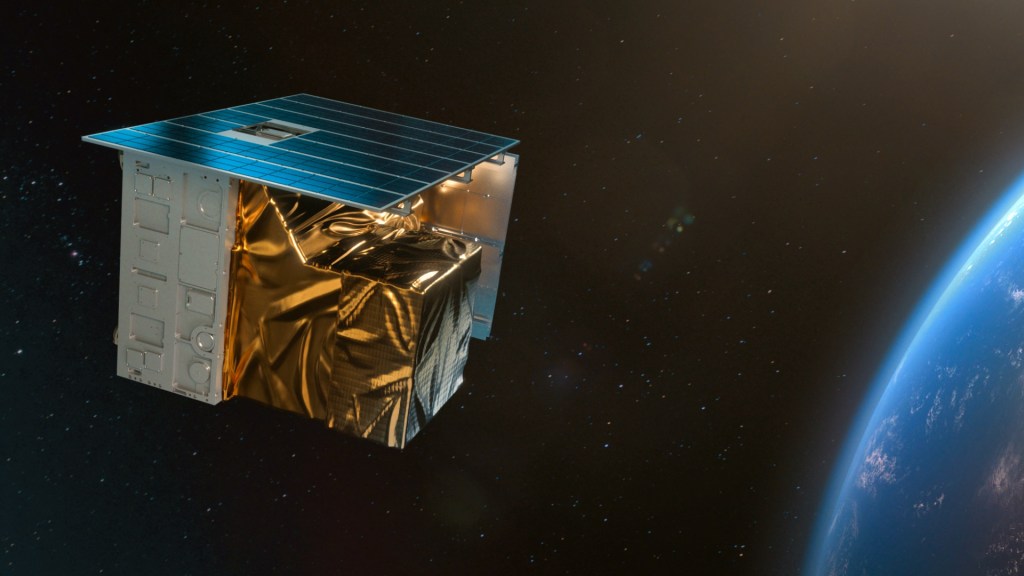

Tantrum will be hosted on a Terran Orbital Nebula satellite bus. This satellite bus has a maximum launch mass (wet) of 250 kg, with room for up to 130 kg of payload. It features a hall effect propulsion system with an ISP of 2150s and a thrust of 1.1 mN. Depending on the configuration, its solar arrays can produce up to 1 kW of power and are either fixed or deployable. It also features reaction wheels, magnetorquers, star trackers, a gyro assembly and GPS to provide attitude control for the payload.
Fly the Lightning Mission Profile
Launch
| Hrs:Min:Sec From Lift-Off | Events |
| -00:00:02 | Stage 1 ignition |
| 00:00:00 | Liftoff |
| +00:00:56 | Vehicle Supersonic |
| +00:01:07 | Max Q |
| +00:02:33 | Main Engine Cut Off (MECO) |
| +00:02:35 | Stage 1 separates from Stage 2 |
| +00:02:38 | Stage 2 Ignition #1 |
| +00:03:04 | Fairing Separation |
| +00:08:16 | Second Engine Cut Off (SECO) |
| +00:49:28 | Stage 2 Ignition #2 |
| +00:49:38 | Second Engine Cut Off (SECO) #2 |
| ~+00:54:34 | Payload Deployment |

Firefly Aerospace
Firefly Aerospace Inc. (“Firefly”) is an American end-to-end space transportation company committed to providing economical and convenient access to space for small payloads through the design, manufacture, and operation of reliable launch and spacecraft vehicles. Firefly’s launch vehicles utilize common technologies, manufacturing infrastructure, and launch capabilities, providing LEO launch solutions for up to ten metric tons of payload in the future. Combined with Firefly’s in-space vehicles, such as the Space Utility Vehicle (SUV) and Blue Ghost Lunar Lander, Firefly provides the space industry with a single source for missions from LEO to the surface of the Moon or beyond. Firefly is headquartered in Cedar Park, TX.
Alpha
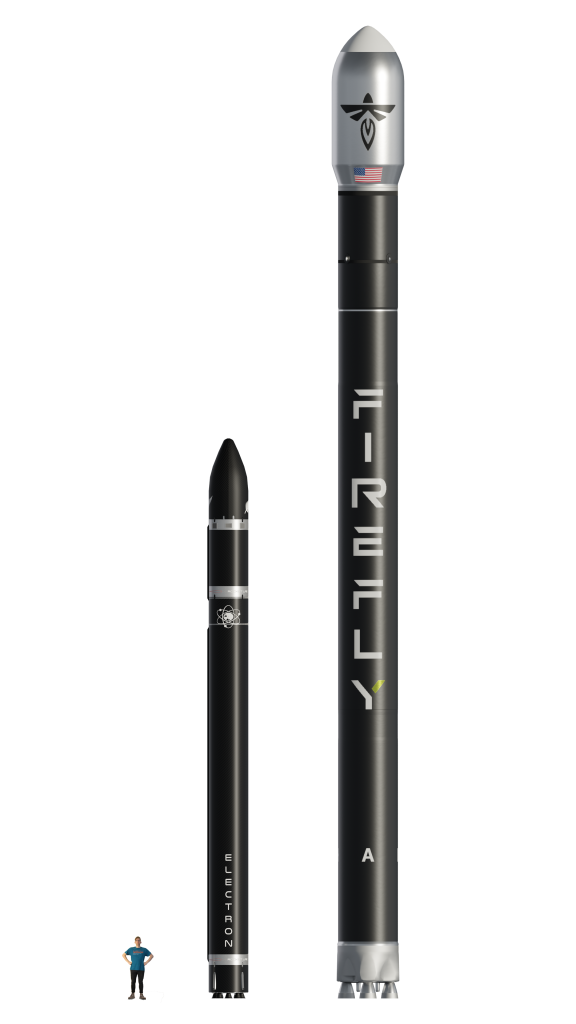
Alpha is a small lift launch vehicle developed and built by Firefly Aerospace. With a payload capacity of 1,030 kg and 630 kg to a 300 km LEO at 28.5° inclination and a 500 km SSO, respectively, Alpha is one of the biggest small lift launch vehicles. It is a two stage liquid-fueled Rocket utilizing highly refined kerosene (RP-1) and liquid oxygen (LOx) as fuel and oxidizer. Alpha stands a total of 29.48 m (~96.7 ft) tall while being 1.8 m (~71 in) in diameter with a 2.21 m (~87 in) fairing. The rocket is entirely made from advanced carbon-fiber composite, which results in a lighter, but still strong vehicle, able to lift more payload than comparable rockets made from metal.
Stage 1
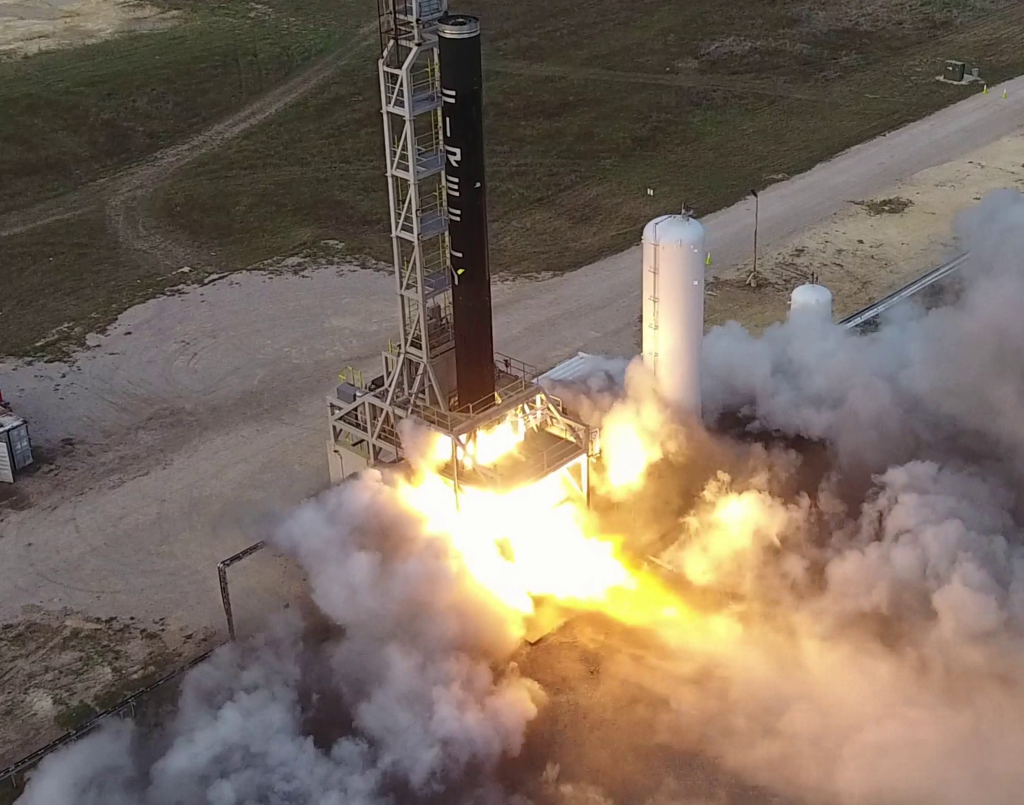
Alpha’s first stage is powered by four Reaver 1 engines producing a total of 736.1 kN (~165,000 lbf) at lift off. The Reaver 1 engine is a “simple” combustion tap-off cycle engine where hot exhaust gasses are driving a single-shaft turbo pump, which feeds the engine with propellants. This makes the engine relatively simple, but also complicated to start. During this complicated start up procedure, Firefly uses TEA-TEB as an ignition fluid, which causes the green flame at start-up. This will be the first time that a tap-off cycle engine will fly on an orbital class rocket. Up until now there has only been Blue Origin’s BE-3 engine as another tap-off cycle engine that has been flown on a vehicle.
Each Reaver engine produces ~184 kN of thrust at a specific impulse (ISP) of 295.6 seconds at lift off. The maximum total thrust of the rocket is 801kN (~180,000 lbf) in a vacuum. Furthermore, each engine features single axis gimballing resulting in pitch, yaw and roll control when all four engines are combined.
Stage 2
The second stage is powered by a single Lightning 1 engine producing 70.1 kN at an ISP of 322 seconds. Furthermore, the engine’s nozzle extension gets cooled by the exhaust gas of the turbopump. Just like Reaver, Lightning is also a tap-off cycle engine and uses the same TEA-TEB as its ignition fluid.
FLTA001 DREAM Failure
Shortly after successful ignition of all four Reaver engines and a nominal lift off of Alpha, the rocket experienced a premature engine shut down of its engine two on the first stage at approximately T+14s. This was caused by a main fuel valve that closed off the fuel supply to the engine. The valve closed due to a loss of electrical signal caused by a faulty connector.
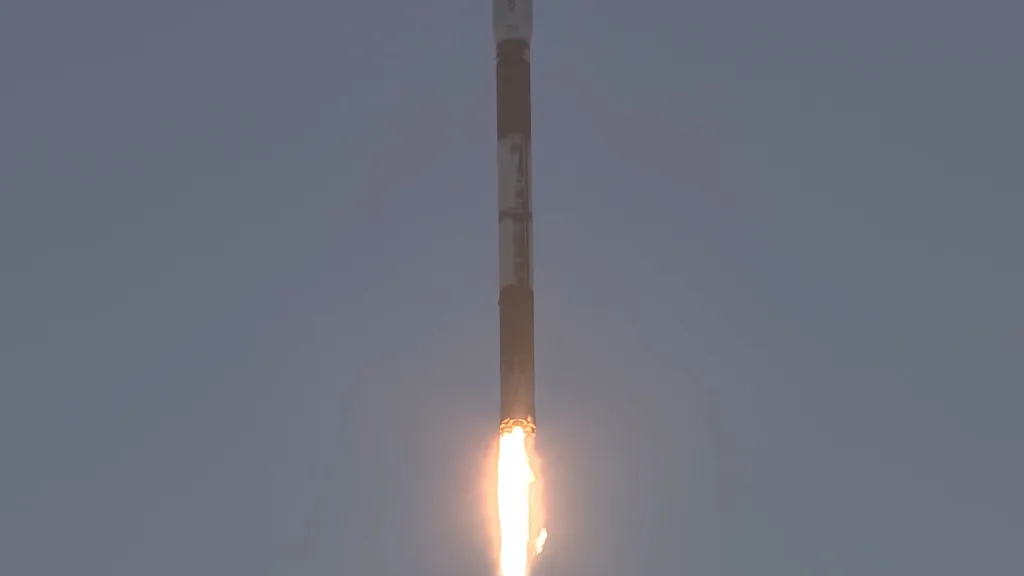
The under-powered vehicle continued to ascend accelerating gradually. At approximately T+2:16 the vehicle reached supersonic speeds. Due to the lack of control authority caused by the early engine two shut down, and the aerodynamics drastically changing in the trans-sonic environment, the vehicle tumbled out of control. The range transmitted a termination signal at T+2:27 after the rocket completed a total of one and a half somersaults.
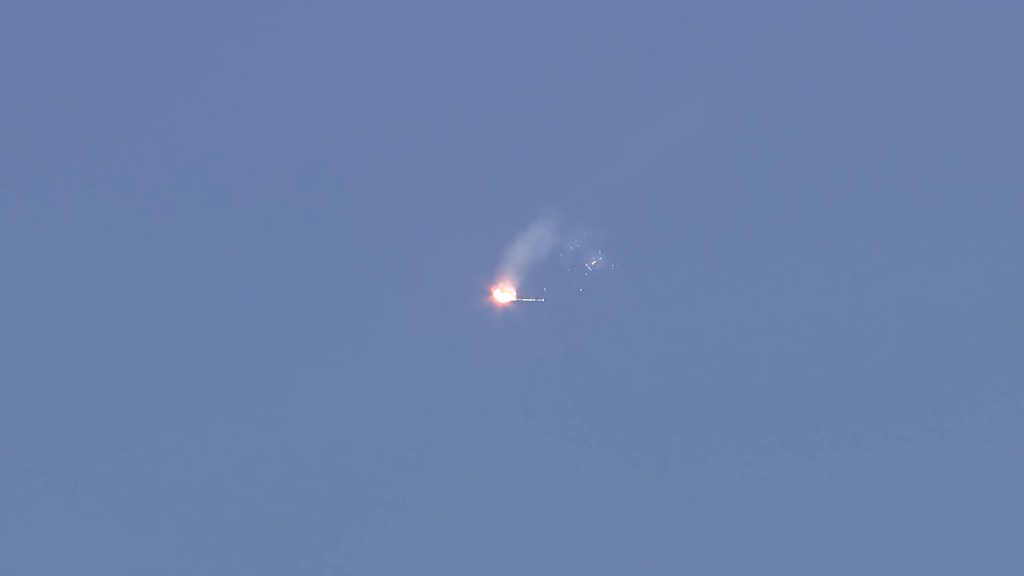
The engine section of the rocket plunged back to the ground and survived the impact in relatively good condition, allowing the teams to gather the remains and analyze the experienced anomaly. Firefly’s Alpha rocket gathered around two and a half minutes of valuable flight data that helped the teams to further improve the vehicle’s design with the aim of reaching orbit with FLTA002 To The Black. Alpha reached an altitude of approximately 15 km when the flight was terminated.

