


Featured image credit: ROSCOSMOS
Lift Off Time | December 16, 2023 – 09:17 UTC | 15:17 ALMT |
|---|---|
Mission Name | Arktika-M No.2, a meteorology and emergency communications satellite |
Launch Provider | ROSCOSMOS |
Customer | ROSCOSMOS |
Rocket | Soyuz 2.1b/Fregat-M |
Launch Location | Launch Complex 31/6, Baikonur Cosmodrome, Kazakhstan |
Payload mass | 2,100 kg (~4,630 lbs) |
Where is the satellite going? | 63.4° Molniya orbit with a perigee at ~1,000 km and an apogee at ~40,000 km |
Will they be attempting to recover the first stage? | No, this is not a capability of the Soyuz 2.1b (or any Soyuz rocket at the moment) |
Where will the first stage land? | The boosters will crash into the steppes of Kazakhstan |
Will they be attempting to recover the fairings? | No, this is not a capability of the Soyuz 2.1b (or any Soyuz rocket at the moment) |
Are these fairings new? | Yes |
This will be the: | – 6th Soyuz 2.1b mission of 2023 – 86th Soyuz 2.1b mission overall – 211th orbital launch attempt of 2023 |
Where to watch | Official livestream (if available) |
What Does All This Mean?
Lifting off on December 16, 2023 at 09:17 UTC, Arktika-M No.2 will be ROSCOSMOS’ second of ten Arktika satellites in the Arktika constellation. Launching on a Soyuz 2.1b from Launch Complex 31/6, Baikonur Cosmodrome, Kazakhstan, Arktika-M No.2 will be orbiting the Earth in a ~1,000 km x ~40,000 km Molniya orbit at an inclination of 63.4°. This is a highly elliptical orbit that enables satellites to spend significant time above a polar region.
How Did It Go?
This launch was fully successful. The satellite was successfully placed into Molniya orbit.
Arktika-M No.2
Based on the Russian Elektro-L weather-forecasting platform, Arktika-M No.2 will be the second satellite in the Arktika constellation. This follows the Arktika-M No.1 which was launched February 28, 2021. Built by NPO Lavochkin with a lifespan of five years, the meteorology satellite will feature a multispectral imager known as MSU-GSM that will help improve weather forecasts of the arctic region. Furthermore, Arktika-M No.2 will help scientists monitor the arctic region to better understand and study climate change. The satellite is also equipped with transmitters that will provide communication for emergency services.

Initially planned to launch in 2015, the Arktika-M No.1 mission was delayed multiple times due to vendors not delivering instruments in time, and awaiting validation of components flown on other missions. The Arktika-M No.1 mission was finally launched February 28, 2021.
In order to serve as a meteorology satellite for the arctic region, Arktika-M No.2 will be launched into a special highly elliptical orbit called Molniya. With a perigee at around 1,000 km, an apogee at around 40,000 km, and an inclination of 63.4°, this so-called Molniya orbit will enable the satellite to monitor and image the arctic region at a high angle of view and for long periods of its orbit. After launch, the thrusters of the service module of the satellite will slowly adjust its orbit by raising its apogee.

The Arktika Constellation
First mentioned on governmental levels in late 2007, the Arktika constellation is planned to consist of ten satellites with four different variants in different orbits. The different variants being:
- Arktika-M
- Arktika-MS1
- Arktika-MS2
- Arktika-R
Arktika-M
The first two Arktika satellites launching will be Arktika-M satellites. These satellites will go to a Molniya orbit and are dedicated meteorology satellites that will provide weather forecasts and communication for emergency services.
Arktika-MS1
The sub-constellation of Arktika-MS1 satellites will consist of three communication satellites that will also be placed in a Molniya orbit. Different to the Arktika-M satellites, MS1 satellites will have an apogee of around 50,000 km, boosting the orbital period to 24 hours. They represent the commercial part of the constellation and are being built by OOO Gazprom Kosmicheskie Sistemy. MS-1 satellites will add communication capacity to the Polyarnaya Zvezda (Polar Star) network.
Arktika-MS2
The sub-constellation of Arktika-MS2 satellites will consist of three communication satellites that will also be placed in a Molniya orbit. Arktika-MS2 satellites will also have an apogee of around 50,000 km to achieve an orbital period of 24 hours. They will be used by governmental bodies, for air-traffic control purposes and to relay navigational signals of the American GPS and Russian GLONASS global navigation systems.
Arktika-R
There are two Arktika-R remote sensing satellites planned to be launched into 550 km x 750 km Sun-synchronous orbits. These satellites will feature a 9.5 to 9.8 GHz radar antenna that will be able to either capture detailed ground images with a 450 km field of view, or less detailed images with a field of view of 600 km.
| Arktika-M | Arktika-MS1 | Arktika-MS2 | Arktika-R | |
|---|---|---|---|---|
| Number of satellites | 2 | 3 | 3 | 2 |
| Purpose | meteorology, emergency communication | commercial communication | government communication, air-traffic control, GPS & GLOSNASS signal relay | remote sensing radar |
| Orbit | Molniya | Molniya | Molniya | Sun-synchronous (SSO) |
What Is The Soyuz 2.1b?
Introduced in 1966, the Soyuz rocket (also known as R7) has been the workhorse of the Soviet/Russian space program. The first launch of the Soyuz 2.1a, on November 8, 2004 from the Plesetsk Cosmodrome, represented a major step in the Soyuz launch vehicle’s development program.
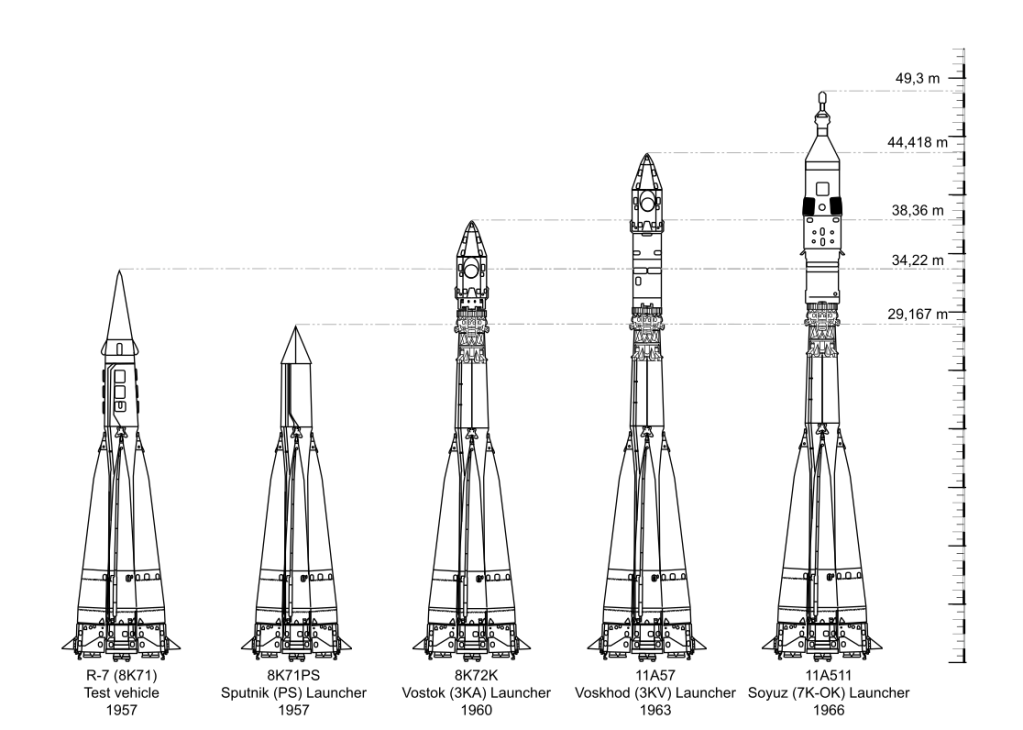
The Soyuz version currently being used for most satellite launches is a four-stage launch vehicle, that consists of:
- four side boosters
- a central core booster
- an upper (central) stage which is common to all Soyuz rockets regardless of payload
- an optional Fregat upper stage
Side Boosters
Each side booster has a singular RD-107A engine, which runs on liquid oxygen and RP1. The RP-1 tanks are located in the cylindrical part of the booster, and the liquid oxygen tanks are in the conical section. Each engine has four combustion chambers and four nozzles, which is common in older Russian engines as the USSR could not solve the problem of combustion instability in large nozzles.
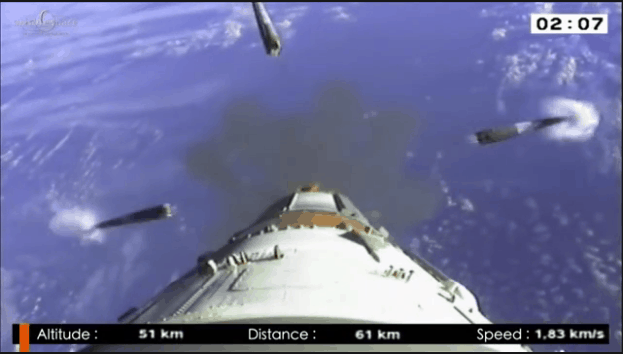
During side booster separation, the boosters perform a well-known pattern, in which they peel off and cartwheel outwards. This is known as the “Korolev cross,” named after Sergei Korolev, the Chief Design Engineer of the USSR space program in the 1960s.
Soyuz Center Core
The center core is fitted with an RD-108A engine, which also has four combustion chambers and four nozzles. The engine contains four attitude thrusters, used for three-axis flight control once the side boosters have separated. The center core also runs on RP1 and LOx.
Third Stage
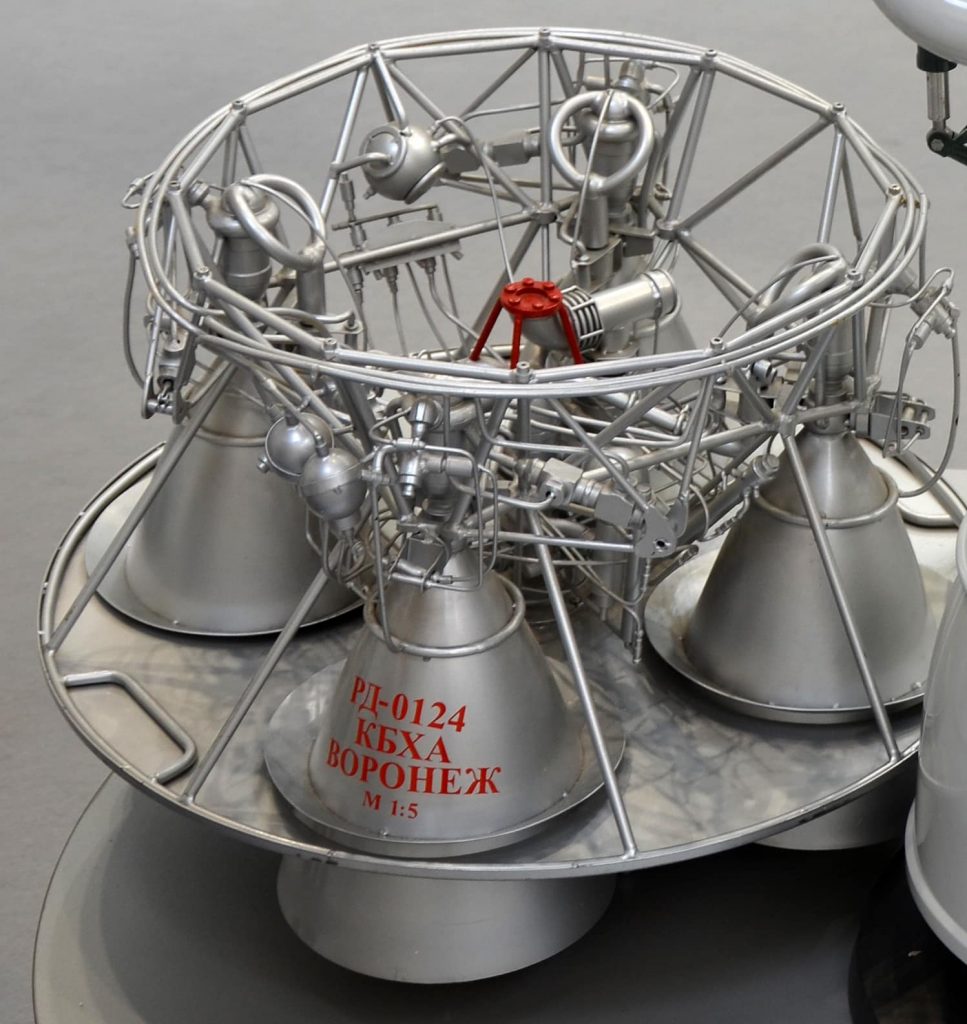
The third stage uses an RD-0124 engine on the 2.1b (ST-B) version. This closed cycle engine once again runs on LOx and RP1, producing 294 kN of thrust, and having an ISP of 359 seconds.
Soyuz Fregat Upper Stage
Flight qualified in 2000, the Fregat upper stage is an autonomous and flexible stage that is designed to operate as an orbital vehicle. It extends the Soyuz launcher’s capability, now covering a full range of orbits (LEO, SSO, MEO, GTO, GEO and Earth escape). Fregat is independent of all the other stages, as it has its own guidance, navigation, attitude control, tracking, and telemetry systems. The engine burns storable propellants – UDMH (unsymmetrical dimethylhydrazine) and NTO (nitrogen tetroxide) – and can be restarted up to 50 times in flight so that it can carry out very complex missions.
The Fregat upper stage is encapsulated in a fairing with the payload and a payload adaptor/dispenser. It is entirely independent from the rest of the rocket, having its own systems on board for guidance, navigation and control. It also provides its own telemetry data back to the ground.
Fregat uses the S5.92 engine, which uses unsymmetrical dimethyl hydrazine (UDMH) as fuel and nitrogen tetroxide (NO4) as an oxidizer. The propellent is hypergolic, which means they combust on contact.

