

By Tim Dodd, the Everyday Astronaut. Web version by Joey Schwartz
Imagine for a second, a simple conversion error from Metric to Imperial units. Now imagine that this error caused a multi-million dollar mission to go puff! A video released by Everyday Astronaut this week looks at how NASA lost the Mars Climate Orbiter in 1999. Both the video and this article explore how NASA’s team made a math boo-boo. It cost them the mission just as it approached Mars.

Introduction
Have you ever accidentally used a tablespoon instead of a teaspoon? Or maybe grabbed a metric wrench when you were trying to loosen a 9/16ths inch bolt? Maybe you’ve heard someone say something weighs a tonne and have had to ask, a short ton or a metric tonne?
Luckily when you and I mix up units it likely only makes our food taste bad, or strips a bolt, or leads to an annoying argument about which is the right measurement system. But when NASA and Lockheed Martin mixed up units for the Mars Climate Orbiter, it led to the loss of a $327 million mission to Mars.
Welcome to another episode of the Biggest Facepalms of Spaceflight history, otherwise known as spacepalms. This is where we will look at a mission or an event that led to everyone in mission control collectively face palming.
Now this is a well-known story, one you may have heard your physics professor regale you with when talking about the importance of units. But honestly, I don’t think I’ve ever heard the whole story told right, and I definitely didn’t know what happened before writing this article!
So, let’s look at the planned mission, versus what wound up happening and why. It is a classic lesson that will live on for generations. And it’s a fun story to tell, so let’s get started!
Party Like It’s 1999: Mars Climate Observer Mission Overview
The year is 1999. Back when websites looked like a Commodore 64’s display on steroids. The Matrix was playing on movie screens across North America. Cher’s song “Believe” was a number one hit. And NASA was hoping to have a big hit on their hands with an exciting new Mars orbiter. That space probe would study the Martian climate. But, we knew it as, you guessed it, the Mars Climate Orbiter.
Faster, Better, Cheaper
Under administrator Daniel Goldin, a 1994 panel on Small Spacecraft Technology set new guidelines for NASA interplanetary missions. The informal and popular name for this new ethos was “faster, better, cheaper.”
Goldin’s doctrine meant probes were to be less expensive and smaller to allow for more missions and higher launch cadences. These new probes would be under 1,000 kilograms, with fewer but more focused scientific instruments. This differed from the previous “Swiss Army Knife” approach of cramming every instrument possible into a probe.
Mars Global Surveyor
Mars Global Surveyor was the first mission in this new program. It was launched in 1996 on a Delta II rocket from SLC-17A, Cape Canaveral Air Force Station, now known as Cape Canaveral Space Force Station. This first probe would map the surface of Mars with more detail than ever before which would help pave the way for future Mars landers.
Mars Climate Orbiter
The Mars Climate Orbiter was to follow the success of the Mars Global Surveyor. It would take with it instruments designed first for the Mars Global Surveyor. The two would be a mini-powerhouse for studying Mars from orbit.
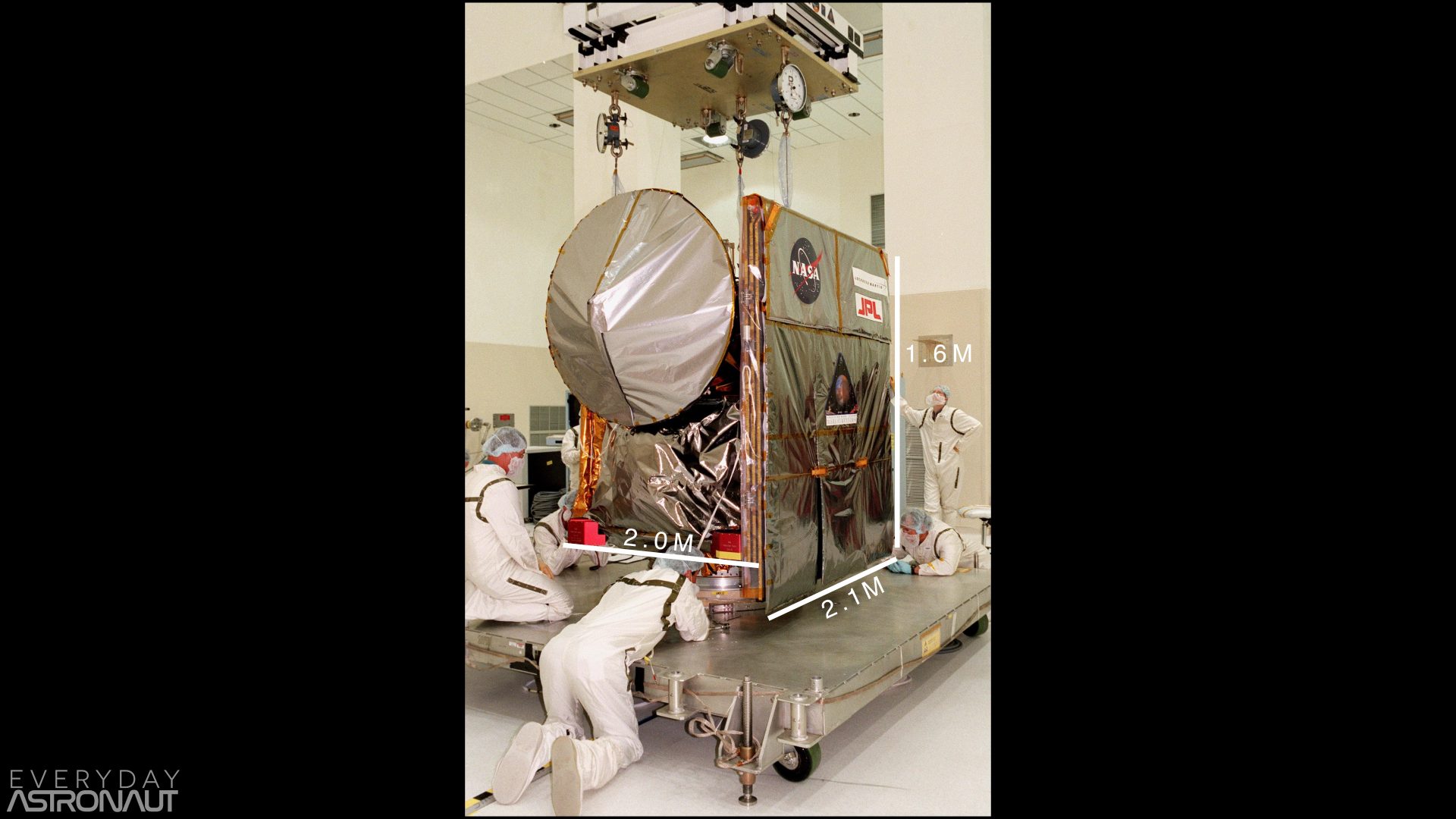

The spacecraft wound up being 2.1 meters wide (6’9”), 1.6 meters tall (5’3”) and two meters deep (6’6”). It would weigh only 638 kilograms making it capable of being launched on a Delta II with only four solid rocket boosters.
But despite its negligible weight it still carried loads of instruments. These scientific instruments included:
- Mars Orbiter Camera
- Mars Orbiter Laser Altimeter
- Thermal Emissions Spectrometer
- Magnetometer and electron reflectometer
- The Ultrastable Oscillator
- One Mars Relay signal receiver
Propulsion Systems: Mars Climate Orbiter
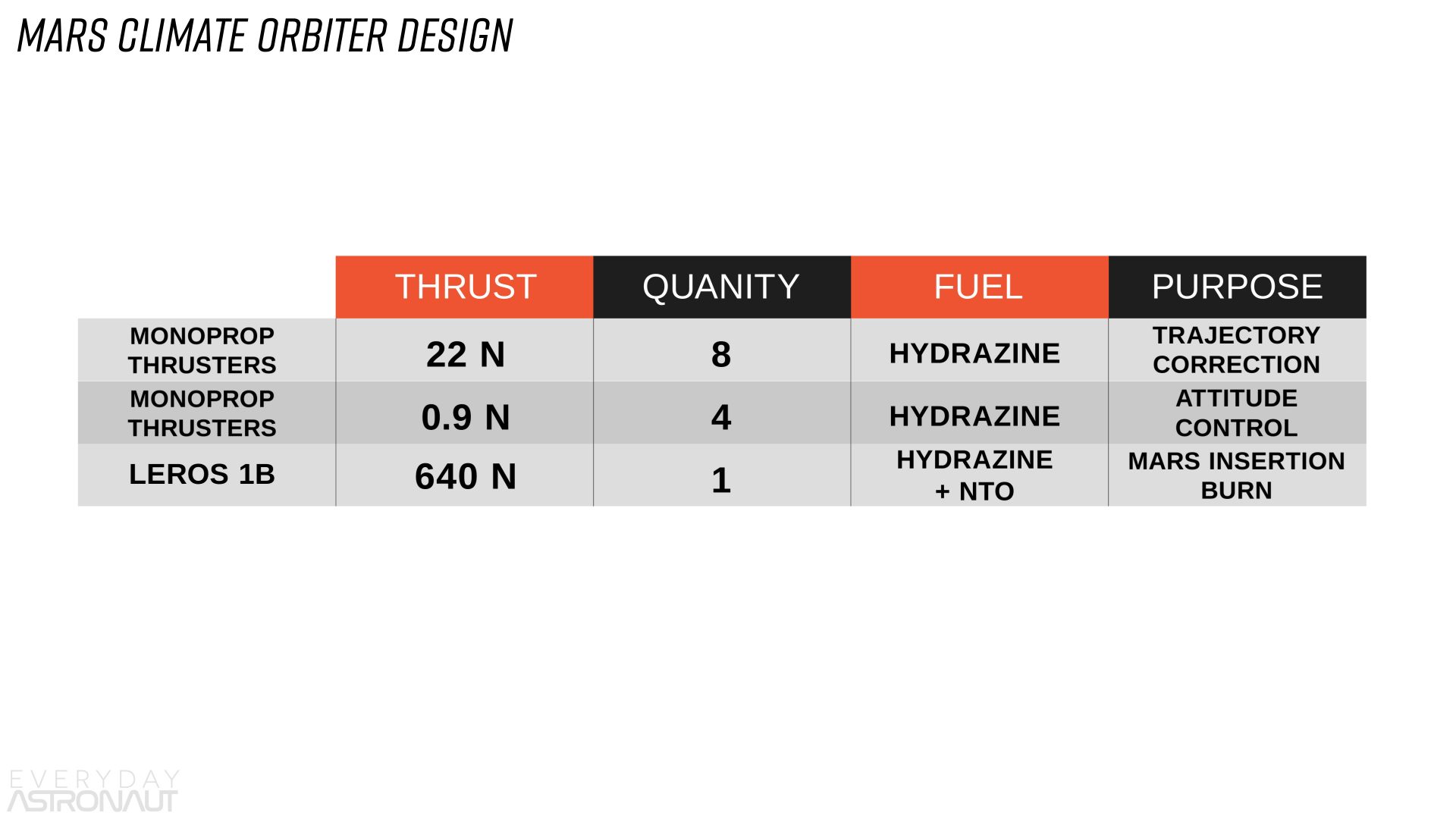
The vehicle had eight mono-propellant thrusters. Each thruster had 22 Newtons (4.9 lbs) of thrust for trajectory corrections and four smaller 0.9 Newtons (3.2 oz) thrusters for attitude control. Last, but not least, it had one larger main engine, a LEROS 1B. It provided 640 Newtons (140 lbs) of thrust for the Mars insertion burn.
Single Solar Panel Design
Mars Climate Orbiter had a unique design, having only a single large solar panel off to one side capable of 500 watts at Mars. A side note, Mars is 50 percent further away from the sun than the Earth is. Because of the square inverse law, a solar panel on Mars is about 45 percent as powerful as it is on Earth.
Mars Climate Orbiter’s Launch and Mars Injection Burn
Showtime for the big launch was December 11, 1998. At 18:45 UTC, the Mars Climate Orbiter launched from Cape Canaveral Air Force Station’s SLC-17A. With its successful launch, it began its 10-month journey to Mars.
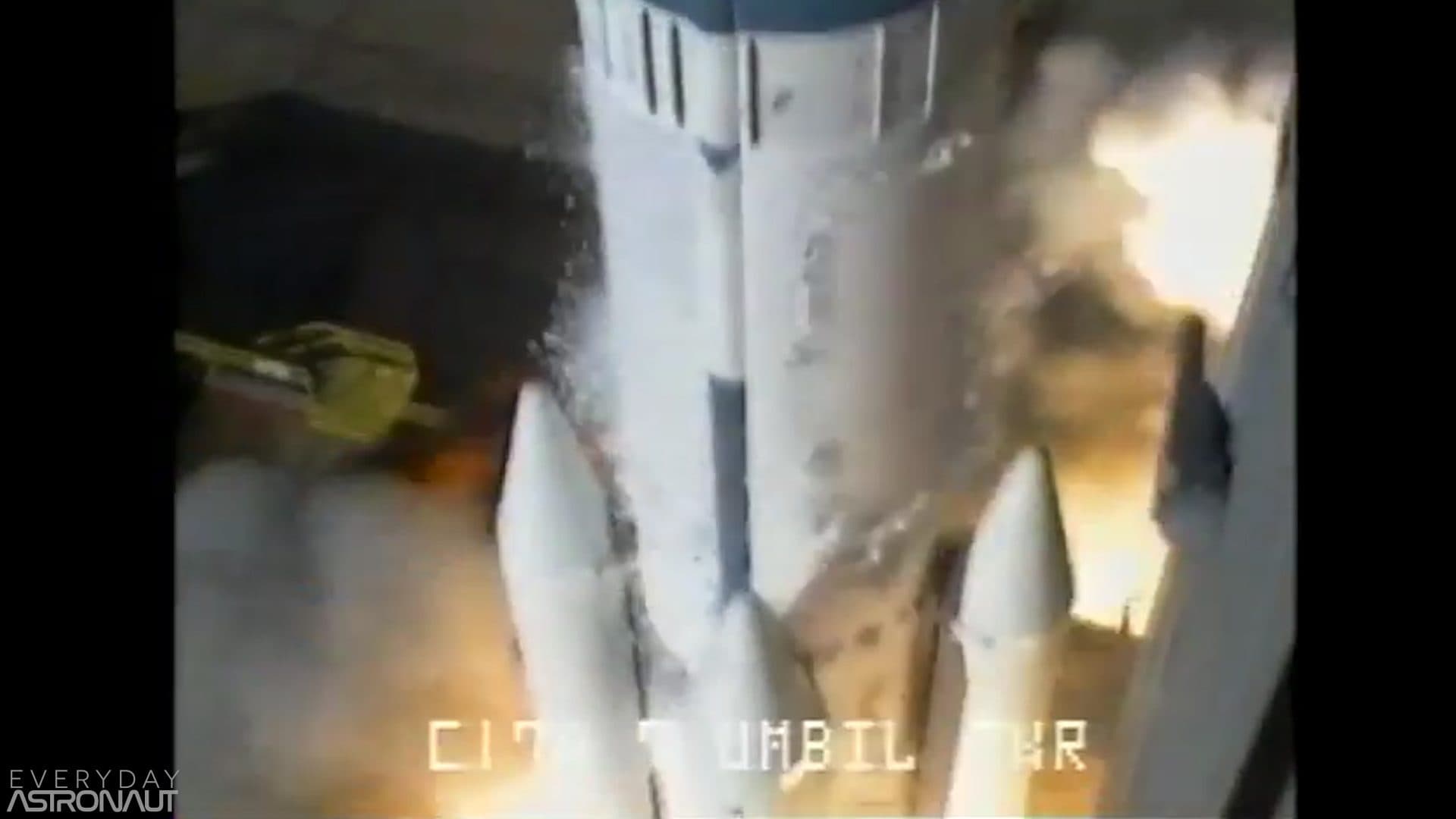
One of my favorite things about this launch is the Star 48B spin stabilized solid propellant third stage. That’s right, it’s spin stabilized. So, if there’s any minor offset in the thrust you can null it out by spinning the stage. Once the burn is complete, there’s a Yo-Yo de-spin mechanism that mostly nulls out the spin. It’s stuff like this that I just think is super cool!
So the little probe was on its way, everything looking good. And like all deep space missions, it’s normal to do a few correction burns to make sure you’re on target. No big deal. NASA does this all the time.
Course Corrections on the Way to Mars
There were four course corrections performed: December 21, 1998; March 4, July 25; and September 15, 1999. There was another optional course correction planned just one-day prior to the Mars insertion burn. However, management denied it because they thought the probe was on course.
Alongside the course corrections, the spacecraft also performed angular momentum desaturations or AMDs. Many spacecraft do this, but especially the Mars Climate Orbiter. Since it had that single solar panel, it experienced more solar pressure on one side than the other.
Solar Pressure, Not Solar Wind
By-the-way, a fun side note. Solar pressure is the momentum of the massless photons exerting pressure on a spacecraft. It’s NOT solar wind. Particles with mass ejected by the Sun, like nucleons, and electrons make up the solar wind. Thanks Scott Manley and the rest of space Twitter for helping clarify that for me!
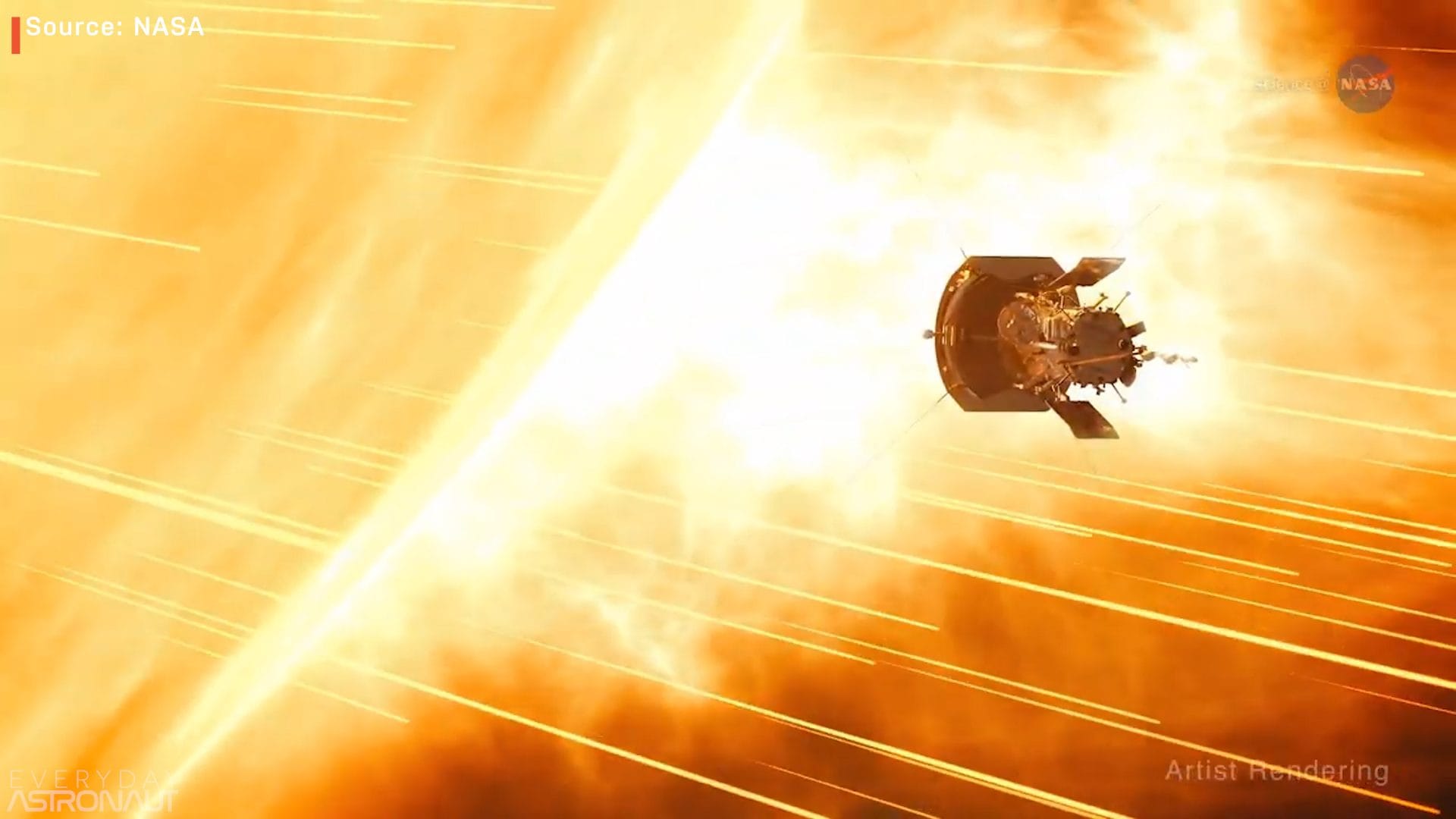
Ok, so your spacecraft is ever so slightly rotating in a direction you don’t want. To keep the reaction wheels from having to work overtime, you can perform an AMD. This will reset the spacecraft back to its ideal orientation. The key benefit, it keeps the reaction wheels happy.
Now, each time the spacecraft performs any desaturation maneuver or correction burn, NASA records the exact impulse and time every thruster fired. Then, the probe sends this telemetry back to Earth so Mission Control can calculate exactly how much the spacecraft changed its trajectory. They can measure even the tiniest variation during these corrections.
Tracking a Spacecraft In Metric, but Getting Imperial Units
Mission Control can track the probe and its trajectory in deep space on its way to Mars. The primary method is by Doppler shift. This method isn’t accurate at all times. During portions of the journey, especially when the changes in velocity are perpendicular to the vantage point, it gives insufficient data points.
Think of it like this, Doppler can precisely tell if something is speeding up or slowing down moving straight away from you. However, it can’t really tell if something is speeding up side-to-side from Earth’s vantage point. That paralleling motion happens for a good portion of the journey to Mars.
Hohmann Transfer Burn
Often, guidance teams will precisely calculate the vehicle’s exact trajectory after the Hohmann transfer burn that sends the probe on its way to Mars. Flight controllers take into account trajectory variables, so long as any outside force doesn’t act upon the vehicle. Spoiler alert, it’s space, the variables change little.
But this also means that they need to account for every thruster fire. Even those tiny little impulses change the exact destination of the vehicle. If by even a tiny amount, the spacecraft does something enough; it adds up over time to a trajectory change.
Approaching Mars: Suicide Is Painless
Aiming at a planet that’s over 200 million kilometers away, any minor error could mean missing it. Or, perhaps worse, smacking right into it. And NASA was aiming to only miss Mars by about 200 kilometers. So there was little room for error.
To have the planet capture the spacecraft, it has to aim and get as close as it safely can to the planet. When a planet has an atmosphere, controllers need to calculate that variable and not get too low. But the closer the spacecraft gets to the planet, the less energy it takes to get captured into orbit.
One-week to Mars
Just one-week prior to the Mars encounter and insertion burn, NASA performed the fourth and final Trajectory Correction Maneuver on September 15, 1999. That placed its trajectory 226 kilometers above the Mars surface. Perfect for the Mars Orbital Insertion burn, or so they thought.
But following that burn, the navigation team noticed their calculations and observations didn’t match. In fact, the observed trajectory kept getting lower and lower. They saw it go down to just 150 kilometers. But that still was safely above the minimum altitude of 80 kilometers.
However, go below 80 kilometers, and Mars’ thin atmosphere will shatter a fragile spacecraft. Just imagine that tiny little fragile solar panel getting knocked about by Martian winds. Oh, the humanity! (Apologies to Les Nessman.)
Mars’ gravitational effects grew stronger just 24 hours before the orbital insertion burn. The new 110 kilometer trajectory was still above the 80 kilometer survivable limit. So management proceeded with the burn, despite vocal opposition by some operators.
Mars Orbital Insertion Burn
At 9:00:46 UTC on September 23, 1999, the insertion burn began. Everything was performing as planned… at first! Mission Control expected a loss of signal when the spacecraft went behind Mars. They calculated the exact time it would happen.
The first signs of serious trouble cropped up when the loss of signal occurred 49 seconds earlier than expected. It was further emphasized when they did not reacquire the signal 21 minutes later. Controllers kept trying to contact the spacecraft for a further two full days.
So what happened? Was it something wrong with the insertion burn? Was it NASA reading altitude in kilometers when the probe was saying miles? Find out after we hear from this week’s sponsor, Banana for scale.
Look Away, Look Away. Banana Units Commercial

Are you tired of measuring stuff based on some old guy’s feet? Are you constantly asking Siri how many ounces are in a pint only to get the wrong answer? Is it just too easy knowing there’s 1,000 milliliters in a Liter? Or perhaps you’re measuring horses in hands and you just can’t even. Introducing Banana for scale, the one TRUE unit of measurement.