
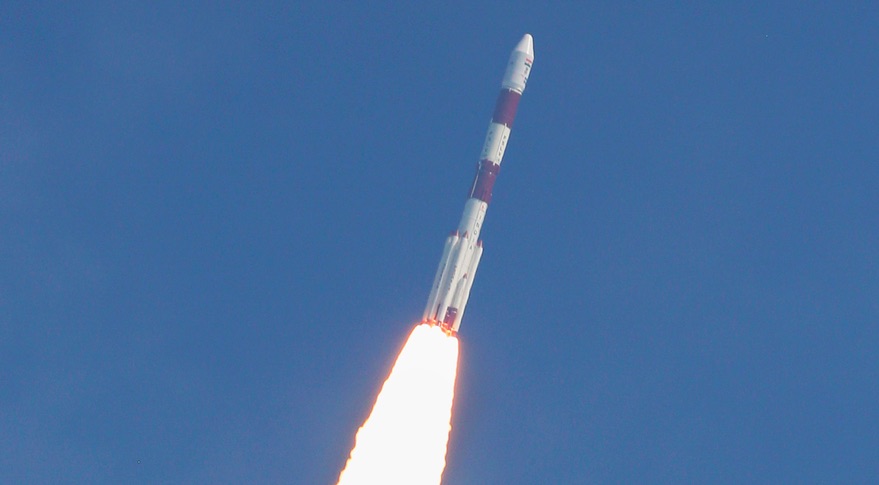
Featured image credit: ISRO
Lift Off Time | February 28, 2021 – 04:54 UTC | 10:24 IST |
|---|---|
Mission Name | Amazônia-1 |
Launch Provider | Indian Space Research Organization (ISRO) |
Customer | Brazil’s National Institute for Space Research (INPE) |
Rocket | Polar Satellite Launch Vehicle (PSLV)-DL |
Launch Location | First Launch Pad, Satish Dhawan Space Centre, India |
Payload mass | 638 kg (~1,400 lbs) |
Where are the satellites going? | 752 kilometer Sun-synchronous orbit |
Will they be attempting to recover the first stage? | No, this is not a capability of ISRO |
Will they be attempting to recover the fairings? | No, this is not a capability of ISRO |
How’s the weather looking? | N/A |
This will be the: | – 79th ISRO mission – 54th PSLV mission – 3rd PSLV-DL mission – 16th orbital launch attempt of 2021 |
Where to watch | Official livestream |
What does all this mean?
The Indian Space Research Organizations’s Polar Satellite Launch Vehicle (PSLV) will launch Brazil’s Amazônia-1 satellite into a 752 kilometer sun-synchronous orbit. It is the first earth observation satellite developed by Brazil.
Amazônia-1 and other payloads
Amazônia-1 is an Earth observation satellite developed by Brazil’s National Institute for Space Research (INPE). The satellite is equipped with a camera that can pass over and take pictures of any place in the world every five days. This high revisit rate is useful for tracking things like deforestation in the Amazon rainforest.
This will be the first satellite based on Brazil’s Multi Mission Platform (MMP) satellite bus. The satellite bus is built for 500 kg satellites and provides power, propulsion, and other critical satellite elements.


This mission will also feature several rideshare payloads. They are:
- Satish Dhawin Sat – nano-satellite intended to study radiation levels and space weather
- UNITYsat – provides radio relay services
- SinduNetru – technology demonstrator
- SAI-1 NanoConnect-2 – technology demonstrator
- SpaceBEEs (*12) – communications and data relay satellites
PSLV
ISRO’s workhorse rocket, PSLV, is an expendable medium-lift launch vehicle capable of putting up to 1,750 kilograms into a 600-kilometer sun-synchronous orbit and 1,300 kilograms into a geostationary transfer orbit. PSLV has a fairly modular design and has flown in six variants in the course of its life. It was debuted in 1993 and has flown successfully 48 out of 51 times. The vehicle’s reliability, as well as its customizability and relatively low cost have made it a popular rocket for both foreign and domestic customers.
This will be the third mission of the PSLV-DL variant; it was first launched in 2019.
PSLV has four stages:
- Stage 1 is 20 m (66 ft) long and 2.8 m (9 ft 2 in) in diameter. Its S139 solid rocket motor produces 4,800 kN of thrust and uses hydroxyl-terminated polybutadiene (HTPB) for fuel.


- Stage 2 is 12.8 m (42 ft) long and 2.8 m (9 ft 2 in) in diameter. Its single Vikas rocket engine produces 800 kN of thrust and uses dinitrogen tetroxide (N2O4) as its oxidizer and unsymmetrical dimethylhydrazine (UDMH) for fuel.


- Stage 3 is 3.6 m (12 ft) in length and 2 m (6 ft 7 in) in diameter. Its one S-7 motor uses HTPB for fuel and produces 250 kN of thrust.
- Stage 4 is 3 meters (9.8 feet) long and 1.3 meters (4 feet 3 inches) in diameter. It has two L-2-5 engines that use monomethylhydrazine as fuel and produce a combined 14.7 kN of thrust.

The PSLV-DL configuration in particular also has two side boosters, each using HTPB as fuel and producing 700 kN of thrust.