

Launch Window/Lift Off Time | December 22, 2020 – 04:00 UTC | 12:00 BJT |
|---|---|
Mission Name | XJY-7 & others (XJY means “new technology validation”) |
Launch Provider | China Aerospace Science and Technology Corporation (CASC) |
Customer | – China Association for Science and Technology (CAST) (XJY-7) – Guoadian Gaoke (Tianqi 12) – Ethiopian Space Science & Technology Institute (ESSTI) (ET-SMART-RSS) |
Rocket | Long March 8 |
Launch Location | LC-2, Wenchang Spacecraft Launch Site, Wenchang, Hainan, China |
Payload mass | Up to 5,000 kg (11,000 lbs) for SSO |
Where is/are the satellite(s) going? | Sun-synchronous Orbit (SSO) |
Will they be attempting to recover the first stage? | Not yet. They are working on a partially reusable version of this rocket that will launch in the next 3-5 years. |
Where will the first stage land? | It will crash back into the ocean in the South China Sea. |
Will they be attempting to recover the fairings? | No |
Are these fairings new? | Yes |
How’s the weather looking? | N/A |
This will be the: | – 1st ever launch of a Long March 8 – 38th launch from China in 2020 – 1st launch of an orbital-class (potentially) reusable rocket from China – 356th launch of a Long March rocket (any family) |
Where to watch | Official livestream (if available) |
What does all this mean?
China Aerospace Science and Technology Corporation (CASC) is launching a designed-for-reuse Long March 8 rocket for the first time. The primary payload is unknown but known as XJY-7. There are two known secondary payloads.
What’s the XJY-7 payload and what are the others?
The details of the primary payload have not been disclosed. Payloads on debut flights of rockets tend to be dummy items, mass simulators, or just development instrumentation. All we can say is that the payload is called XJY-7. XJY means “new technology validation”.
XJY-6 previously flew on a Long March 7A. It was a validation platform for some form of missile detection system.
Also on board are two smaller payloads. The first is the Tianqi 12 satellite made by Guoadian Gaoke. It is a 6U CubeSat. It is a demonstration payload for an “Internet of Things” (IoT) constellation. There will be 38 such satellites in the full constellation.
The second rideshare payload is called ET-SMART-RSS. It has been developed by the Ethiopian Space Science & Technology Institute (ESSTI) . The worked together with Beijing Smart Satellite Technology (SMART). This is also a 6U nanosatellite whose purpose is to offer Earth observation services. These will be offered to both China and countries in Africa.
Long March 8
The Long March 8 is China’s first venture into orbital-class reusable rockets. It is designed to replace the Long March 2 and Long March 3 rockets that use hypergolic fuels for their first stages. The rocket consists of:
- liquid-fueled side boosters
- center core (ignited at lift-off)
- upper stage
The rocket takes off from the island facility at Wenchang in Hainan province. Therefore it flies out over the ocean and there is no chance of the boosters landing on villages.
Long March 8 side boosters
The Long March 8 features two liquid-fueled side boosters, known as K2. They use RP-1 and LOX for propellant. Each booster has a single YF-100 engine. They are 26.9 m (88.3 ft) tall and 2.25 m (7 ft 5 in) wide.
When the side boosters have finished burning, they stay attached to the center core. This is unusual in orbital-class rockets.
The side boosters are believed to be based on those used on the Long March 11 rocket.


Center Core (first stage)
The center core, known as K3, has two YF-100 engines (the same as on the side boosters). Again, it uses RP-1 for fuel and LOX as oxidizer. It is 25.1 m (82.3 ft) tall and 3.35 m (11 ft) wide.

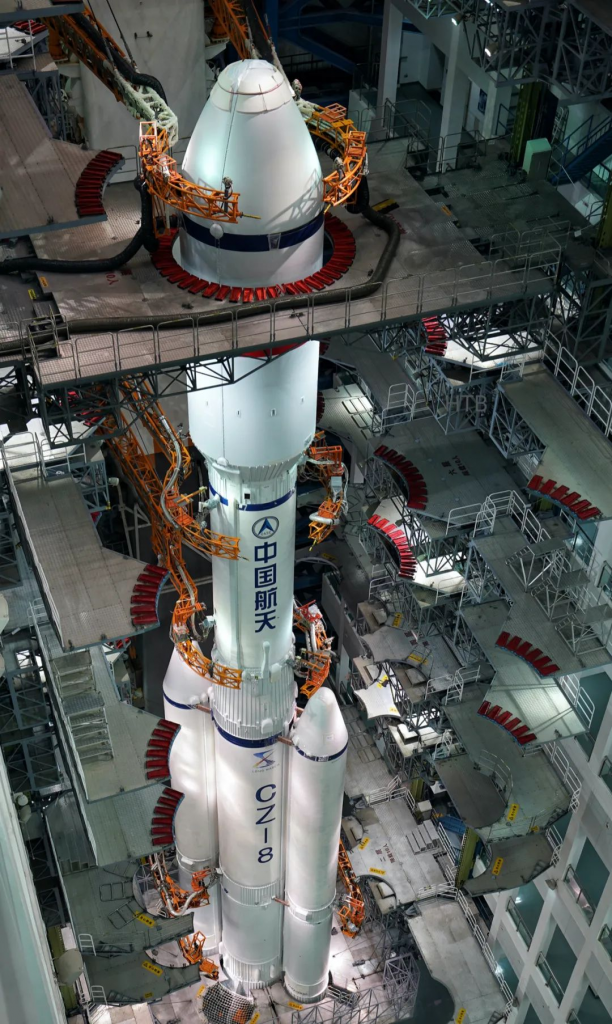
Unlike any other Chinese rocket beforehand, the center core is designed to have four landing legs! It will also have grid fins to be used when re-entering the atmosphere and landing.
The core stage is based on the Long March 7 which first flew in 2016. However the engine will have been adjusted to permit throttling and restart capabilities. The engines have a specific impulse of 300 seconds at sea level and 335 seconds in a vacuum.
The center core is thought to complete its burn about 15 seconds after the side boosters. On this flight, the center core and side boosters may attempt a “return to launch site” profile. However they will not attempt a full landing. The rocket will return the ocean just next to the launch facility.
Long March 8 second stage
This is based on the 3 m wide LH2 / LOX second stage for the Long March 3A rocket. It has two YF-75 engines on board. The stage is 12.4 m (82.3 ft) long and 3.0 m (9.8 ft) wide. The engines have a specific impulse of 438 seconds. The stage can deliver 4.3 km / s of DV.
Reusability
This is not the first exploration of reusable rockets in China. A private company, Linkspace, has been carrying out demonstration flights with vertical launch and landing capabilities. They intend to be ready to fly an orbital-class vehicle soon.
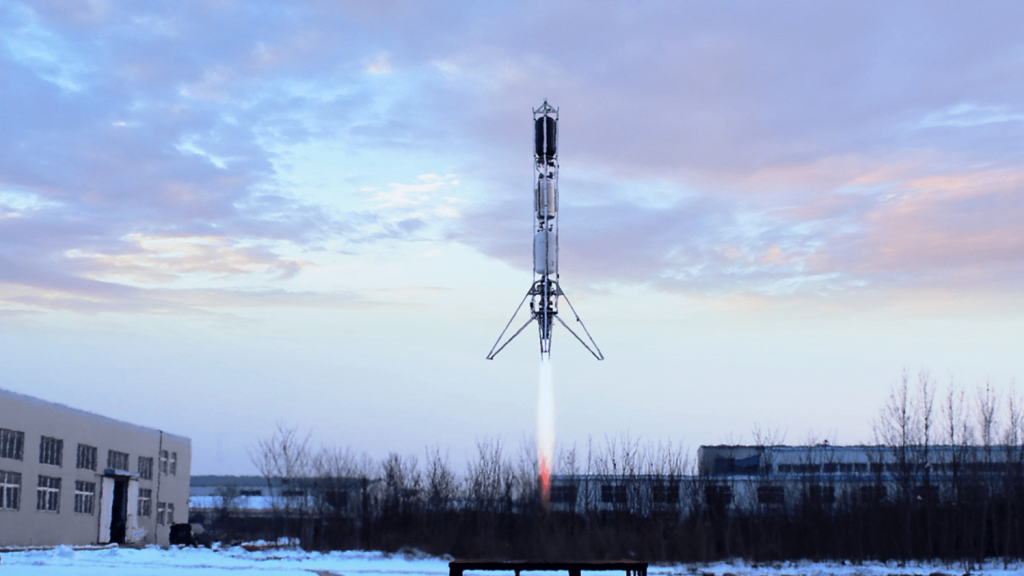
The Long March 8 however is the first orbital-class vehicle designed for reuse. The side boosters will not separate from the center core after they finish burning. Instead, the center core will return to the launch site and will in the future deploy four landing legs, just like the Falcon 9.
The first truly reusable version of the Long March 8 rocket is expected to fly in 2023-2025.
