
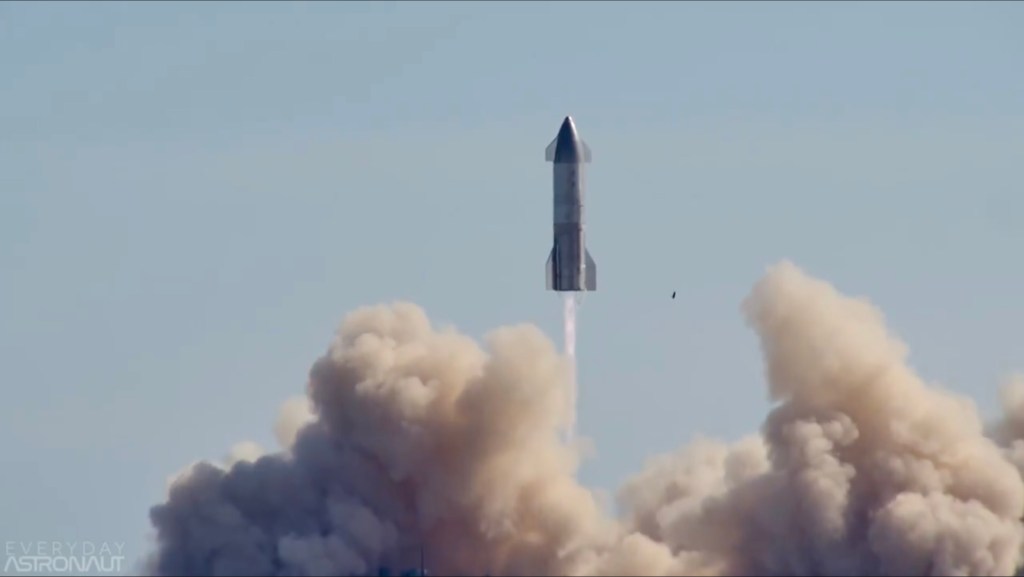
Lift Off Time | February 2, 2021 – 20:25 UTC | 14:25 CST |
|---|---|
Mission Name | 10 km flight test |
Launch Provider | SpaceX |
Customer | SpaceX |
Rocket | Starship SN9 |
Launch Location | Test Stand B, Boca Chica Launch Site, Boca Chica, Texas |
Payload mass | There was no payload on this flight |
Did they attempt to recover the first stage? | Yes |
Did the first stage land? | Not successfully, SN9 crashed onto the landing pad |
Did they attempt to recover the fairings? | The fairing (or more accurately, the nosecone) was integrated into the vehicle and was supposed to be recovered with it |
This was the: | – 1st flight of SN9 – 2nd medium-altitude flight of a Starship prototype – 4th flight of a Starship prototype (6th if you count Starhopper’s two hops; 8th if you count Starhopper’s two short tethered hops as well) – 2nd flight of a prototype with a nosecone and aerodynamic control surfaces – 2nd flight of a Starship prototype with three engines |
Where to re-watch/re-read | Official livestream Tim Dodd, the Everyday Astronaut, was streaming. Live Updates on SN9’s flight. |
How did it go?
SN9’s Ascent
At 20:25 UTC (14:25 CST) on February 2nd, 2021, SpaceX’s Starship SN9 successfully lifted off from Test Stand B in Boca Chica, Texas and slowly ascended under the power of its three throttled-down Raptor engines.
To decrease acceleration, one of the engines shut down as planned at about 1 minute and 40 seconds into flight. A second engine was shut down at about 3 minutes and 10 seconds into flight.
The vehicle continued upward until it reached its 10 kilometer apogee, where it hovered for a period of time. There, it performed a propellant transition to the header tanks before reorienting itself into a horizontal position and shutting off its third Raptor engine at around 4 minutes and 30 seconds into flight.
SN9’s Descent and Landing
SN9 remained very stable as it used its four body flaps — two forward and two aft — to control itself during descent.
The vehicle tucked in its flaps and ignited one of two Raptor engines to perform the final flip and landing burn. The second engine that was supposed to ignite failed to. Because of this, SN9 was unable to slow down and translate into a vertical position. It impacted the ground at a high speed and exploded.
The explosion was much greater than SN8’s because of how much fuel was still left in the vehicle. Debris was sent flying hundreds of meters away from the point off impact.

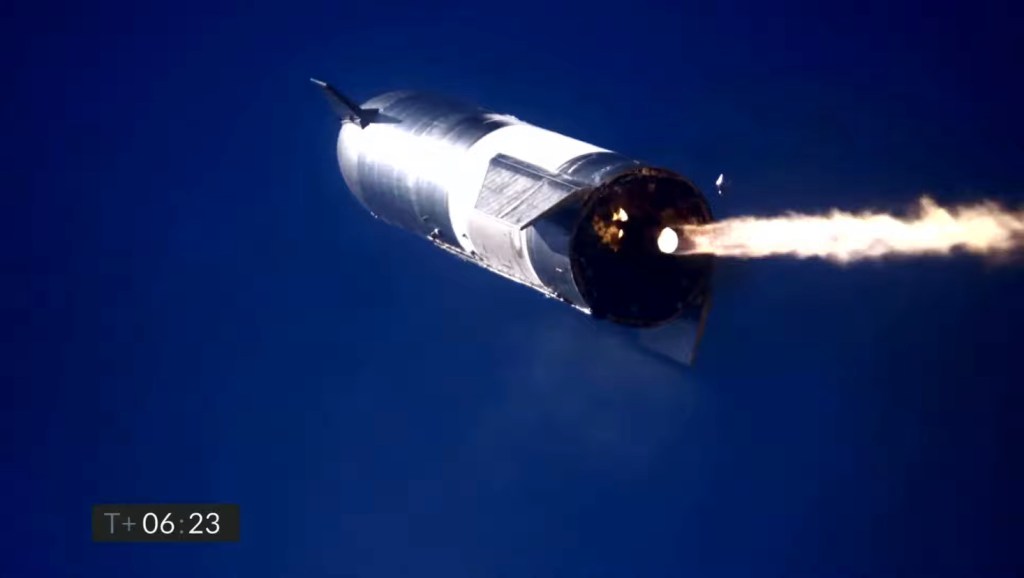
Nominally, the vehicle would have ignited two engines to perform the flip. Once vertical, SN9 would have performed a propulsive landing.
What Starship is next?
Starship SN10 is currently on Test Stand A — right next to where SN9 lifted off from. Once all three of its engines are installed, SN10 will perform a static fire followed by a test flight. Several Starship prototype vehicles, as well as the first Super Heavy booster, are currently in production and will soon have their own test campaigns.