
Lift Off Window (Subject to change) |
NET September 3, 2020 |
|---|---|
Mission Name and what it is |
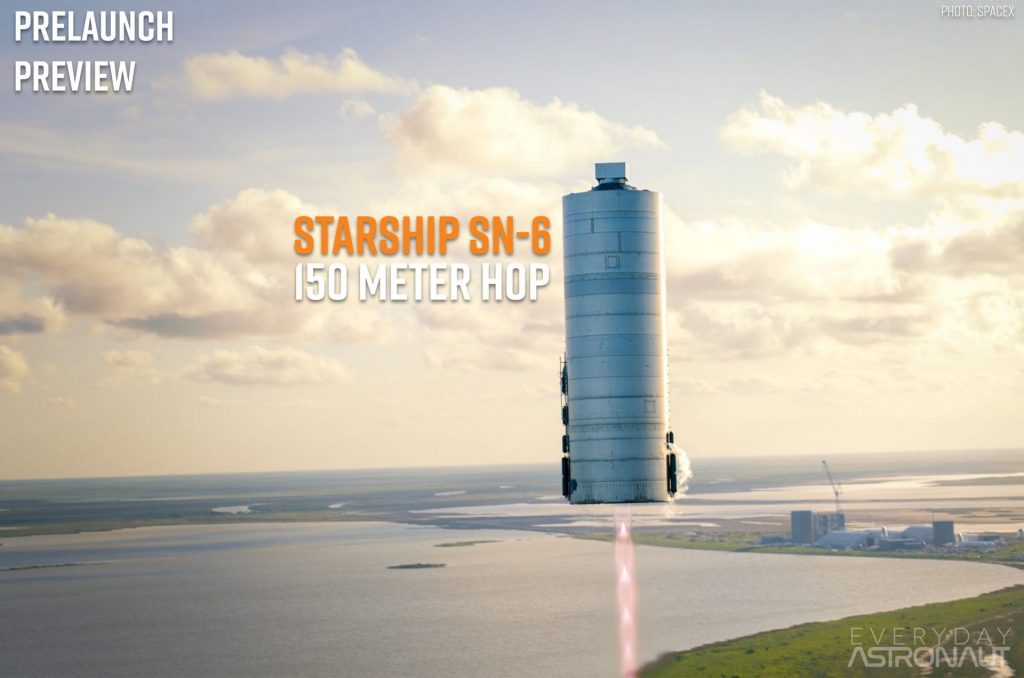
150-meter hop, the second flight of a Starship prototype vehicle |
Launch Provider (What rocket company is launching it?) |
SpaceX |
Customer (Who’s paying for this?) |
SpaceX |
Rocket |
Starship SN-6 |
Launch Location |
Boca Chica Launch Site, Boca Chica, Texas |
Payload mass |
There is no payload on this test flight |
Where are the satellites going? |
There are no satellites on this test flight |
Will they be attempting to recover the first stage? |
Yes |
Where will the first stage land? |
SN-6 will attempt a landing at a nearby landing pad |
Will they be attempting to recover the fairings? |
There are no fairings on this vehicle |
Are these fairings new? |
n/a |
This will be the: |
|
Where to watch |
SpaceX Maybe even more fun you can watch with Tim Dodd, the Everyday Astronaut, starting at T minus 30! Come ask questions and join the conversation live! |
What’s this all mean?
SpaceX’s Starship will be attempting its second test flight with Starship Serial Number (SN)-6. SN-6 will launch from its Boca Chica launch site in South Texas. The vehicle will fly to an altitude of 150 meters, and come down for a landing at a landing pad next to the launch site. SN-6 is SpaceX’s latest prototype vehicle to be tested. If all goes well, it will pave the way for future, higher hops.What is Starship?
Starship is SpaceX’s next-generation super-heavy launch vehicle. Starship can refer to the second stage of the vehicle or the entirety of the launch vehicle. Its first stage, known as Super Heavy, will have 31 Raptor engines and will produce 71.2 MN (16 million lbf) of thrust. That will make it more powerful than the Saturn V moon rocket. Starship and Super Heavy will lift off from a launchpad in either Boca Chica, Texas, Cape Canaveral, Florida, or from a modified oil rig. After main engine cut-off (MECO), Super Heavy will separate from Starship and perform several maneuvers to go back and land on a landing pad near the launch site. Starship will continue on to orbit. Depending on the mission, Starship will either deploy its payload or rendezvous with several “tanker” Starships and refuel before continuing to the Moon or Mars.Prior to re-entry, Starship will perform a re-entry burn to bleed off some of its velocity. It will then flip around and re-enter horizontally. Just before landing, Starship will flip around for a second time, performing a “belly flop maneuver” to orient itself to a vertical position. It will fire three of its Raptor engines and land in the same way as the Falcon 9 and Super Heavy first stages.
History of Starship
Interplanetary Transport System
The history of Starship goes back to at least 2012 when it was known as Mars Colonial Transporter. At this time, it wasn’t much more than a few murmurings from Elon, but more detailed plans were unveiled in 2016 at the International Astronautical Congress. A two-stage carbon-fiber vehicle was announced. The vehicle, now dubbed Interplanetary Transport System (ITS), would be a whopping 122 meters (400 ft) tall and 12 meters in diameter. In an expendable configuration, the vehicle could carry over 500 tons to Low Earth Orbit (LEO). In a reusable configuration, it could carry 300 tons to LEO, more than double that of the Saturn V.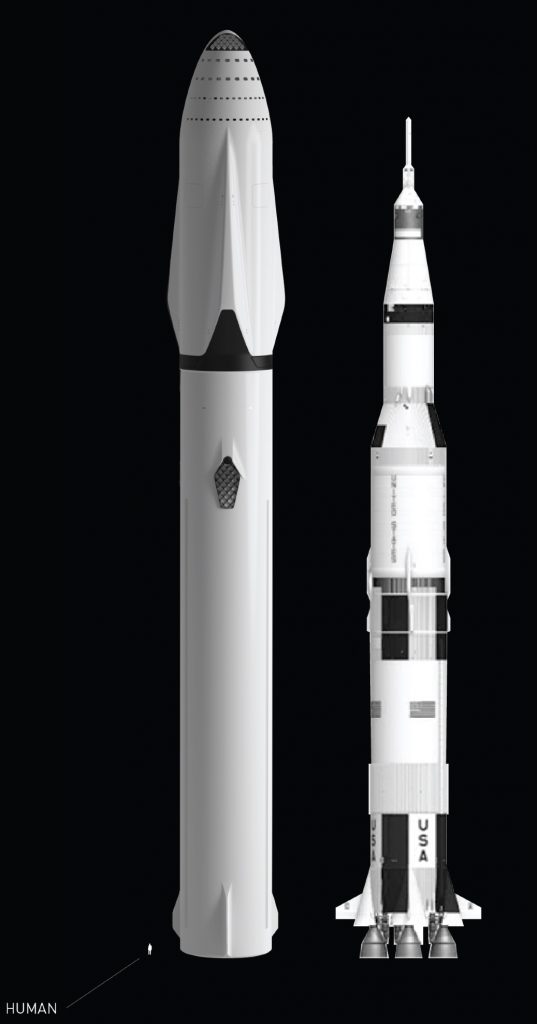
Big “Falcon” Rocket
At the 2017 International Astronautics Congress, the major redesign was announced. At this time, the name was changed to Big ‘Falcon’ Rocket (BFR). It was downsized slightly, to only 9 meters in diameter. Small delta wings were added to the vehicle to control it during re-entry. The BFR was a smaller and more feasible design, which was intended to launch to Mars as a cargo variant in 2022, with a crewed flight following two years later. Construction of a prototype vehicle started in early 2018 at the Port of Los Angeles.Starship
In September of 2018, SpaceX announced another major redesign. The vehicle now featured three rear fins, that doubled as landing legs, and two forward canards for control during atmospheric re-entry. At the same event, it was also announced that Japanese billionaire Yusaku Maezawa was partially funding Starship development and would be one of the passengers during Starship’s first crewed trip around the moon. He, along with several different types of artists, are planned to take a flight around the moon in Starship as part of the #dearMoon project with the goal of inspiring the artists to create things to inspire people on Earth. A few months after this event the vehicle was renamed to Starship/Superheavy.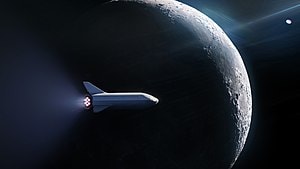
The big switch
In December 2018, Elon Musk announced that Starship would switch from being built out of carbon-fiber to stainless steel. He also explained that the particular alloy they were using was significantly cheaper than carbon-fiber and got 50 percent stronger at cryogenic temperatures. The material is also tough at high temperatures, meaning it needs little heat shielding compared to what the previous carbon-fiber design would have required. The parts of the vehicle not exposed to the most intense heat would be cooled by liquid fuel “sweating” through tiny pores in the steel.Starhopper
Around the time of the announcement of the new stainless steel design, SpaceX began building its first prototype: Starhopper. The vehicle was built outdoors in Boca Chica, Texas, a small village near the Mexican border. In 2014, SpaceX acquired a property in Boca Chica, but until 2018 the area sat largely dormant with little activity. Occasional dirt deliveries were the most exciting thing happening in the four-year interim period. Late spring of 2019 saw the completion of Starhopper. Initially, Starhopper was built with a nosecone, but a windstorm in January caused it to fall off the vehicle and collapse. Since the nosecone was not necessary for flight, SpaceX decided to forgo the nosecone and launch without it.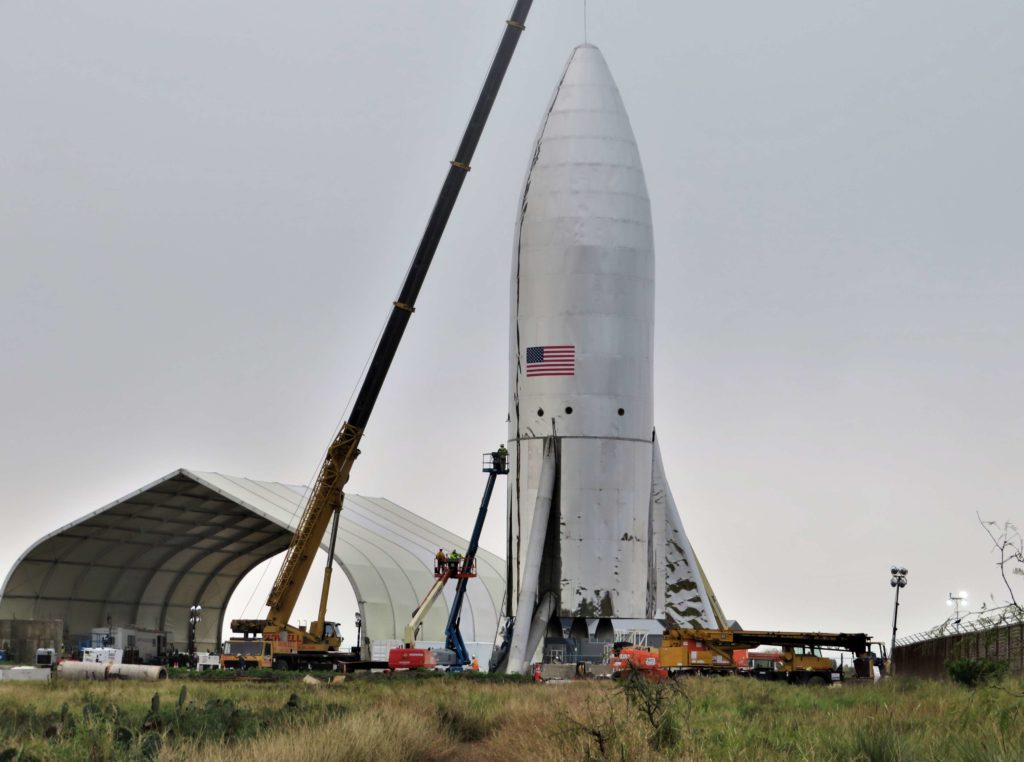
Starhopper hops!
On July 25, 2019, Starhopper completed its first untethered hop, successfully reaching an altitude of 20 meters, before completing a soft landing. A month later, on August 27, Starhopper completed a 150-meter hop. Though the hop was successful, the landing was a bit rough. After this flight, Starhopper was retired and SpaceX started going full-steam-ahead with MK-1.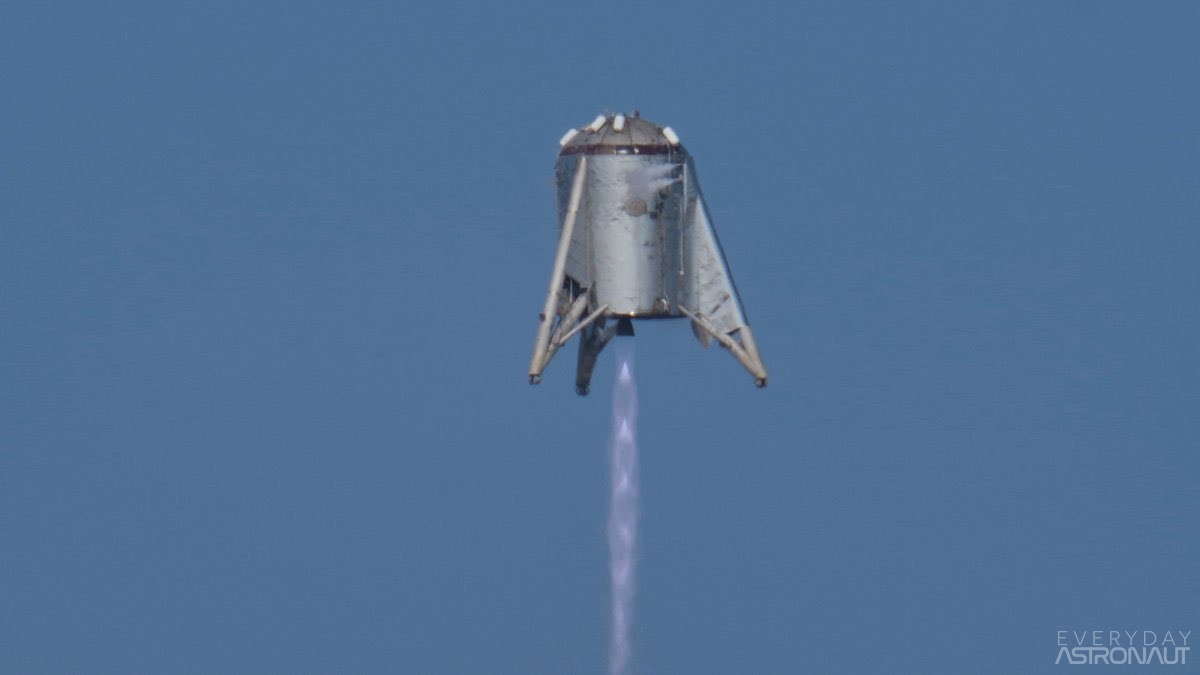
Starship Mk-1 and Mk-2
While testing Starhopper, SpaceX also began constructing its first of two full-scale prototype vehicles: MK-1 in Boca Chica and MK-2 in Cocoa, Florida. Elon Musk announced on twitter that the teams at each facility were in a race to orbit. Each team constructed the vehicles using their own techniques, but they were required to share anything they learned along the way. Because SpaceX had already started constructing their first two full-scale Starship prototypes as Starhopper was undergoing testing, for the first time 2019’s Starship presentation took place in front of an actual Starship. Mk-1 was rolled out to the launch site on October 30, 2019.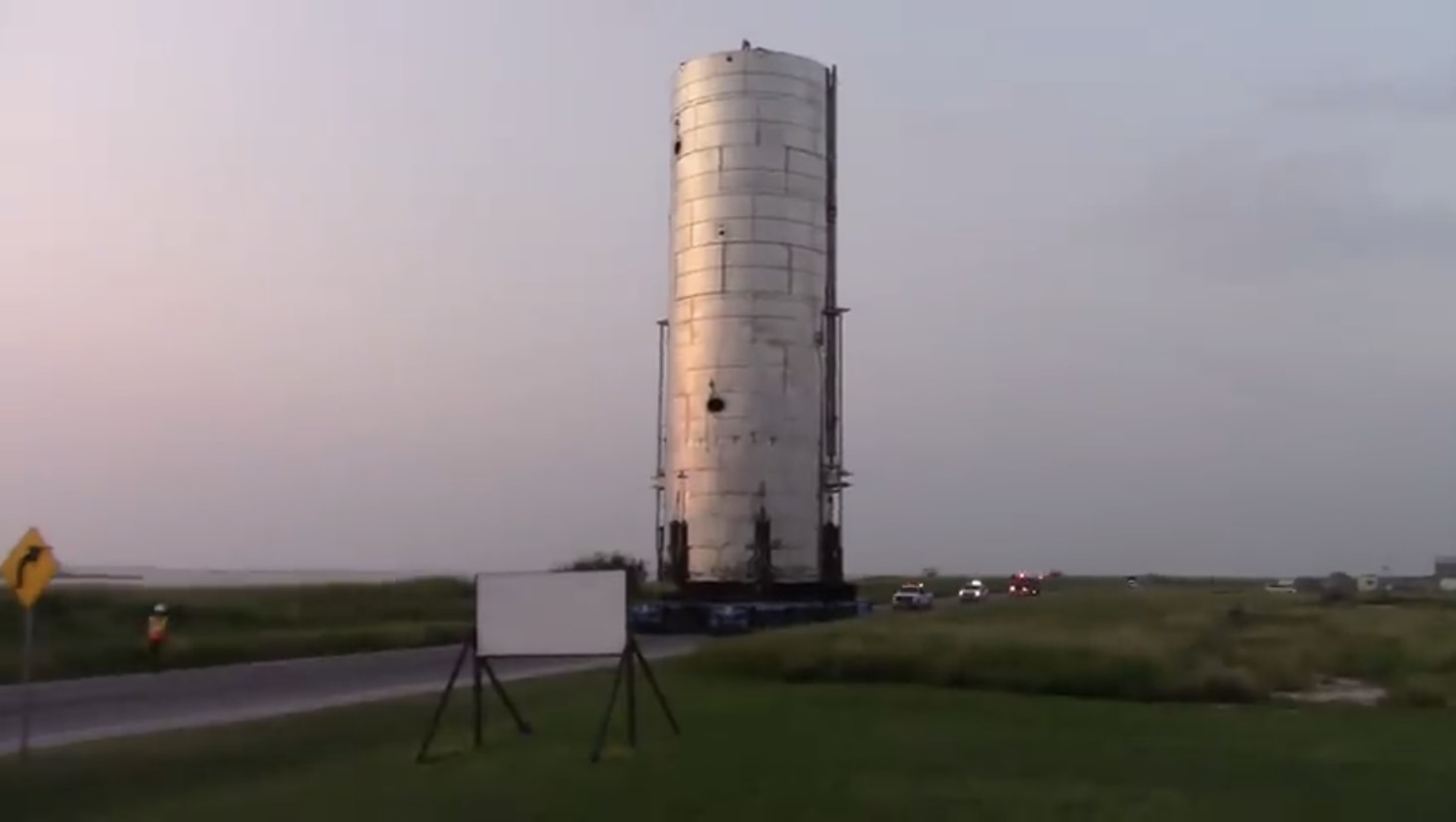
Mk-1 and Mk-2 testing
Mk-1’s testing began with a cryogenic pressure test on November 30, 2019. This test was meant to make sure Mk-1 could hold up to the high pressure and low temperatures that would occur during flight. Due to bad welds, the vehicle couldn’t handle the pressure and exploded in a cloud of super-chilled nitrogen.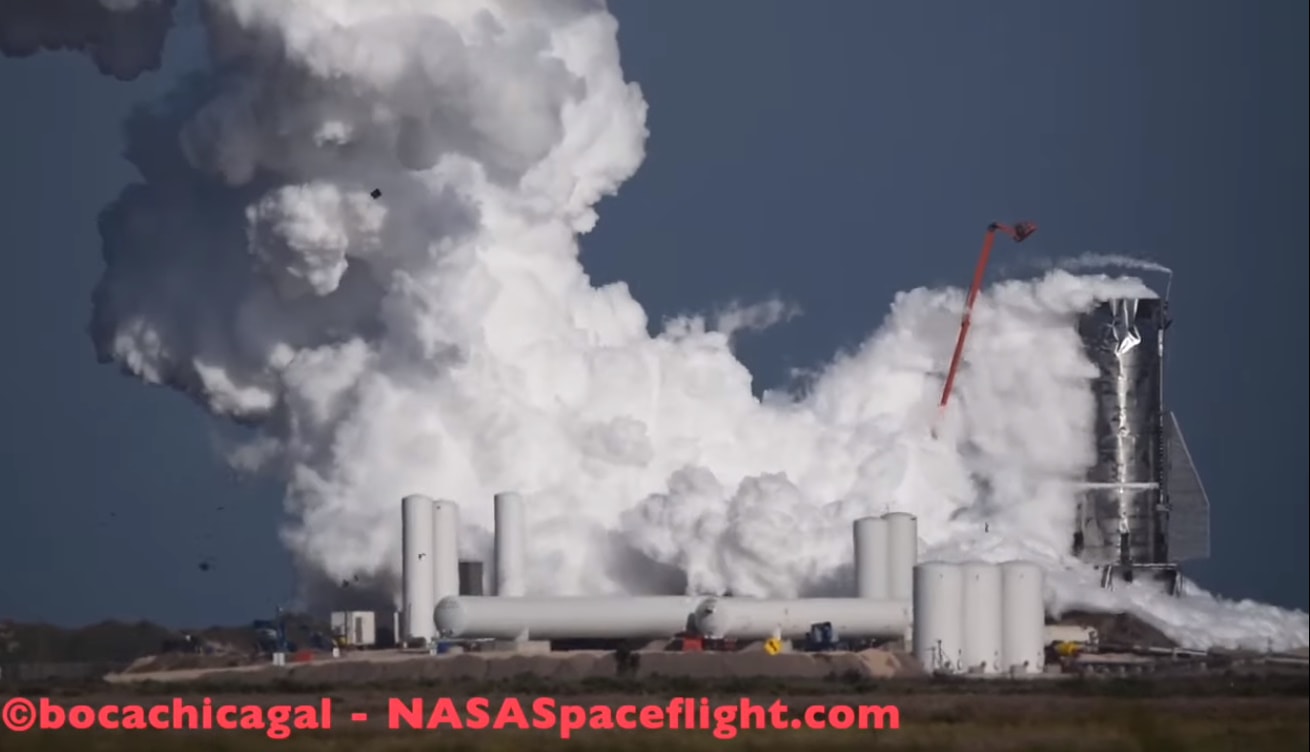
New Rings
Mk-1’s construction process and failure revealed issues that would prevent a Starship of its construction method from ever flying. SpaceX radically changed its construction process, not only to decrease the number of welds but also to decrease the mass. Mk-1 was made up of large steel rings stacked on top of each other and welded together. Each ring was made of several pieces of steel. Not only did that create many weak points, but it also made building the vehicle laborious and time-consuming. With the purchase of an IMCAR machine, SpaceX began making each ring out of a single sheet of rolled steel. IMCAR is an Italian company that specializes in making machines that roll steel into circular barrels.
SN-1, SN-2, SN-3, and the ‘Boppers’
In the early part of 2020, we saw the construction and completion of two scaled-down Starship test tanks. These two tanks used different welding techniques and had improved bulkhead designs. Both were tested to destruction at the launch site.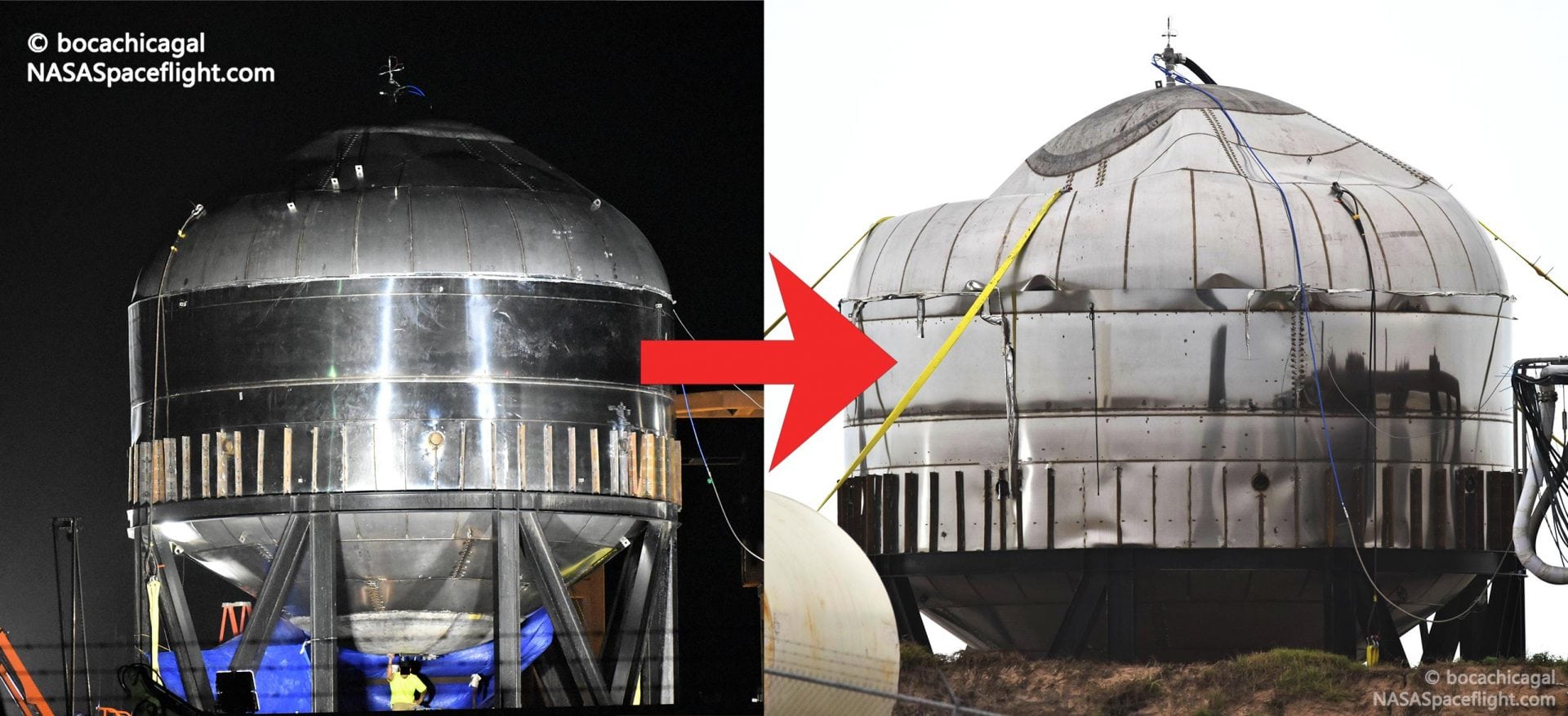
SN-1 testing
SN-1 failed during its first cryogenic test when its thrust puck failed. The thrust puck is the bottom bulkhead that doubles as an attachment point for Raptor engines. The thrust puck must take the force from the raptors and distribute it across the airframe. The failure sent the vehicle several meters into the air.
Thrust puck redesign
SpaceX temporarily refocused their efforts on the thrust puck. They completely redesigned it to be able to withstand the 7 bar needed for flight. They built a smaller-scale prototype, SN-2, which was similar to the pre-SN1 test tanks, to test the new design. SN-2 passed cryogenic testing with flying colors and was retired to a concrete stand near SpaceX’s scrapyard.Starship SN-3
SN-3 was the next prototype, with the newly redesigned thrust puck. It was smoother than SN-1 and had many improvements, big and small. Unfortunately, a testing configuration error caused the vehicle to lose pressure in its lower tank and collapse during a cryogenic test. Thankfully, it wasn’t the fault of the vehicle this time, but it was actually the ground support equipment (GSE). The GSE was unable to keep the two tanks in the vehicle at similar pressures. The lower tank crumpled under the weight of the upper tank.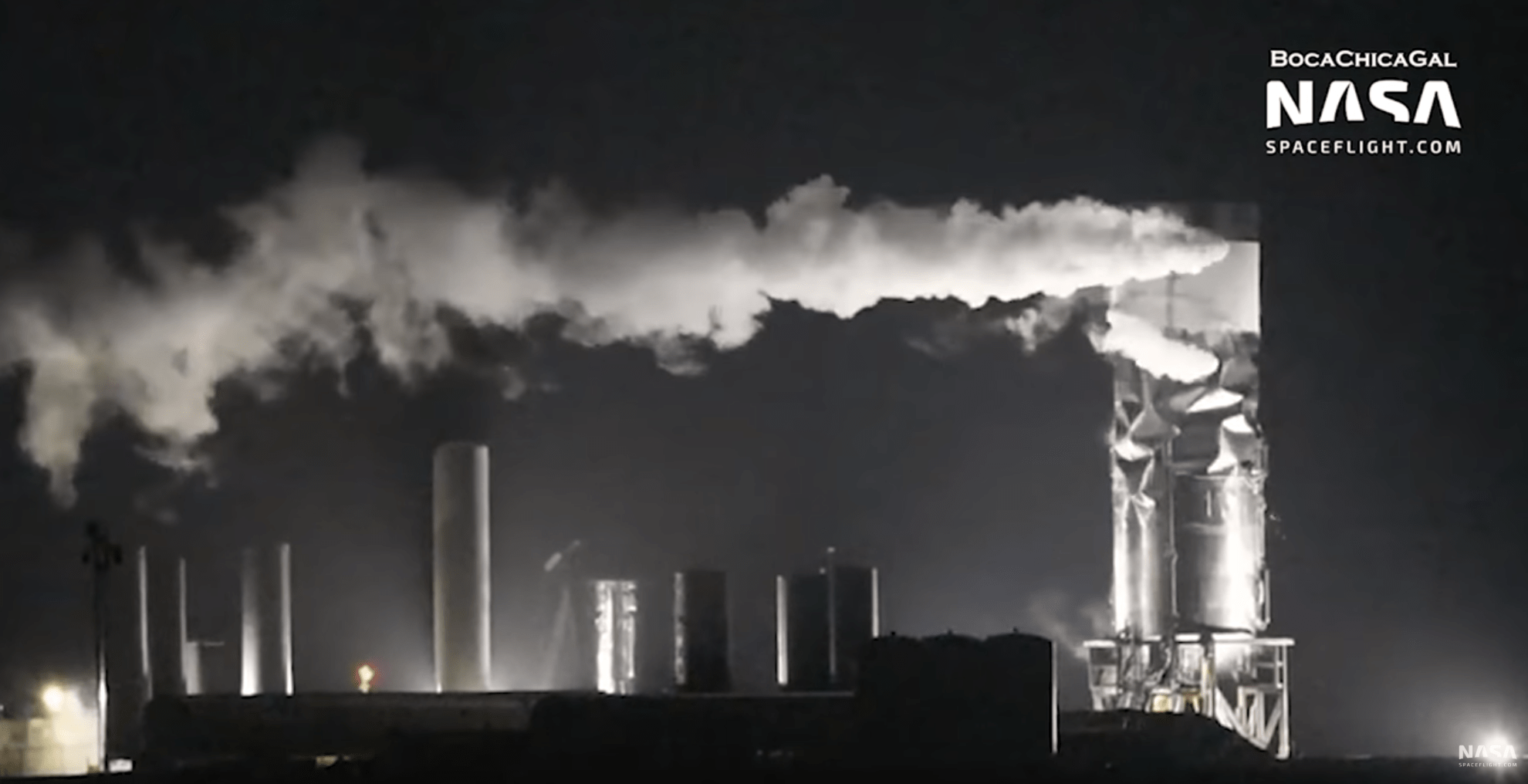
Starship SN-4 and first static fires
After the SN-3 failure, SpaceX quickly churned out the next prototype: SN-4. It was again noticeably smoother than the previous prototypes and reused the lower part of SN-3’s undamaged skirt section. On April 26, 2020, SN4 passed cryogenic testing, becoming the first full-sized Starship prototype to do so. It reached a pressure of 4.9 bar, which Elon Musk said was “a softball tbh, but that’s enough to fly!” A Raptor engine was installed the next day, and SN4 static fired for the first time on May 5, then again only a day later on May 6. The first static fire fed fuel from the main tanks while the second one fed fuel from the smaller header tanks. Following the two successful static fires, the Raptor engine was uninstalled.More SN4 testing
SN-4 underwent another cryogenic test, but this time reached a pressure of 7.5 bar, enough for an orbital flight. Following that, a different Raptor engine, Raptor SN-20, was installed. That engine static fired for the first time on May 19. During the static fire, a methane line was knocked loose from the vehicle, and scorched it as well as some wiring. SpaceX was unable to safely depressurize the vehicle, so no one was allowed to be near SN-4 for two days. Fortunately, the repairs were easy and the vehicle static fired again on May 29.SN-4 failure
The static fire was successful, but the vehicle started leaking oxygen and methane, due to a GSE pipe becoming disconnected. Moments after the static fire, a hot spot in the engine skirt ignited the cloud of gas around the vehicle and the vehicle exploded.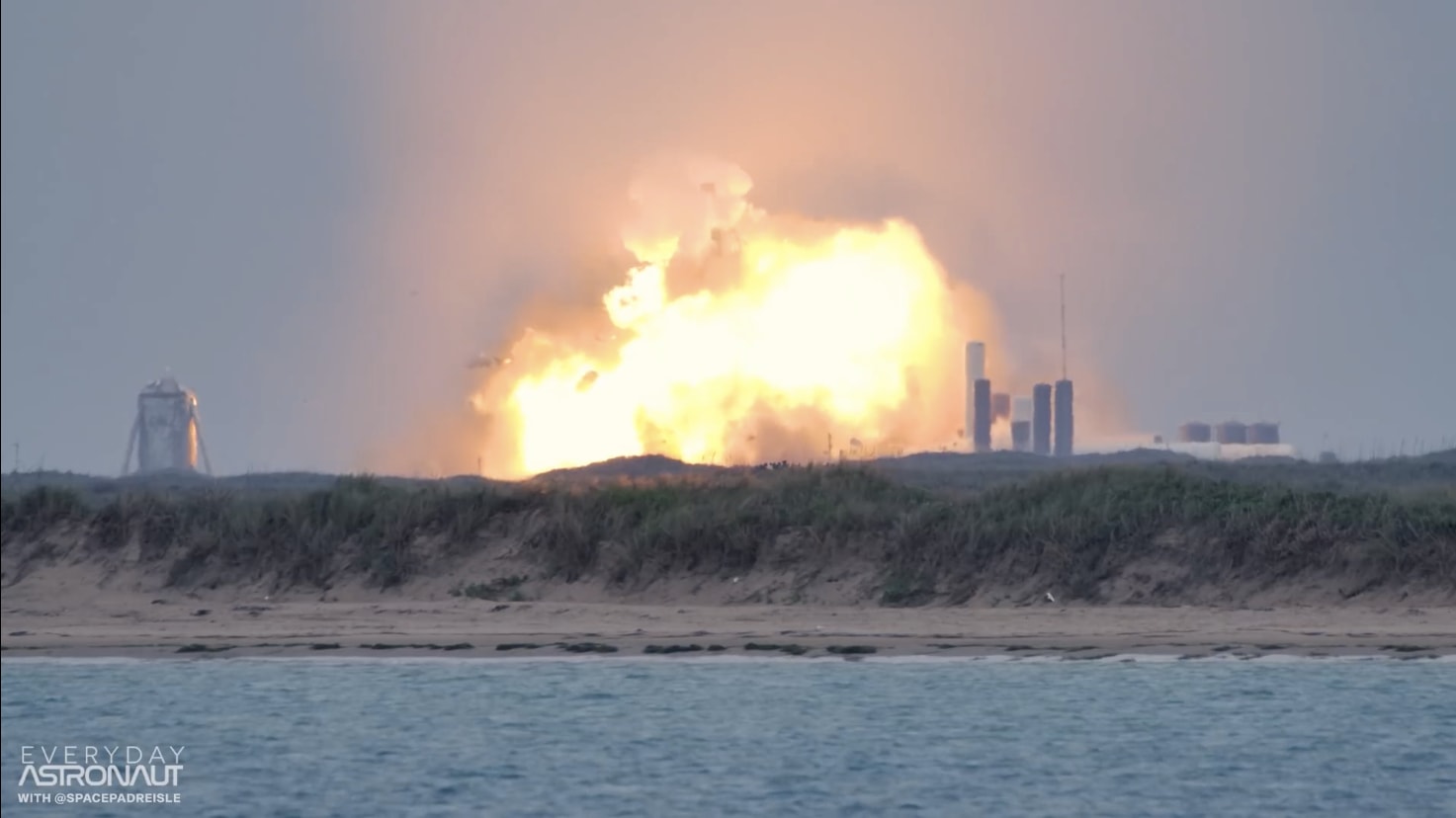
The cause of SN4’s failure
It was later found out that the quick disconnect system was responsible for the failure. The quick disconnect system disconnects the vehicle from ground support equipment prior to launch. The quick disconnect test was expected to be an easy test but ended up in a catastrophic failure.Starship SN-7
SN-7 followed SN-4. It was made of an entirely different steel alloy. The previous Starship’s used 301 stainless steel, while SN-7 used 304L stainless steel. 304L steel is stronger under cryogenic temperatures. During its first cryogenic pressure test, intended to be to destruction, the vehicle didn’t pop, but rather, sprung a relatively small leak at 7.61 bar. SpaceX reinforced the failure point and conducted another pressure test a few days later. This time, the vehicle failed at the bottom bulkhead’s weld line and went several meters into the air and to the side, taking its test stand with it. The pressure SN7 reached during its second test is still unknown. While the exact pressure is unknown, it is thought that the tank reached an extremely high pressure due to the energetic explosion.Starship SN-5
SN-5, after waiting in the wings for several weeks, rolled out to the pad on June 24. SN-5 passed cryogenic testing on July 1. Later, a mass simulator was installed on the vehicle’s top bulkhead to simulate the weight of a nosecone. A successful static fire occurred on July 30. On August 4, SN-5 successfully hopped to 150 meters and landed at the nearby landing pad. SN-5 may get to fly again after some repairs, according to Elon Musk. He said SpaceX needs to conduct several short hops to smooth out the launch process.
