
LIFT OFF TIME(SUBJECT TO CHANGE) |
December 11, 2020 – 01:09UTC December 10, 2020 – 20:09 EST |
|---|---|
MISSION NAME AND WHAT IT IS | NROL-44, a mission for the National Reconnaissance Office (NRO) |
LAUNCH PROVIDER(WHAT ROCKET COMPANY IS LAUNCHING IT?) | United Launch Alliance (ULA) |
CUSTOMER(WHO’S PAYING FOR THIS?) | National Reconnaissance Office (NRO) |
ROCKET | Delta IV Heavy |
LAUNCH LOCATION | SLC-37B, Cape Canaveral AFS, Florida, USA |
PAYLOAD MASS | Not disclosed, but max is 14,220 kg (31,350 lb) |
WHERE ARE THE SATELLITES GOING? | Geostationary Earth Orbit ~35,900 km (~22,300 miles) |
WILL THEY BE ATTEMPTING TO RECOVER THE FIRST STAGE? | No, this is not a capability of ULA |
WHERE WILL THE FIRST STAGE LAND? | It will crash into the Atlantic Ocean |
WILL THEY BE ATTEMPTING TO RECOVER THE FAIRINGS? | No, this is not a capability of ULA |
ARE THESE FAIRINGS NEW? | Yes |
HOW’S THE WEATHER LOOKING? | The weather is currently 90% go for launch. (as of December 9, 2020 – 13:00 UTC) |
THIS WILL BE THE: |
|
WHERE TO WATCH | ULA Livestream |


What’s all this mean?
In a succession of launches for the National Reconnaissance Office (NRO), United Launch Alliance returns with NROL 44. Because this launch is for the United States Government, not much is known about the size, mass, and capabilities of the payload.
What is the NROL-44 mission?
Because United Launch Alliance has built up the reputation over the past few decades of being an incredibly reliable launch provider, they can often be trusted with high value payloads such as Mars missions, future piloted missions, and government contracts. In this case, the National Reconnaissance Office (NRO) has designed and built another satellite, which will be launched by ULA.
Not to mention that this has been a mission, ready to go for a while. In November of 2019 the Delta IV Heavy rocket for this mission was transported and erected at Space Launch Complex (SLC)-37B. Due to multiple complications with range violations, mechanical and electrical problems found during the Wet Dress Rehearsals (WDR)(link), NROL-44 has been pushed back farther and farther.
Keep in mind that the only purpose of ULA is to boost the satellite into orbit. After it separates from the Delta Cryogenic Second Stage (DCSS), ULA no longer is in charge of the satellites and the NRO takes over.


What about the payload?
Not much is known about the NROL-44 payload. Considering that it is a government built and operated satellite, it is kept secret. Due to this, not much is known about the orbital parameters and the only public information available is a final orbital height of about 35,900 km (22,300 miles).
Traditional spy satellites have often been large vehicles, such as the KH-11 (or “Key Hole”) family of vehicles, that look remarkably similar to the Hubble Space Telescope. These satellites could have a mass between 12,000 kg and 20,000 kg.
Technological advancements since the time of the Key Hole design of the 1970s, plus the size of the rocket and its payload capability, tell us that this payload is likely to be smaller than what we may be used to thinking a reconnaissance satellite should look like. Improvements in electronics and electro-optics, particularly in miniaturization, have seen a reduction in size over the years for virtually all types of satellite.

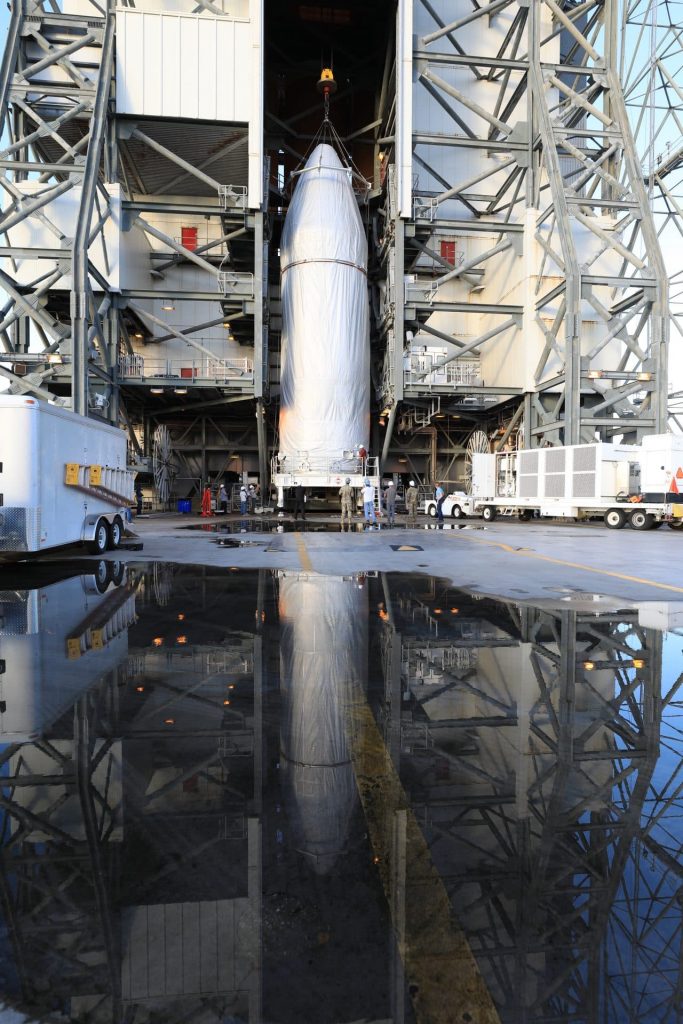
What is the Delta IV Heavy?
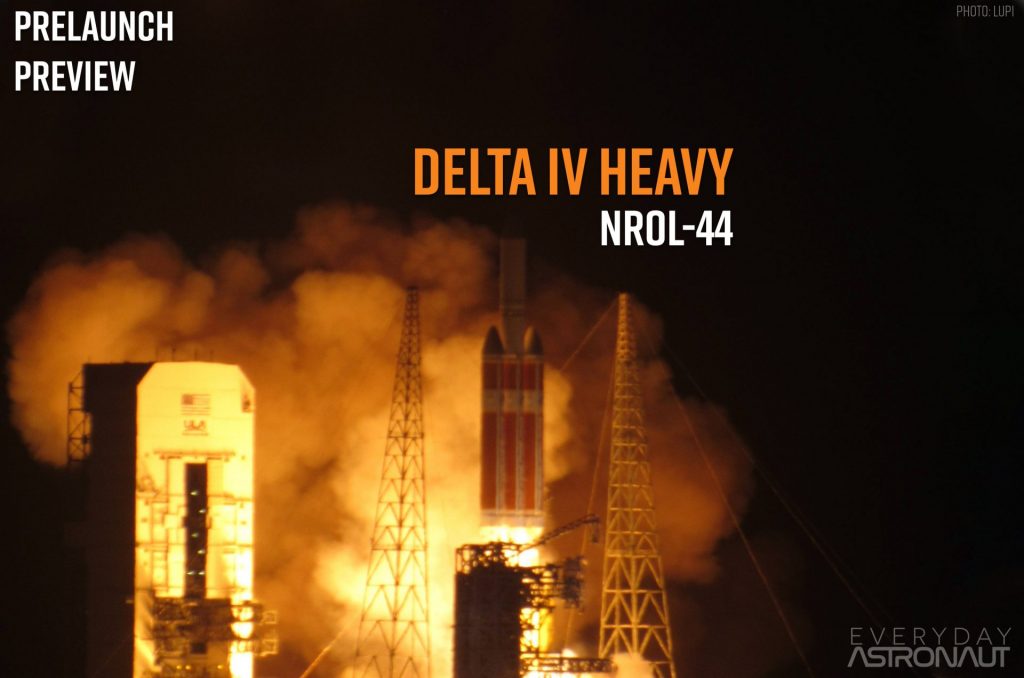
Another mighty and hefty rocket of ULA’s fleet, the Delta IV Heavy has only flown eleven times, making NROL-44 the 12th flight. Because the rocket uses Liquid Hydrogen (LH2) as its fuel, the rocket appears to light itself on fire prior to lifting off and soaring into the sky. Don’t worry all is fine, this procedure is purely to burn off the excess H2. However, it is very unique and something that will be missed as the Delta IV Heavy retires.
The Delta IV First Stage (At take off)
The gigantic three core first stage consists of the core booster stage plus the side boosters. Each of these is known as a Common Booster Core (CBC). Each of the 3 CBCs on the launch configuration is 40.8 m (134 ft) long, features one RS-68A engine each running on Liquid Hydrogen (LH2) and Liquid Oxygen (or LOX). The combined thrust of all three CBCs running together is 9,420 KN (2,120,000 lb).