
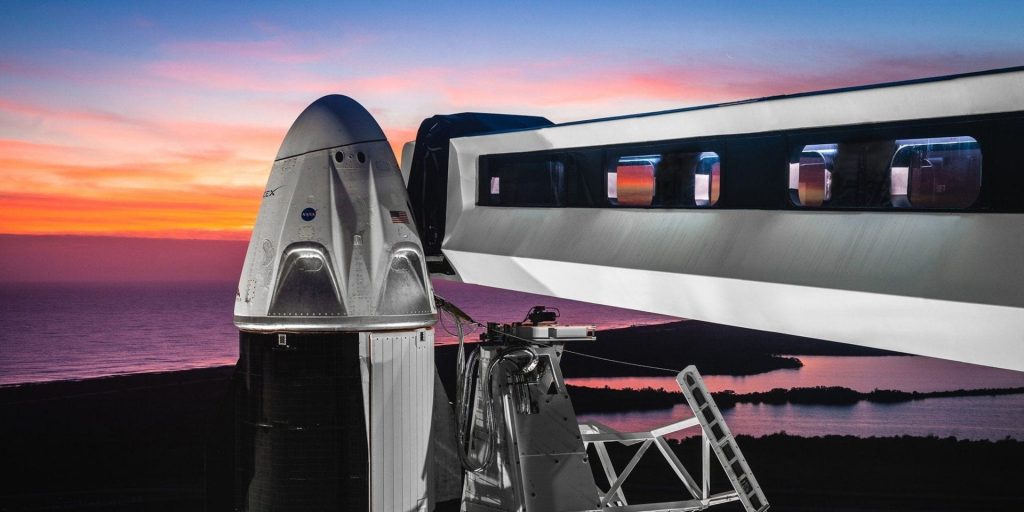
Launch Window Opens(Subject to change) | January 19, 2020 – 15:30 UTC | 10:30 EST |
|---|---|
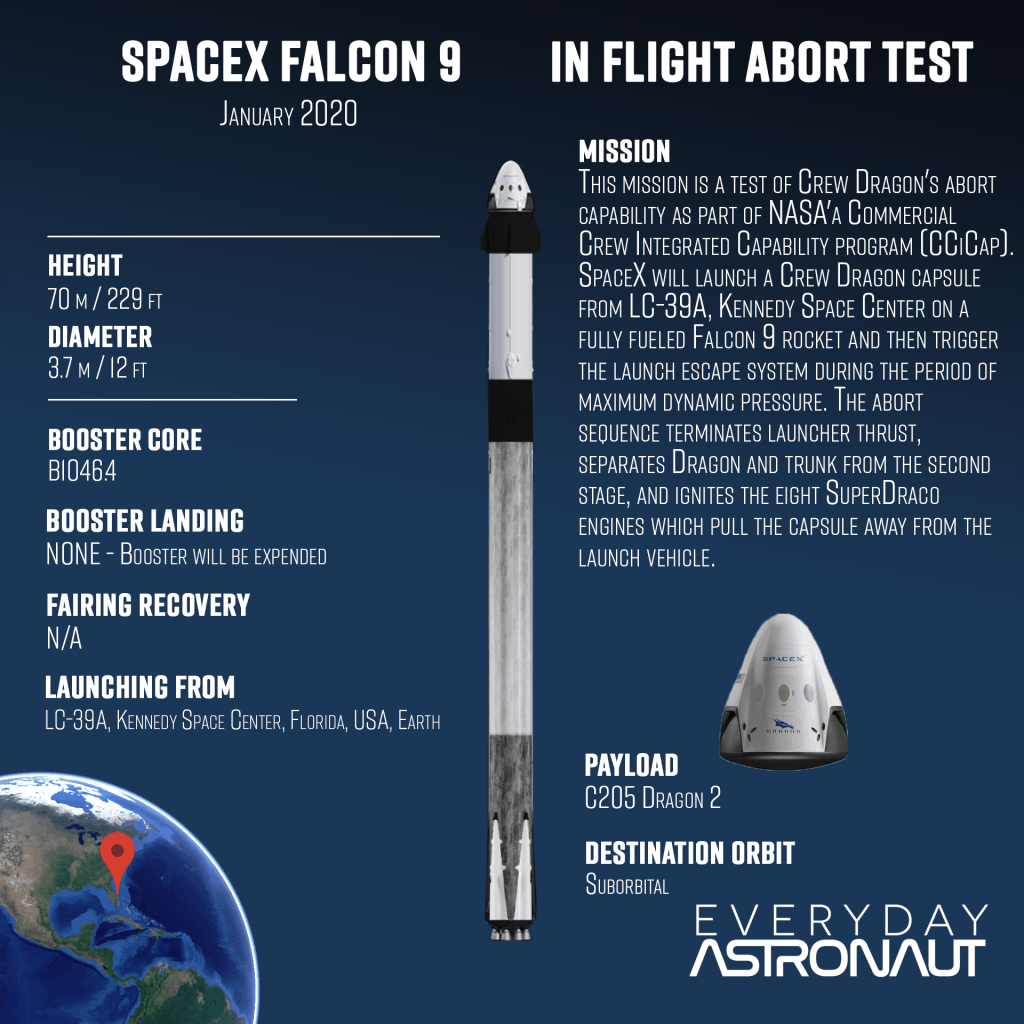
Mission Name | In-Flight Abort Test, an uncrewed demonstration of Crew Dragon’s launch abort capability. |
Launch Provider | SpaceX |
Customer | NASA (Commercial Crew Program) |
Rocket | Falcon 9 Block 5 (B1046.4 – the first Block 5 booster) |
Launch Location | Launch Complex-39A, Kennedy Space Center, Florida |
Payload mass | 12,055 kg (~25,600 lb) |
Where is the spacecraft going? | Nowhere, the capsule will splashdown 34 km downrange in the Atlantic Ocean. |
Will they be attempting to recover the first stage? | No, but it will land – in many pieces |
Where will the first stage land? | Over a small geographical area |
Will they be attempting to recover the fairings? | No, the Crew Dragon spacecraft is not enclosed in a fairing |
This will be the: | – 4th (and final) flight of B1046 – 79th flight of a Falcon 9 rocket – 2nd mission for SpaceX in 2020 – SpaceX’s final flight in their Commercial Crew Transportation Capability contract |
Where to watch | SpaceX official livestream NASA official livestream Tim Dodd, the Everyday Astronaut, will be streaming at T-30 minutes; come ask questions and join the conversation live! |
What’s all this mean?
Following on from their successful DM-1 mission, SpaceX will conduct an uncrewed In-flight Abort (IFA) Test. This will validate Crew Dragon’s ability to pull crew away to safety in the event of a failure during launch.
Mission Profile
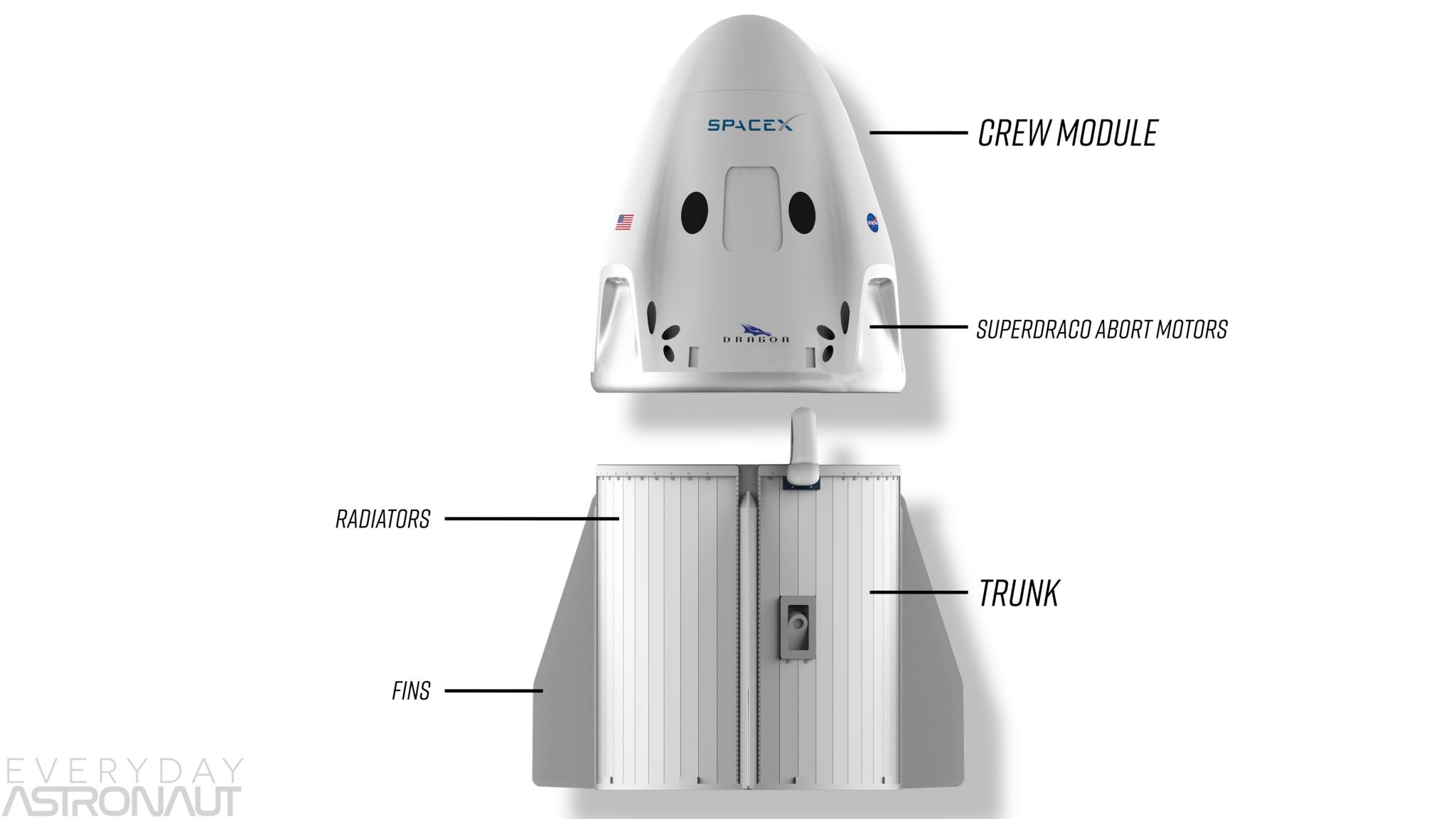
At the point of maximum dynamic pressure (max q), the Falcon 9 rocket will terminate thrust, simulating a failure. This will trigger the launch escape system, causing the spacecraft to fire its integrated SuperDraco abort motors and pull itself safely clear of the rocket. After a 10-second burn, the capsule will coast up to its apogee of 40km, detach from the trunk and later, deploy its parachutes, finally splashing down 34 km downrange, in the Atlantic Ocean.
Within an hour, the spacecraft will be recovered from the water and brought back to Port Canaveral by Go Searcher and other members of SpaceX’s east coast fleet. As a result of extreme aerodynamic forces, the Falcon 9 rocket is expected to disintegrate immediately after the abort, which will be performed at approximately T+00:01:24.
The second stage is not required to function for this flight, subsequently, its vacuum optimised Merlin engine has been replaced with a mass simulator as a money-saving measure.

Test stand anomaly
The mission, originally slated for late 2019, was delayed as a consequence of a ‘test stand anomaly’ in April. The anomaly resulted in the spectacular destruction of the capsule, which had been planned for use in the IFA. The destroyed spacecraft had previously flown on DM-1, an uncrewed orbital demonstration of its capability to ferry astronauts to and from the ISS.
The failure occurred during a static fire test of the capsule’s abort motors, when before SuperDraco ignition: A slug of Dinitrogen Tetroxide oxidiser leaked past a helium check valve and into the pressurisation system. During pressurisation, the same slug was propelled through the check valve as a result of a phenomenon known as fluid hammer. This event, coupled with the oxidiser rich environment, was sufficient to set fire to the titanium component and lead to an explosion. A more detailed explanation can be found in Scott Manley’s video.
Evolution of the capsule
Crew Dragon has undergone many changes since its ostentatious unveiling in 2014. When SpaceX founder and chief engineer, Elon Musk, presented the futuristic spacecraft, it was capable of seating seven astronauts and would land propulsively. However, the complexity of propulsively landing a capsule, and its entailing safety concerns, resulted in certification difficulties, and ultimately, SpaceX pulled the plug on the idea.
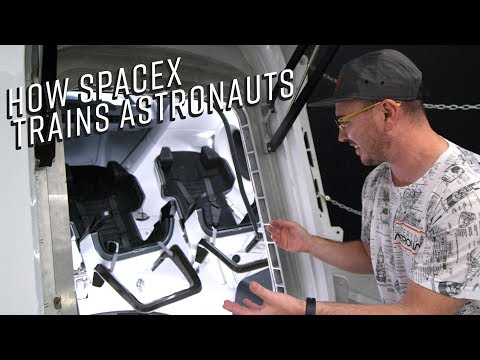
Since then, numerous changes have been made. Most notably, due to concerns regarding the g-forces crew might experience, the angle of the seats was changed. As a result of which, the three bottom seats of the original seven-seat configuration were removed, leaving a row of four.
To prevent the recent test stand failure from reoccurring, SpaceX opted to replace the check valves with burst disks. They were hesitant to do so, as burst disks are single-use and subsequently can’t be tested pre-flight. Such a change goes against their company philosophy of testing every possible component to ensure the best chance of flight success.
Furthermore, this mission will fly SpaceX’s new Mk3 parachutes. The new parachutes were developed because the parachute risers were experiencing more load than predicted by models, an issue that has plagued both Boeing and SpaceX. This was rectified with the latest iteration of SpaceX’s parachutes, which were recently drop-tested to gather more data and ensure efficacy.
What’s The Commercial Crew Program?
This will be SpaceX’s last flight in its Commercial Crew Transportation Capability (CCtCap) contract, making it an FAA licensed test flight. The contract is a NASA-funded program that aims to launch American astronauts — and eventually, astronauts from other countries — on American rockets from American soil. The last time this happened was in July 2011 on the final Space Shuttle mission, STS-135. After this, NASA contracted two private-sector companies – SpaceX and Boeing – to developed next-generation spacecraft to transport astronauts to and from the ISS. You can learn more about the Commercial Crew Program on NASA’s website.
DM-2
If performed norminally, the first certified crewed flight (DM-2) will occur shortly after, in February. This mission will carry NASA astronauts Doug Hurley and Bob Behnken to the ISS. This will put an end to U.S.’s reliance on the Soyuz spacecraft for transporting astronauts to and from the International Space Station, a monopoly enjoyed by Russia since the conclusion of the Space Shuttle program in 2011.
For an in-depth comparison of both SpaceX’s Crew Dragon and Boeing’s CST-100 Starliner CCP spacecraft, check out Everyday Astronaut’s video. Furthermore, if you want to learn more about launch abort systems and why SpaceX and Boeing have ditched abort towers, Everyday Astronaut also has a video covering the topic.