

What’s All This Mean?
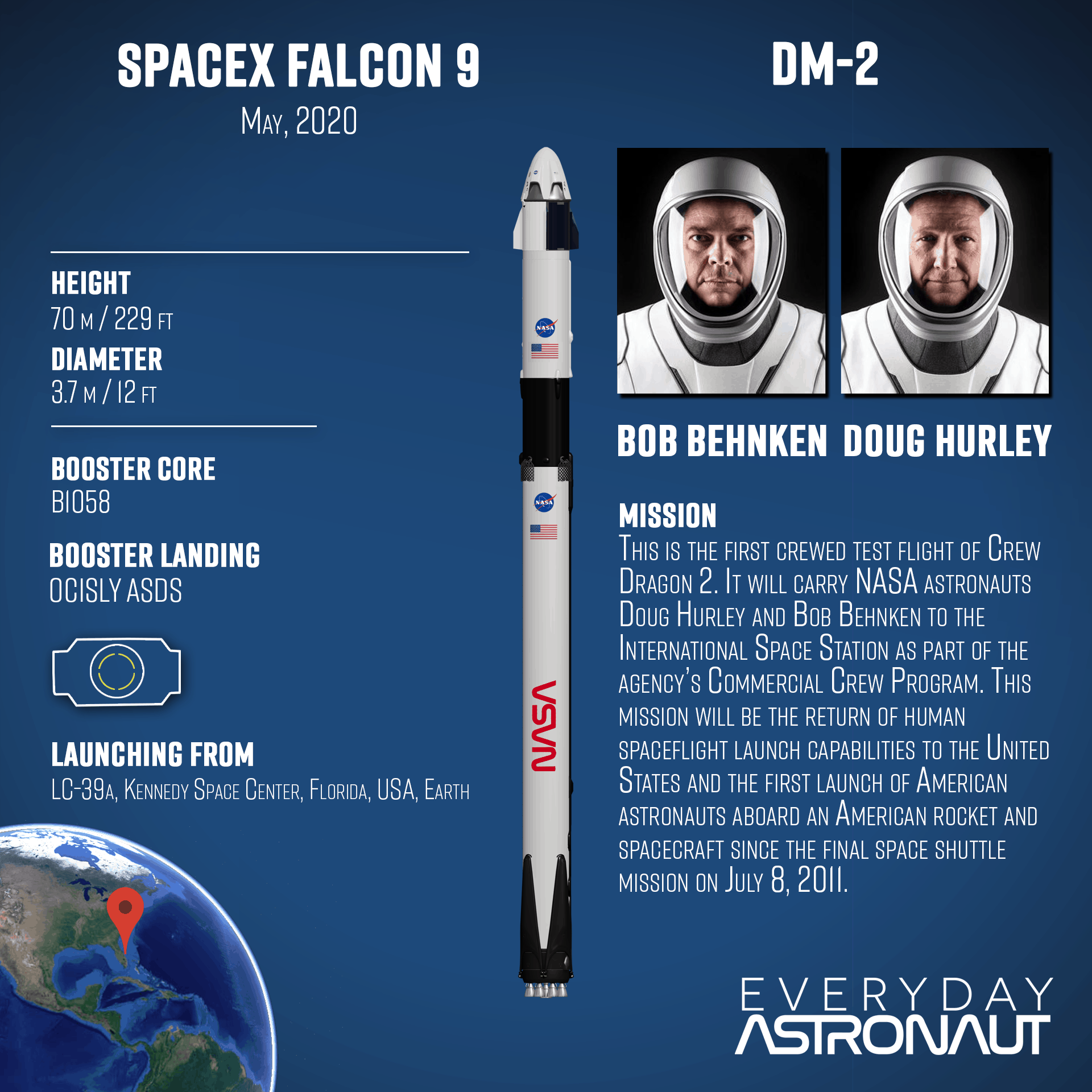
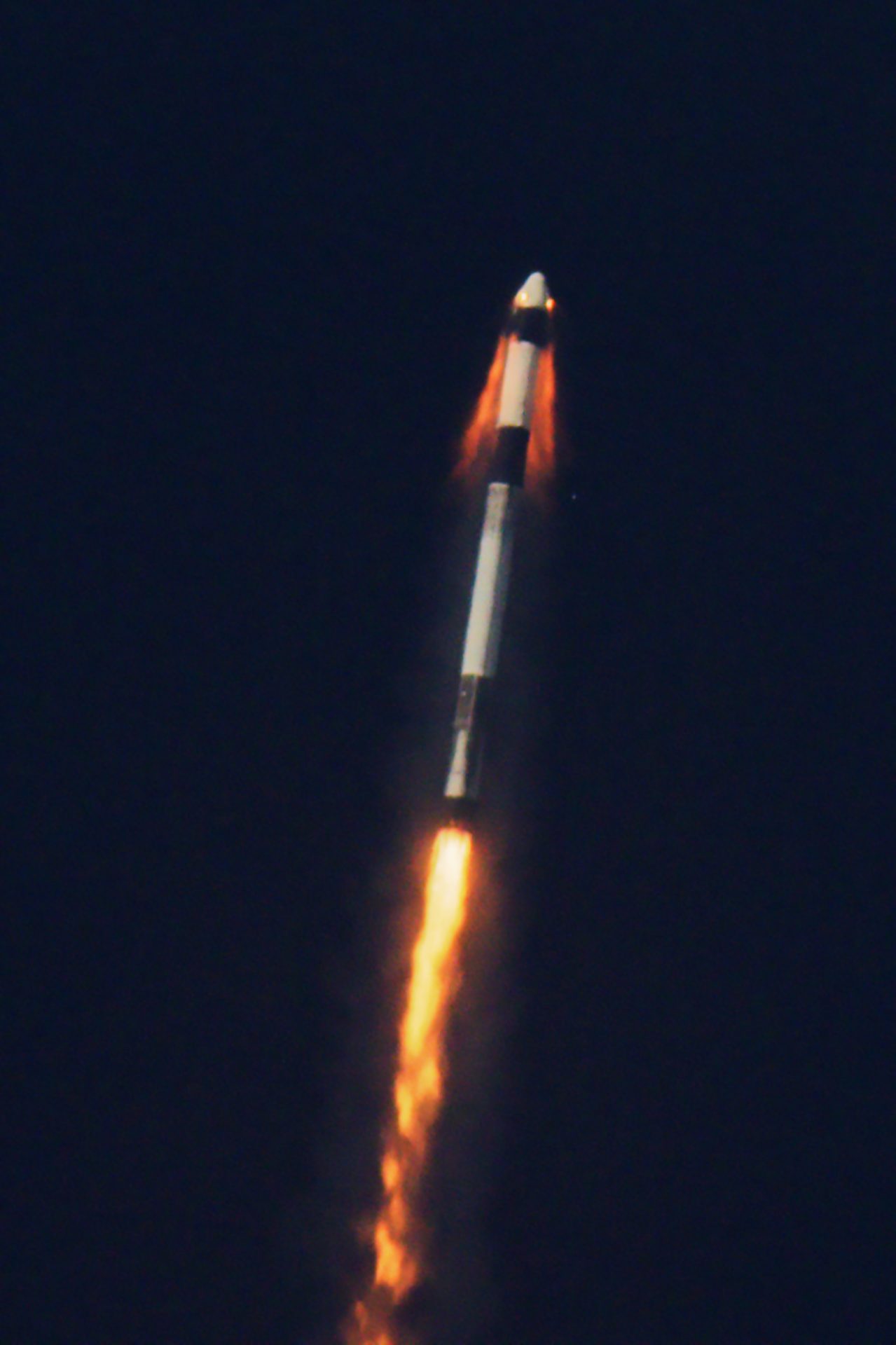
Dragon 2, also known as Crew Dragon, is the first private spacecraft that can carry a crew into low-Earth orbit. Following the successes of Demonstration Mission 1 (DM-1) and the In-Flight Abort test missions, Space Exploration Technologies (SpaceX) is preparing for the DM-2 mission scheduled for May 30, 2020. NASA astronauts Douglas G. Hurley and Robert L. Behnken will launch to the International Space Station (ISS) on top of a brand new Falcon 9 rocket (B1058.1) in their Crew Dragon (C206) spacecraft.
Liftoff Time
|
May 30, 2020 – 19:22:45 UTC | 15:22:45 EDT |
|---|---|
Mission Name and what it is? |
SpaceX Demonstration Mission 2 (DM-2), First Crewed Mission |
Launch Provider
|
SpaceX |
Customer
|
NASA |
Rocket |
Falcon 9 (Block 5) Serial Number B1058.1 |
Launch Location |
Launch Complex-39A (LC-39A) at Kennedy Space Center, Florida |
Payload mass |
12,055 kg (26,577 pounds) |
Where’s the spacecraft going? |
Docking with the International Space Station (ISS) in low-Earth orbit |
Will they be attempting to recover the first stage? |
Yes |
Where will the first stage land? |
510 km downrange on the Autonomous Spaceport Drone Ship, Of Course I Still Love You (OCISLY) |
Will they be attempting to recover the fairing? |
No, there is no fairing |
This will be the: |
|
Where to watch |
SpaceX official Stream
Tim Dodd, the Everyday Astronaut, will stream LIVE The Everyday Astronaut and NASA teams strongly urge and request everyone to stay home and obey all local, state, and federal guidelines. Please enjoy the mission with us from home! |
Who are the Astronauts?
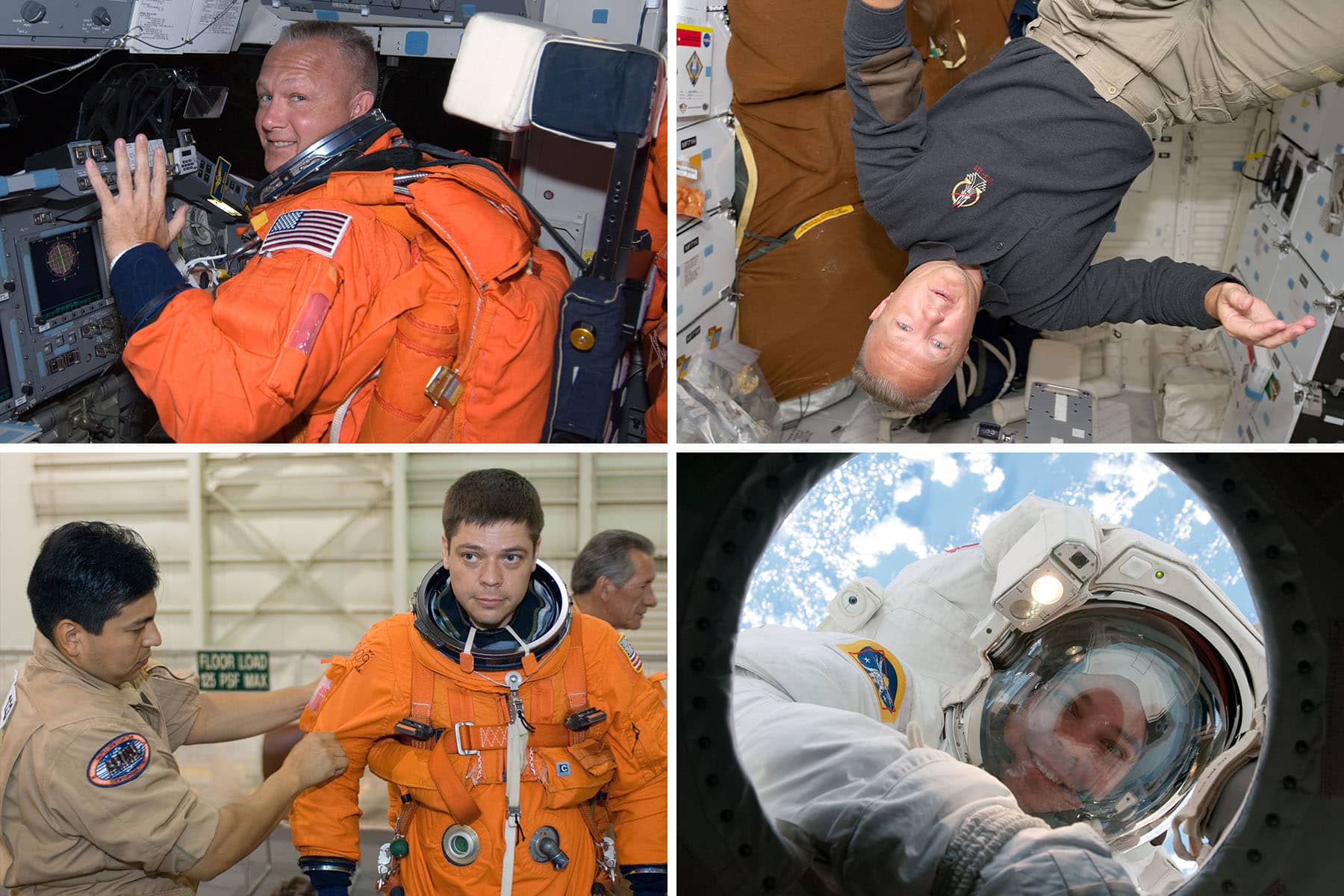
Douglas G. Hurley
Doug Hurley is an American test pilot and NASA astronaut. He will be the commander on the Demo-2 mission, meaning he is responsible for the mission’s overall success. As Dragon 2 is fully autonomous, this role doesn’t come with as many responsibilities as in the Shuttle era. Astronauts will only take manual control in case of an emergency, otherwise their spacecraft will dock to the station automatically.
Demo-2 will be Hurley’s third mission, and his first since the retirement of the Space Shuttle. He was the pilot on STS-127, and last flew as the pilot on STS-135, the last ever Shuttle mission. He was on the last American crewed launch, back in 2011, and now will be on the first mission returning Americans to space with indigenous spacecraft. Hurley has been in space for 28 days, 11 hours, and 12 minutes and has never completed an Extravehicular Activity (EVA) also called a spacewalk.
Robert (Bob) L. Behnken
Bob Behnken is a test engineer and NASA astronaut. He will be the pilot on this mission, meaning that he will assist Commander Hurley with navigation in the unlikely event of an emergency. Previously, he was NASA’s Chief Astronaut from 2012 until 2015 and returned to the active rotation. He married fellow astronaut K. Megan McArthur, who now serves as the deputy Chief Astronaut.
Behnken first flew in space onboard the Space Shuttle Endeavor on STS-123 as a mission specialist. His second spaceflight was on STS-130, also as a mission specialist. So far, he’s spent 29 days, 12 hours, and 17 minutes in space. He performed six EVAs while the Shuttle was at the ISS. He completed three spacewalks on STS-123 and another three on STS-130, for about 37.5 hours outside Station.
What is Falcon 9 Block 5?
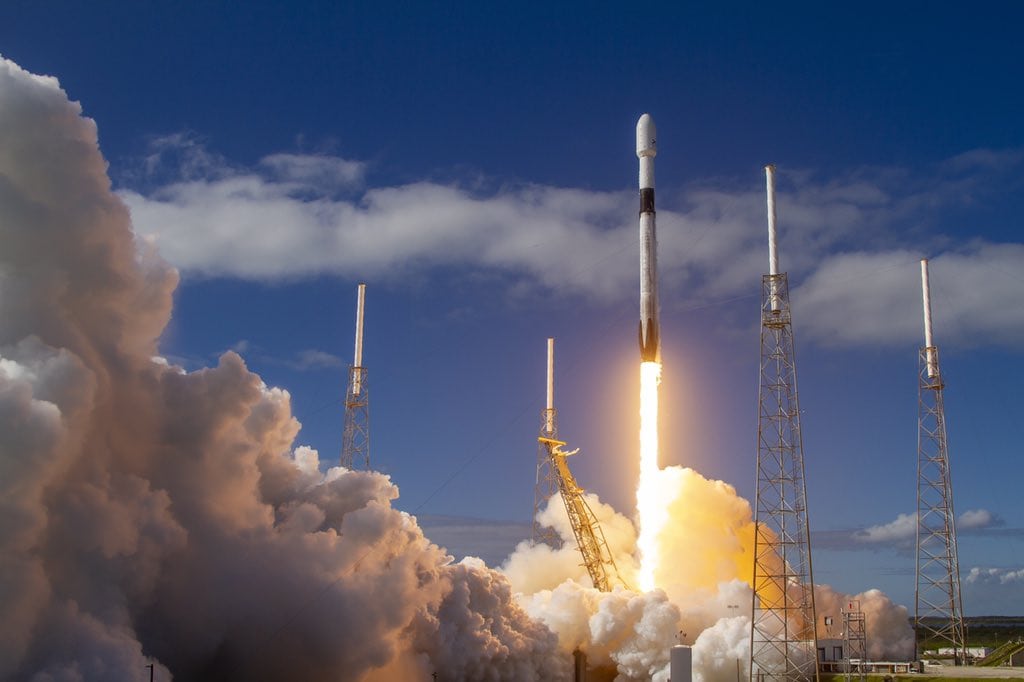
SpaceX’s Falcon 9 rocket first flew in 2010. Since that time, Falcon 9 has flown for a total of 85 times. 82 of those launches being fully successful, one partially successful (CRS-1), one ground anomaly (AMOS-6), and one in-flight failure (CRS-7). DM-2 will be the launch vehicle’s 85th flight. Over the years, it has gone through several upgrades and iterations, not including the Falcon Heavy. The current version is the Falcon 9 Block 5, introduced in 2018 and is now the main version in operation today.
The Block 5 is the final iteration of the Falcon 9 and rated to carry humans into space. Block 5’s goal was to apply all the lessons that SpaceX learned into a human-rated, reusable rocket, capable of sending Crew Dragon into orbit.
Human-rating
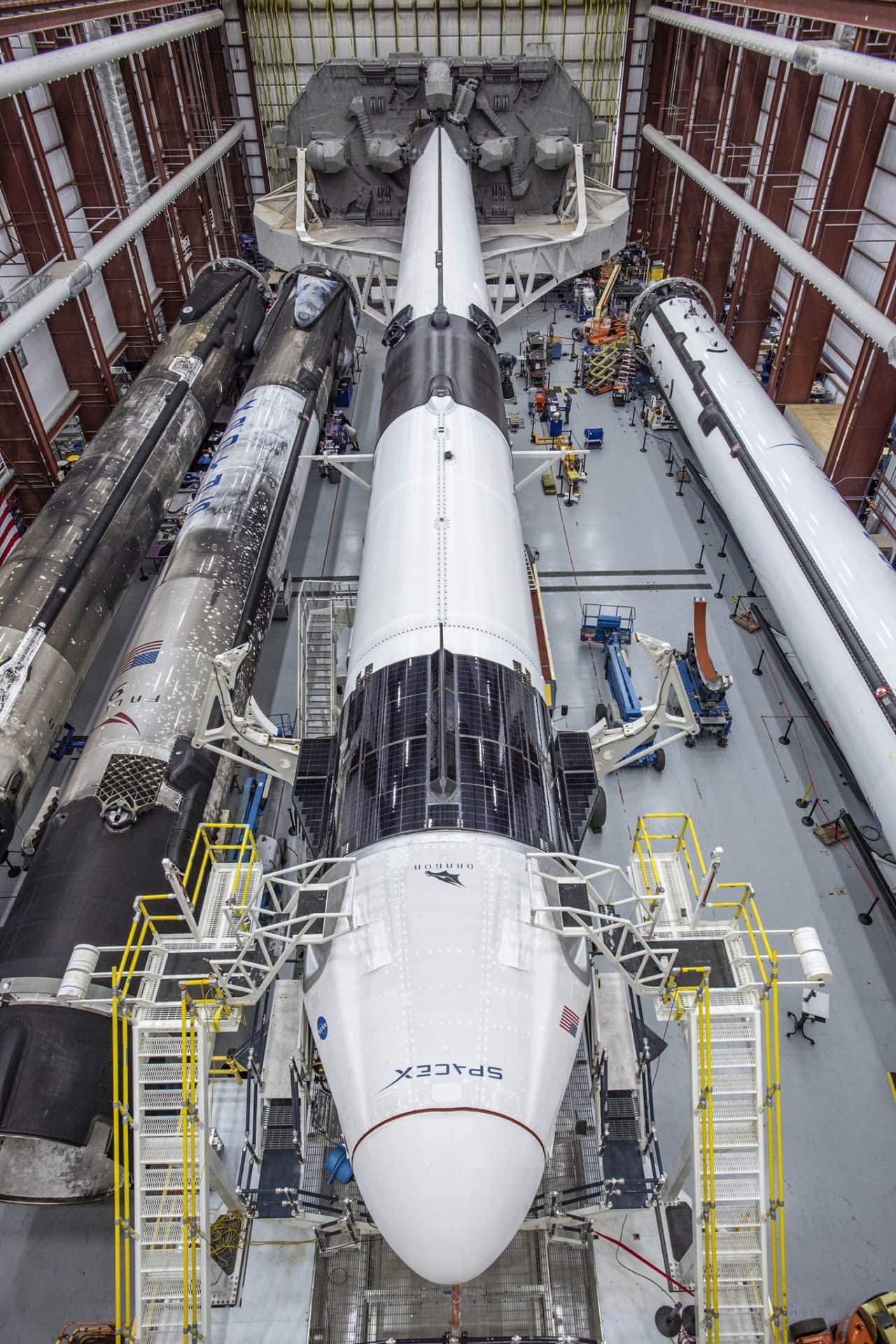
The first change NASA required to human-rate the Falcon 9 was to put it into a design freeze. Before Block 5, no two Falcon 9s were the same, according to a SpaceX representative. Because of these continual improvements, NASA required SpaceX to fly seven missions in a row with no changes to the launch vehicle.
The second major change required the addition of a redesigned carbon over-wrapped pressure vessel (COPV). It was COPVs in the upper stage that caused the two previous Falcon 9 failures (AMOS-6 and CRS-7).
Reusability Tweaks
There were also many modifications in the Block 5 booster stage related to better reusability that were not critical for human-rating. SpaceX reinforced the landing legs, upgraded the grid fins, added a carbon fiber interstage, added a heat resistant external paint, and upgraded the engines. For more information about the changes in Block 5, and the other Blocks of the Falcon 9, check out this video by the Everyday Astronaut:


Dragon 2’s Falcon 9 on DM-2
The booster supporting this mission is B1058.1. It was static fire tested at SpaceX’s McGregor, Texas facility on August 19, 2019 and then shipped to the Kennedy Space Center (KSC). Over the next few months, they will integrate the Falcon 9 and Dragon 2 at KSC Launch Complex-39A (LC-39A).
American Spaceflight
Since the last Space Shuttle, Atlantis, launched on July 8, 2011, the United States hasn’t had a crew-rated spacecraft. In 2010, before that last Shuttle flight, NASA created the Commercial Crew Program (CCP) to replace it. The goal of this program is to create a safe, reliable, and cost-effective way to transport crew from US soil to low-Earth orbit (LEO).
Dragon 2 became one of two winners in this effort to replace the Space Shuttle. NASA selected two commercial partners, SpaceX and Boeing, to provide two redundant rides to the ISS. They wanted to ensure uninterrupted access to space, which is why both companies had to develop spacecraft that fly on different rockets.
Jim Bridenstine on CCP
Because of CCP, NASA administrator Jim Bridenstine stated on February 14, 2019, that NASA wanted “to be one customer of many customers in a robust commercial marketplace.” He then further explained that NASA will use the precedent set in CCP to return to the Moon. The fixed price model used in CCP is also being used for the Artemis human lander system (HLS). He envisions that customers will not only include other nations but also private space tourism.
The Worm is Back
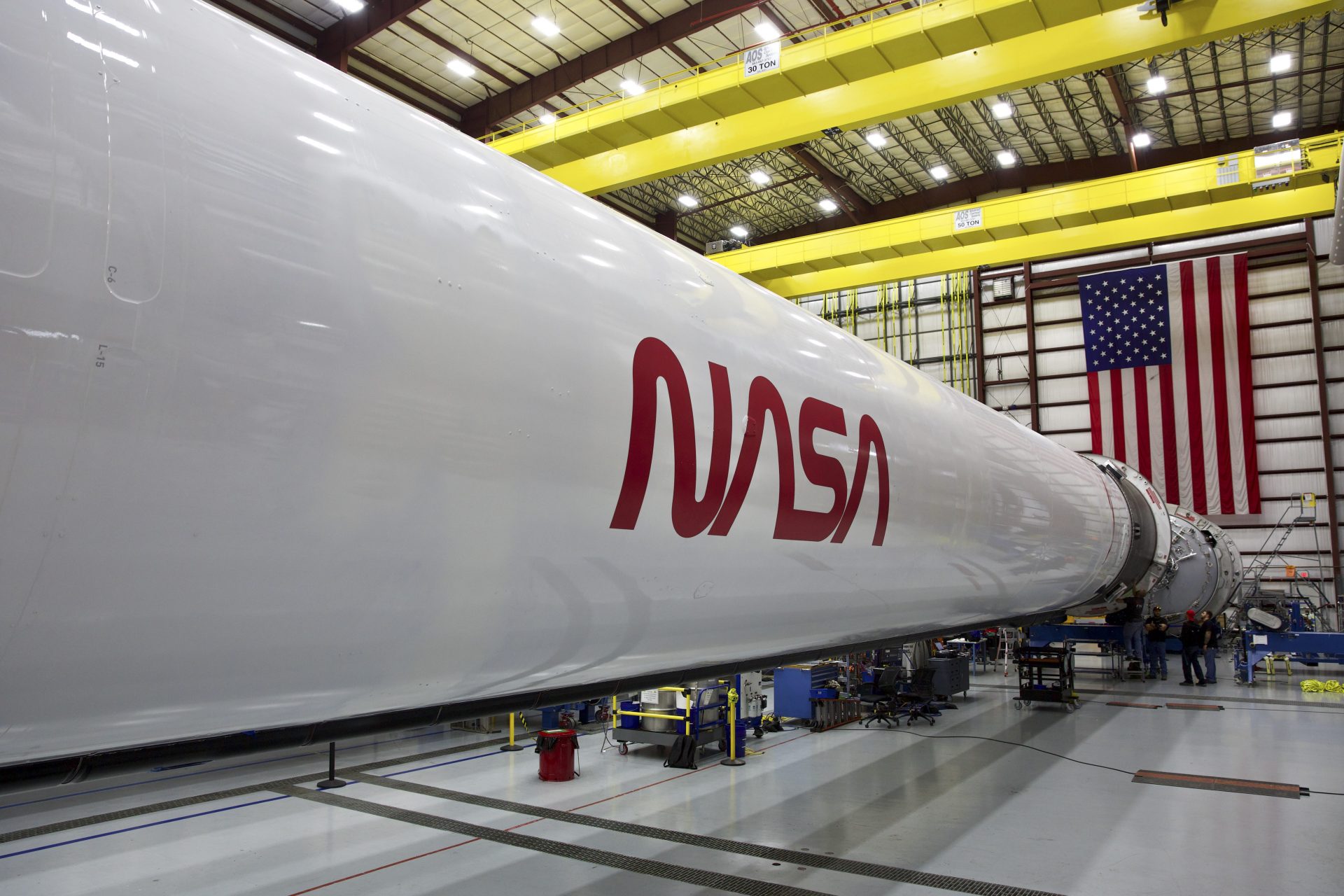
As a memento to returning American astronauts on American rockets from American soil to space, NASA and SpaceX decided to bring back the worm logo on the rocket. They painted the worm logo on the first stage, and will probably appear on the second stage and or the Crew Dragon. NASA stated that “the agency is still assessing how and where it will be used, exactly.”
In the 1970s, after the blue “meatball” logo was too hard to print, NASA created a modern and simple logo to replace the meatball, creating “the worm.” The logo’s name is unofficial, and is called that because of how it looks. This logo flew on most NASA missions starting in 1975 and all through the Shuttle era until the turn of the century.
Mission Profile for Falcon 9 & Dragon 2
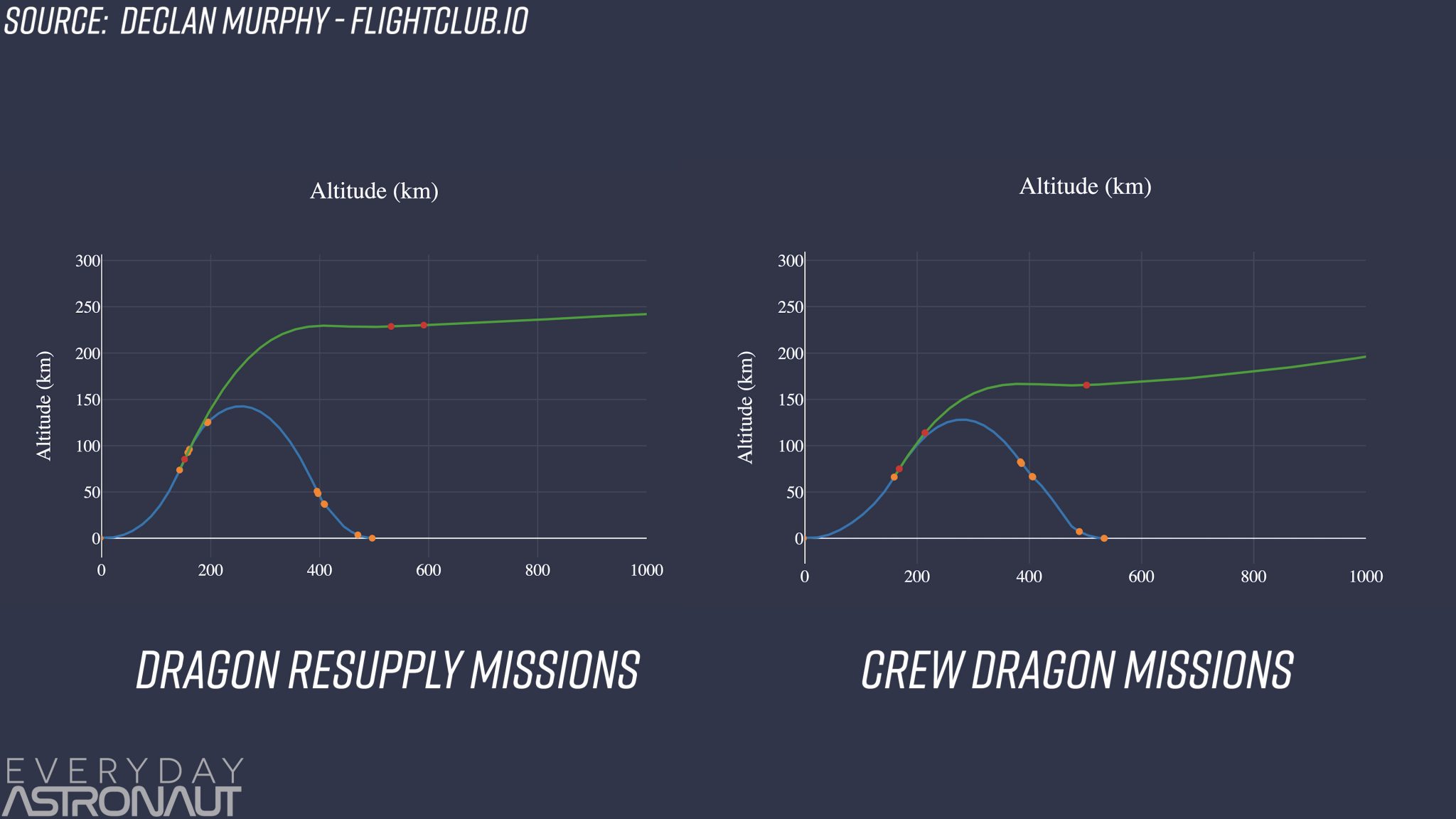
You may wonder why SpaceX is landing the booster downrange despite Crew Dragon being such a light payload? The answer is simple: to ensure the crew can safely abort during any part of the mission.
To ensure a safe abort, SpaceX must fly Dragon 2 on a shallower and flatter flight profile than on a cargo mission. This means that the Falcon does not have the fuel margin to return to Cape Canaveral Landing Zone 1 (LZ-1). Below is a comparison of the flight profile of an ISS Commercial Resupply (CRS) return to launch site (RTLS) mission and a CCP Autonomous Spaceport Drone Ship (ASDS) mission.
Falcon 9 First Stage
The first stage will burn for about two minutes and 35 seconds before shutting down and separating from the second stage, which is carrying Crew Dragon. The booster will then perform a boost back burn, a reentry burn, and finally a landing burn before landing on SpaceX’s ASDS Of Course I Still Love You (OCISLY). SpaceX expects the first stage to land about nine minutes and 52 seconds after liftoff. During ascent–assuming there isn’t an abort–the Dragon 2 will pull up to 3-Gs (29.4m/s/s).
Falcon 9 Second Stage
The Merlin 1-D vacuum engine on the second stage of the Falcon 9 will burn for approximately six minutes and 17 seconds, propelling the Dragon 2 to LEO. Dragon 2 will separate from the second stage about 11 minutes after liftoff. The nosecone will open about 60 seconds later. After performing a series of maneuvers, Dragon 2 will dock with the ISS approximately 19 hours after launch. NASA TV will provide live coverage of this.
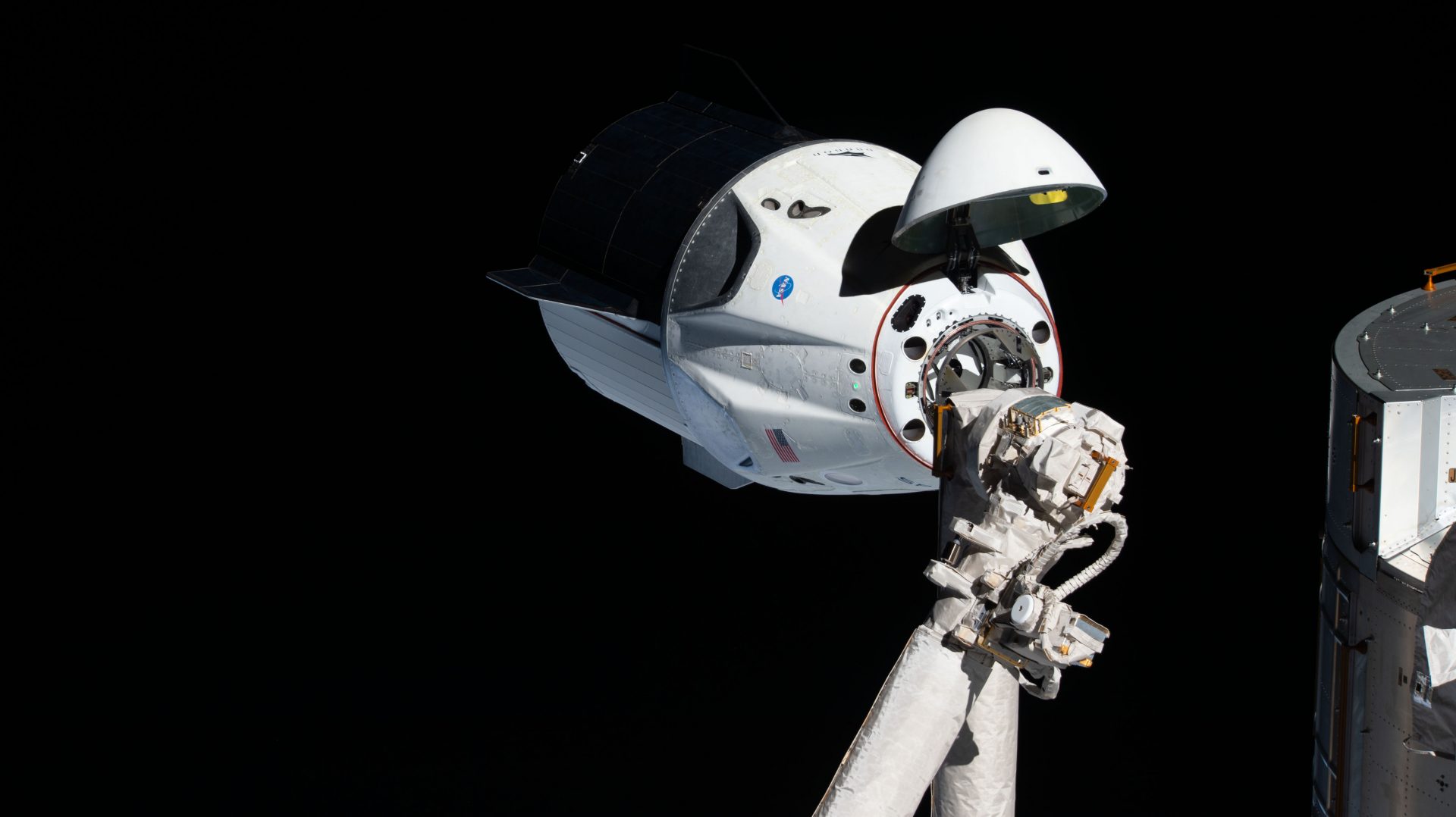
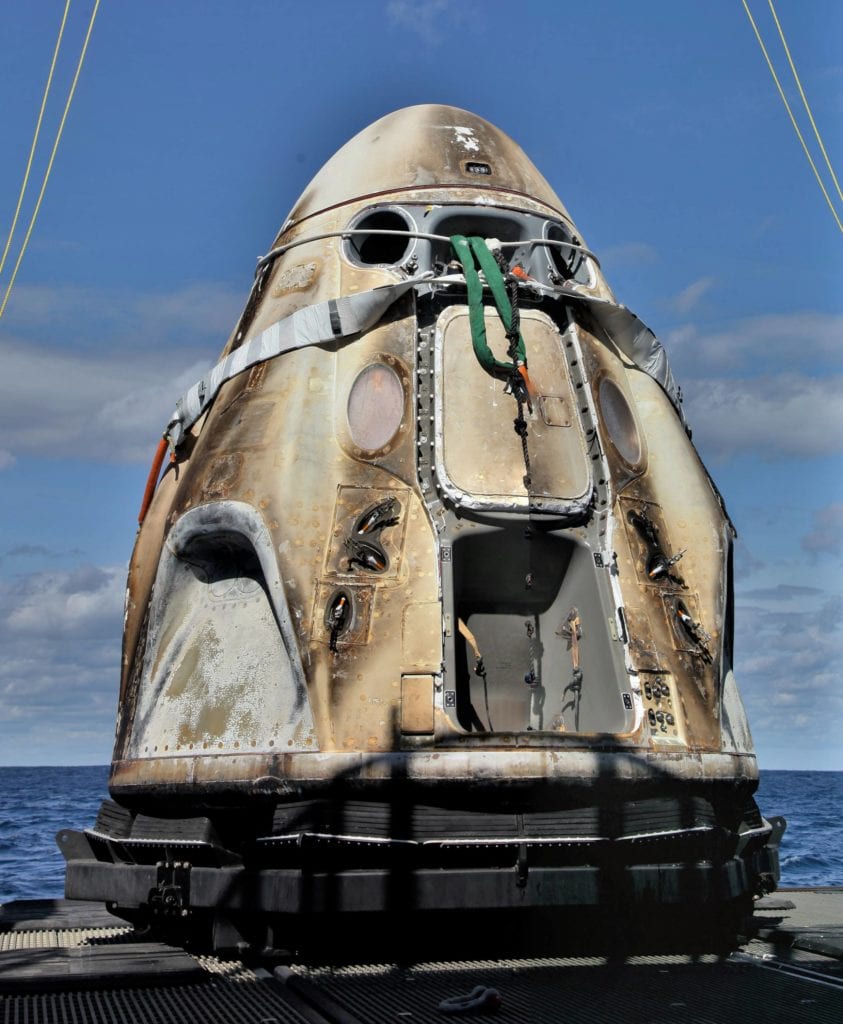
The Dragon 2 spacecraft was originally planned to remain at the station for 8 days, but the duration has now been extended to around three months (with an upper limit of 110 days), before undocking from the station. Dragon will then distance itself from the station, ditch its trunk, then perform its deorbit burn approximately five hours later. After reentry, Dragon will splashdown in the Atlantic ocean. NASA TV will provide coverage of these events. Go Searcher, Go Navigator, and other vessels of SpaceX’s east coast fleet will recover Dragon after splashdown.
What’s new on Dragon 2 Since the Last Launch?
Since Dragon 2’s first launch on SpaceX’s DM-1 mission, there have been several changes to it. We’ll go over those changes below, and explain how they made the spacecraft safer. The delays these changes caused were worth it, as it is a better spacecraft than the one that launched to station in March 2019.
SuperDraco Burst Disks
On April 20, 2019 SpaceX suffered an anomaly to a Dragon 2 on the test stand that destroyed the DM-1 (C201) spacecraft. They were performing extreme vibration and over pressurization testing on the spacecraft. The tests were for the DM-1 spacecraft’s next mission, the inflight abort test.
After going over the data, SpaceX concluded that the failure occurred in Dragon 2’s SuperDraco abort motors. Before ignition, a slug of nitrogen tetroxide leaked past a helium check valve into the pressurization system. During pressurization, a phenomenon known as fluid hammer propelled the same slug through the check valve. This event, coupled with the oxidizer rich environment, set fire to the titanium components and lead to an explosion. The failure caused SpaceX to have to switch the one-way valve to a burst disk and add a protective door on the abort motors.
Mark 3 Parachutes
Another big change to Dragon 2 is the parachutes. The Mark 2 parachutes worked flawlessly on SpaceX’s uncrewed DM-1 in March 2019. However, on October 11, 2019, during an update on Dragon 2, Jim Bridenstine and Elon Musk announced that SpaceX was redoing the parachute system.
After going over DM-1’s post-flight data, SpaceX found that the risers were experiencing more force than the models predicted. Interestingly, this wasn’t their fault. Since the Apollo era, NASA had been using the same models for modeling forces on parachute risers. Only after SpaceX equipped the Dragon 2 with additional sensors for the parachute mechanism that the models’ force predictions proved inadequate.
This forced them and Boeing to have to reinforce the risers. This means their volume and weight had increased, causing the parachutes to need more surface area. As a result, the parachutes would no longer fit in the preexisting housing. To compensate for this, SpaceX switched to zylon, allowing them to overcome these changes. The Mark 3 parachutes incorporate these changes.

4-Seat Crew Dragon
The final change to Crew Dragon was the removal of the second row seating after NASA was not happy with the splashdown data during DM-1. NASA thought the forces applied on the astronauts was too high, causing SpaceX to remove the bottom row seats. This new seat configuration reduces the crew from seven astronauts to four.
To learn more about SpaceX’s Dragon 2 and Boeing’s CST-100 Starliner, check out the video above by the Everyday Astronaut.
Mission Timeline Video

Weather Launch Criteria
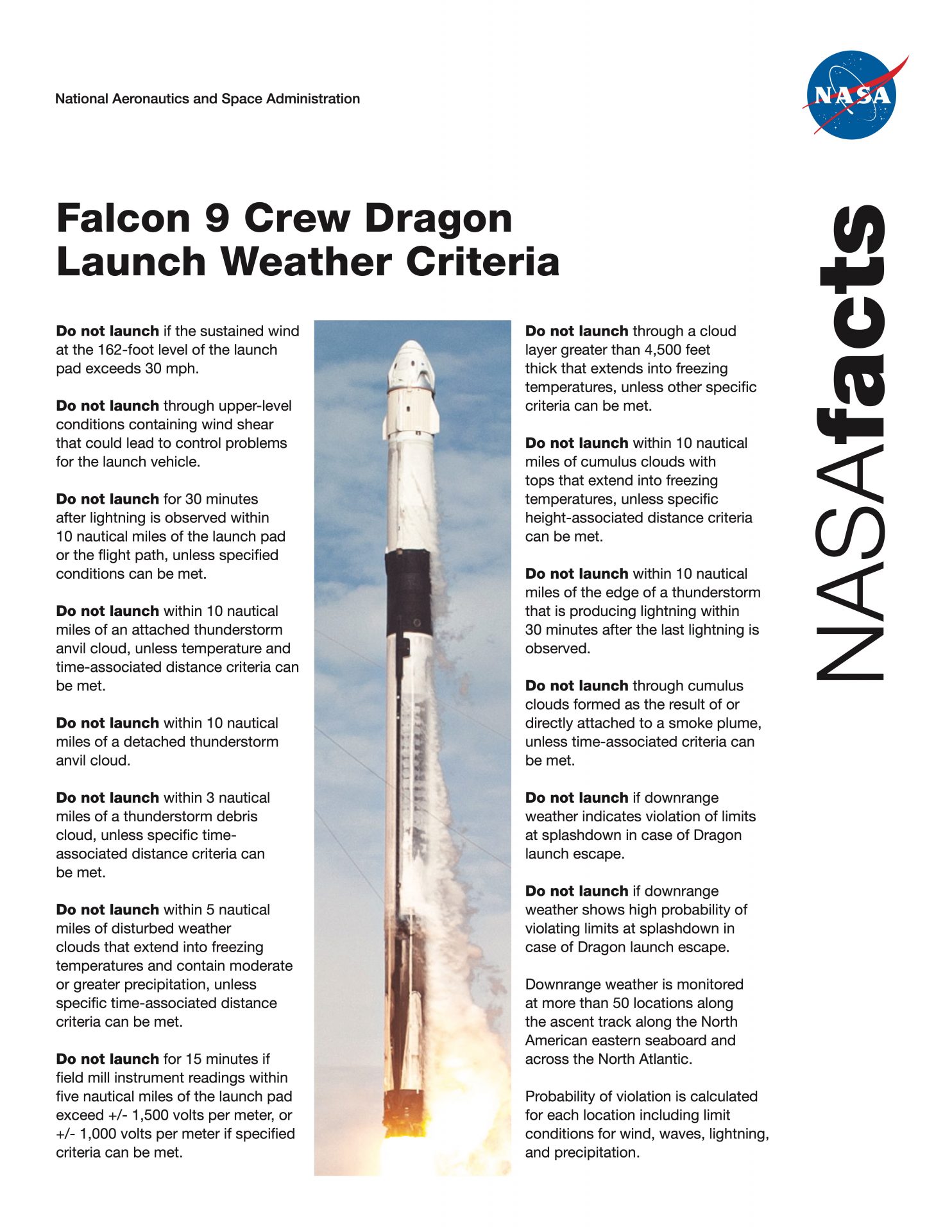
There are several weather criteria that need to be nominal for the Falcon 9 to launch with a Crew Dragon. First, there is the local weather around Cape Canaveral, and outwards to 370 km northeast. On top of that, there are 50 downrange abort locations along the eastern coast of North America and off the coast of Ireland.
Weather in the abort zones could cause a scrub on launch day. Downrange weather is monitored by the 45th Space Wing Weather Squadron in consultation with the Department of Defense Human Space Flight Support (HSFS) Office Rescue Division. Abort zone weather scrubs happened occasionally during the Space Shuttle as well. For details of all the weather criteria, click on the image to the right. For the latest launch weather, see the daily forecast issued by the 45th Weather Squadron.
DM-2 Livestream with Everyday Astronaut
Join Tim Dodd, the Everyday Astronaut, will stream this launch. Come out to ask questions and join the conversation live! If you want the best way to know when a launch is happening, monitor the Prelaunch Previews page. Finally, the SpaceX Fleet website tracks the recovery ships!