
Launch Window
|
NET September 12, 03:00 – 05:30 UTC |
|---|---|
Mission Name |
This mission is only known as “Orbital Launch Attempt” |
Launch Provider
|
Astra |
Customer
|
There is no customer for this launch since it is a test launch |
Rocket |
Rocket 3.1 |
Launch Location |
Launch Pad 3B, Pacific Spaceport Complex in Kodiak, Alaska |
Payload mass |
Up to 25 kg (55 lb) |
Where are the satellites going? |
To a Low Earth Orbit (LEO) of 340 km, |
Will they be attempting to recover the first stage? |
No, this is not a capability Astra has |
Where will the first stage land? |
The first stage will crash into the Pacific Ocean |
Will they be attempting to recover the fairings? |
No, this is not a capability Astra has |
Are these fairings new? |
Yes |
How’s the weather looking?
|
Weather is currently favorable for the launch window on August 7 |
This will be the: |
|
Where to watch |
Unfortunately Astra won’t have a live webcast for this launch, but they will post live updates on their Twitter. |
What does all this mean?
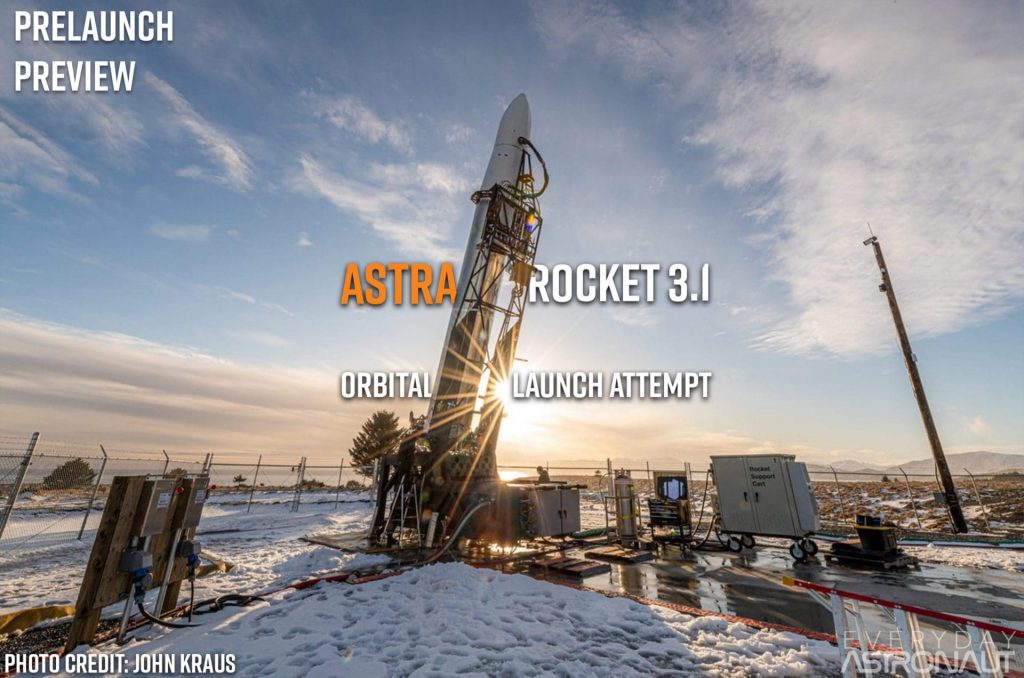
Astra will launch its orbital-class rocket “Rocket 3.1” on September 12 between 01:00 UTC and 03:30 UTC from Launch Pad B, Pacific Spaceport Complex in Kodiak, Alaska.
The Mission
The “Orbital Launch Attempt”, as Astra is naming this mission, will mark their first orbital test flight after a scrub on March 2 with only 53 seconds remaining on the launch countdown. Astra established a launch window for Rocket 3.1 starting on September 11 between 01:00 UTC and 03:30 UTC. This launch window will remain open at the same time every day for a couple of days. Rocket 3.1 will lift off from Launch Pad B, Pacific Spaceport Complex in Kodiak, Alaska.
Since this is a test launch, there will be no additional payload other then the sensors and instruments required for data gathering. This launch will be considered successful after a nominal first stage burn and will help Astra to further develop their launch vehicle. Everything after main engine cut off (MECO) could be described as an additional goody to their cause.
The launch on August 3 will mark Astra’s first launch in their three-launch campaign in order to achieve orbit within three flights.
Mission Timeline
| T-1h15min | Start of final pre-launch procedure |
| T-45min | Propellant load begins |
| T-20min | Propellant load complete |
| T-15min | Entering terminal count |
| T-/+0s | Liftoff |
| T+5s | Roll program initiated |
| T+25s | Vehicle clears range |
| T+1min | Maximum aerodynamic pressure (Max Q) |
| T+2min 3s | Begin to throttle down the engines |
| T+2min 18s | Main engine cut off (MECO) |
| T+2min 20s | Fairing separation |
| T+2min 27s | Stage separation |
| T+2min 32s | Second stage engine ignition |
| T+8min 48s | Second engine cut off (SECO) |
| T+8min 51s | Payload deployment signal |

The Rocket 3.1 Launch Vehicle
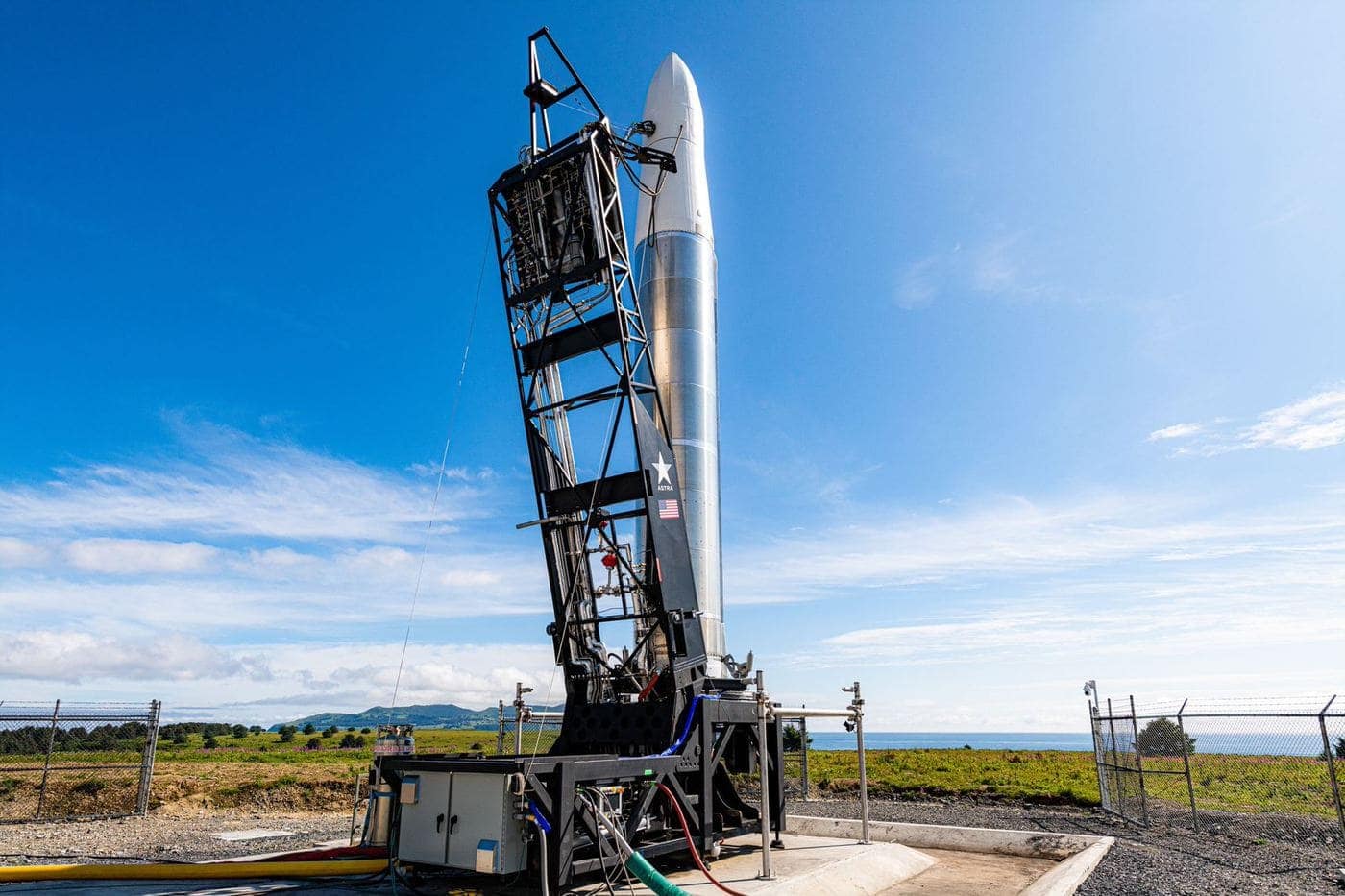
Rocket 3.1 is Astra’s third version of their small-sat launch vehicle and the first version of their orbital rocket. With a height of 11.6 m (38 ft), a diameter of 1.32 m (4.3 ft) and a payload capacity of 25 kg to a 500 km SSO, it is in the same class of small-sat launch vehicles as Rocket Lab’s Electron.


This two-stage rocket is powered by RP-1 and LOX. The first stage will make use of five electric-pump-fed Delphin engines that will produce a total thrust of 140 kN (31,500 lbf) at liftoff. The second stage is powered by a single pressure fed Aether engine that will produce 3.1 kN (700 lbf) of thrust in a vacuum. Since Astra is a rather secretive company, they have not released any technical information about their engines, such as ISP, TWR, or combustion chamber pressure. The aluminum body and tanks of Rocket 3.1 have a similarity to SpaceX’s Starship prototypes, with its welded stacked rings of stainless steel.
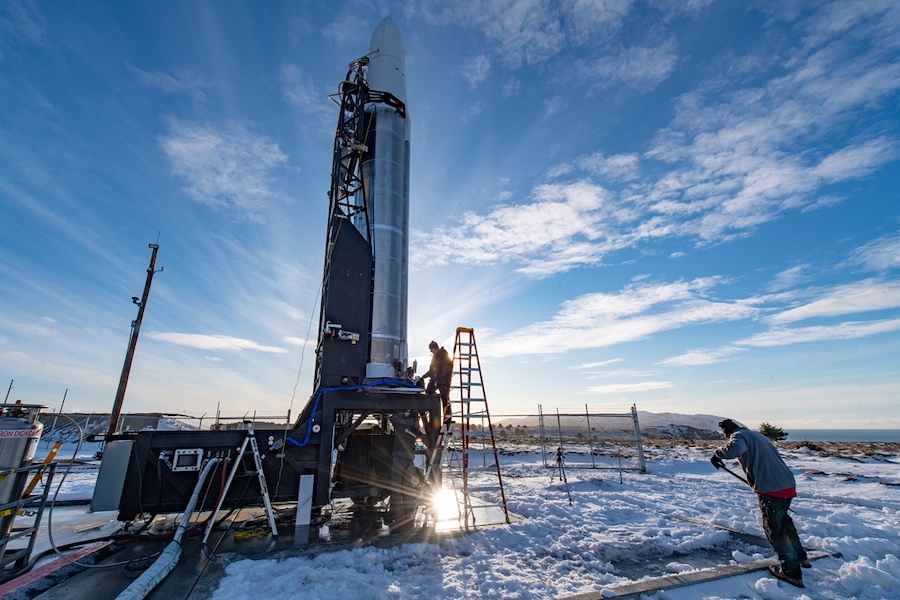
Another unique characteristic is that Astra’s Rocket 3.1 fits into a standard shipping container and can be towed by a truck. To set up the rocket on its mobile launch structure, it only takes a handful of ground support staff and about a week to go through vehicle checks, a wet dress rehearsal and the launch readiness review. Astra’s goal for the future is to bring the time required to set up the rocket down to under 24 hours. Therefore, it can meet the needs of some special customers who require a rapid launch schedule for their payloads.
Bringing Down Cost
Due to their focus on cost-efficient techniques for building rockets and by using proven and inexpensive materials, Astra will try to drive down the cost of accessing space. In the future, they will be offering dedicated launch services at a significantly lower price, compared to any other orbital vehicle in operation today.
ASTRA
Astra, previously known as Ventions LLC, is a launch vehicle provider founded in 2005 and based in Alameda, California. Rocket 3.1, their most current launch vehicle, gets its name from being their third main iteration of their launch vehicle.
Rocket 3.1 will be their first orbital rocket with its first orbital test flight on August 3, 2020. As Ventions LLC, their initial focus was to pioneer a new and innovative fabrication technique to create fine-featured injectors and cooling channels in rocket engines. They developed small impellers with blade heights as small as 0.51 mm (0.02 inches). In September 2016, Ventions LLC became Astra. Astra’s next milestones were their two suborbital test launches of Rocket 1.0 and Rocket 2.0. They launched on July 20, 2018 and November 29, 2018 respectively.
Employees
Despite Astra being a rather new launch provider, it already employs some major space industry veterans and former SpaceX employees. Such engineers as Chris Thompson, Matt Lehman, Roger Carlson and Bryson Gentile, who were founding members, are part of the propulsion team. They worked on the Dragon capsule and on the Falcon 9, respectively.
Astra’s future goal is to become the FedEx of space deliveries in the small-sat sector by providing an easy to build transportable launch system that is cheap and simple.
DARPA Competition
Early in 2018, the Defense Advanced Research Projects Agency, also known as DARPA, started a launch contest where contestants could win a grand prize of $10 million USD. Participants had to meet the following criteria:
- two separate launches
- different launch sites
- short notification to first launch
- only days to two weeks between launches
- different payloads
- different orbits
Initially, 18 teams got pre-qualified by DARPA. However, only three became finalists: Virgin Orbit’s VOX Space subsidiary, Vector Space and Astra. While Vector Space ran into financial problems, Virgin Orbit dropped out because they focused on getting their air-launch system ready for commercial operations. Therefore, only Astra remained as the final participant.
After continuous delays because of bad weather, Astra had to scrub their “One of Three ” launch attempt on March 2 at T-53 seconds. A faulty sensor on Rocket 3.0’s first stage caused the scrub. The March 2, 2020 launch date was the last day in the launch window of the DARPA’s Launch Challenge. The scrub meant that Astra lost out on $12 million USD in prize money. In a tweet they published after the scrub, they explained that safety and complete investigation of the problem is more important to them than winning the DARPA launch challenge. By doing so, they want to increase the probability of overall success of their three-launch campaign.
In a post-scrub interview, Chris Kemp stated that Astra needs to get a new FAA licence to launch, since it will no longer be the DARPA launch challenge payload. “We expect the new license approval to take one to two weeks, but no longer than a month.”
Loss of Rocket 3.0
After a wet dress rehearsal as part of a pre-launch test in March, Astra’s Rocket 3.0 suffered from a catastrophic anomaly. This incident lead to the loss of Rocket 3.0. The anomaly was caused by a valve which was stuck open during de-tanking of the rocket. Fortunately, nobody was harmed during this incident, and only Astra’s hardware was damaged. Astra went back to the drawing board and tried to recreate the problem with the valve which has previously been tested thousands of times. After months of finding the root to the problem, Astra implemented three levels of redundancy in order to prevent another anomaly.